[MOVIE]
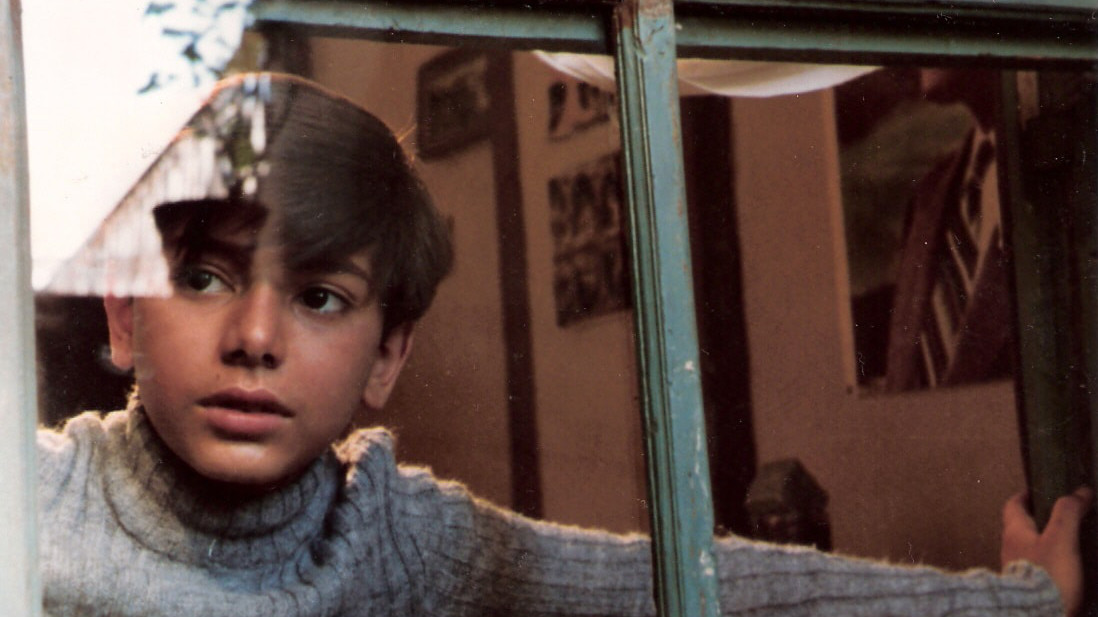
Scen.: Mohammad Malas, Samir Zikra. F.: Urdijan Engin. M.: Haitham Kouatly. Int.: Yasmine Khlat (madre), Bassel el Abdiadh (Deeb), Rafik Sbeit, Hisham Khcheifati, Talhat Hamdi, Adnan Barakat, Naji Jabr, Adib Chhadeh, Ayman Zeidan, Nazir Sarhan, Raja Kotrach, Hasan Dakkak. Prod.: National Film Organization. 35mm. D.: 120’. Col.
In Ahlam al-Medina, memory begins with the sound of wings fluttering as the image slowly pans from left to right across a stone building, establishing in its course that the sound belongs to the white doves flying around inside a second story window of the building. The pan continues rightward to encompass the Barada River, the main river in Damascus, with a small bridge crossing, setting the location in an oddly quiet and unpopulated street of the city. Shot by Turkish cinematographer Orhan Orguz, who had just won a prize at the Cannes Film Festival for his work on Yilmaz Güney’s 1982 film Yol, this scene captures a sense of disquiet. The strangeness of birds inside a building, and the singling out of the sound of their flapping wings directs us to read the scene allegorically as a metaphor for cultural imprisonment. This location is important as one of the key scenes early in the film that relates the historic plunging of a military tank into the river during a government parade, to the mean grandfather who harshly punishes Deeb, for attending the parade and Deeb’s little brother, Omar, for shouting back at the angry patriarch…
“When my father died, I was seven or eight years old. We had to leave the city and move to Damascus. What I particularly recall from that time is that, after my father’s death, my mother called my name. So I turned and looked at her. It saddened me to see the pale shades of grief on her face. I believe that I was the captive prisoner of that moment and that somber face of this young, beautiful woman for a very long time. As we headed on the bus toward Damascus, I said “Oh God, look how beautiful Damascus is, mom!” as if this were an attempt to lift her mood. I was aware of the magnitude of our abrupt departure from the ancestral home toward a new city that was to be our new home, and wanted to see her happy and smiling, to remove the grief from her face. I believe this is the fundamental motivation behind my film. I wanted to show her the city where the dream was first broken. I made this film in 1984, many years after my return.”
Samirah Alkassim, Nezar Andary, The Cinema of Muhammad Malas, Vision of a Syrian Auteur, Palgrave Macmillan, London 2018
Restoration credits
Muhammad Malas and the support of the Italian Institute of Culture in Tunis. Special thanks to Mohammed Challouf