

Film notes
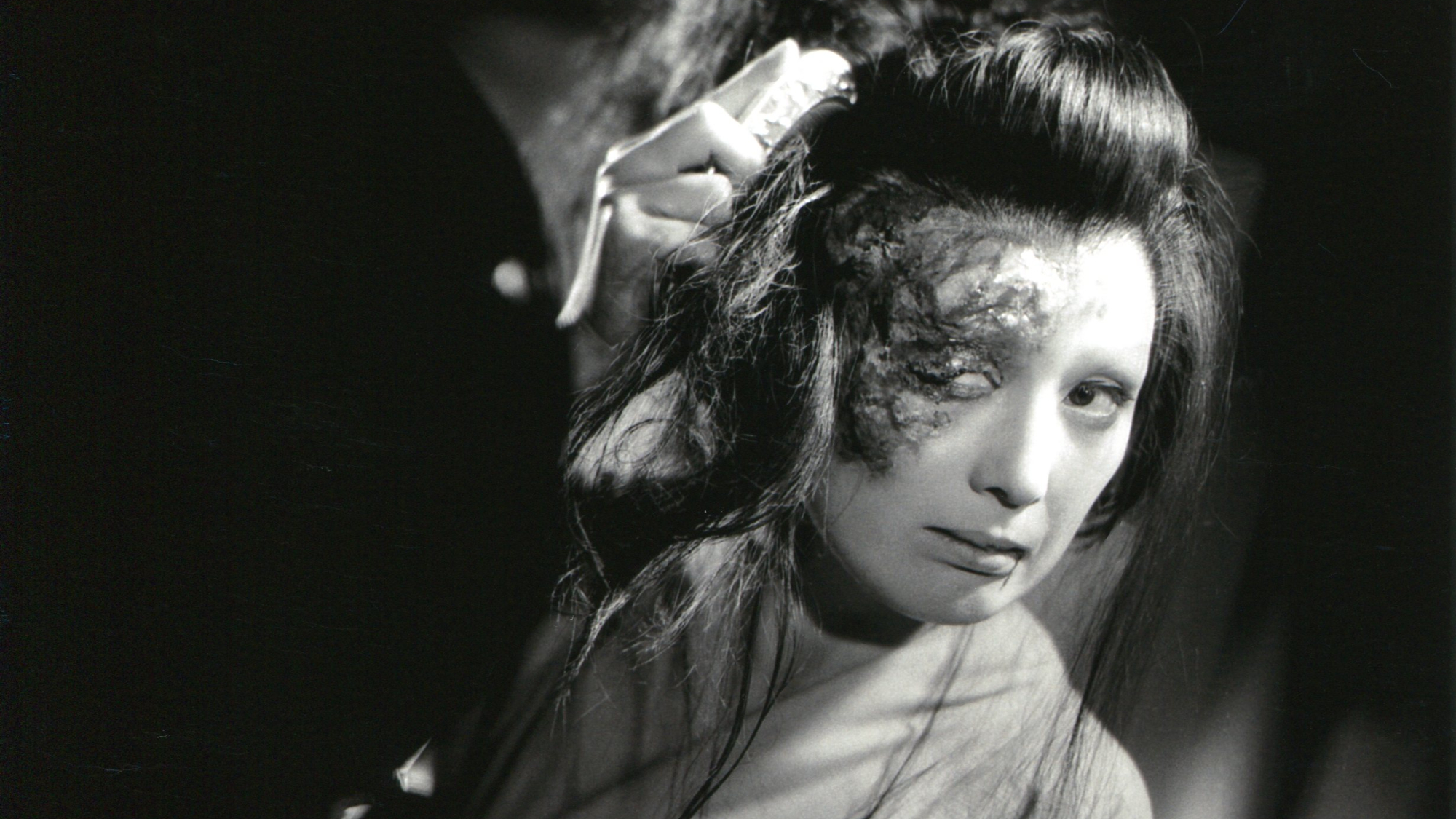
Ghost stories (kaidan) have a long history in Japan and the genre had already achieved considerable popularity in the 1930s, but their great success came in the 1950s and 60s … Various stories were revisited in a series of remakes, and among these the most famous is undoubtedly Ghost Story of Yotsuya (Yotsuya kaidan), based on the 1825 kabuki play of the same name by Nanboku Tsuruya IV. A ronin (masterless samurai) named Iemon, after having killed a man and married his daughter, Oiwa, soon tires of his wife and drives her to adultery in order to kill her and her lover, leaving him free to marry another woman. However, his first wife and her lover return as ghosts and the samurai goes insane, killing everybody before taking his own life. Multiple versions were produced before the war, while the first made after the conflict was by Kinoshita Keisuke in 1949. However, the version directed in by horror maestro Nobuo Nakagawa entitled Tokaido Yotsuya Kaidan is generally considered the best: it is one of the most faithful to the source material and also delivers the horrific impact of its theatrical forebear in the most refined fashion, recreating the visions unleashed by the protagonist’s panic through interesting scenic and make-up effects.
Maria Roberta Novielli, Storia del cinema giapponese, Marsilio, Venice 2001
Tokaido Yotsuya Kaidan is the archetypal popular fantasy film … As the film progresses, the unveiling of atrocities come ever faster and more violent, accentuated by highly stylised decor and lighting. Oiwa, disfigured by a poison, commits suicide, and is thrown into the water. But her body, risen to the surface, turns up in the assassin’s bedroom, brushes past, falls onto him, etc. This film follows a codification that the Japanese spectator knows well. Its effectiveness, and that of other works of this genre, is measured by the moment when the fantasy element (in this case, the cadaver) bursts onto the scene, and by the violence of this entrance. The audience is expecting it but is bound to be surprised that it happens at that particular moment and in such a brutal way. The deftness of the film resides in the disconnectedness it can trigger in relation to the viewer.
Hubert Niogret, “Positif ”, n. 165, January 1975