
Film notes
WIDE-GAUGE FILMS FROM THE MUTOSCOPE & BIOGRAPH COMPANY 1897-1902
The Biograph group of companies was a remarkable venture in the formative years of moving pictures. Its unique selling point was the quality of its sharp and steady images provided by the large 68mm format, motorised camera and high frame rate. Biograph set up a company in London and from there, other European cities so guaranteeing the supply of films to its premiere venues in each of the countries. W.K.L. Dickson, one of the Company’s founders, travelled back to England in 1897 after his long career in the US to establish these links but despite being an engineer focused very much on the supply of content, rather than hardware, for the big screen and for its individual viewer, the Mutoscope. The chosen venue for the American Biograph, as it was always known, was London’s Palace Theatre of Varieties where it had an exclusive residency till 1902 for its premiere product. Dickson’s films were characterised by an international outlook with an interest in celebrity, royalty and entertainers, travel, sporting fixtures and industrial and military demonstrations. A European tour took Dickson to Italy in 1898 to film Pope Leo XIII and in 1899 to South Africa to report directly from the Boer war.
A collection of 68mm Biograph films was acquired by the BFI – National Archive in 1969 from the widow of Dr Rolf S. Schultze, formerly curator of the Kodak Museum in Harrow. Another cache of Biographs were discovered in the offices of a newspaper in the Hague in 1948 and is now held at the EYE Filmmuseum.
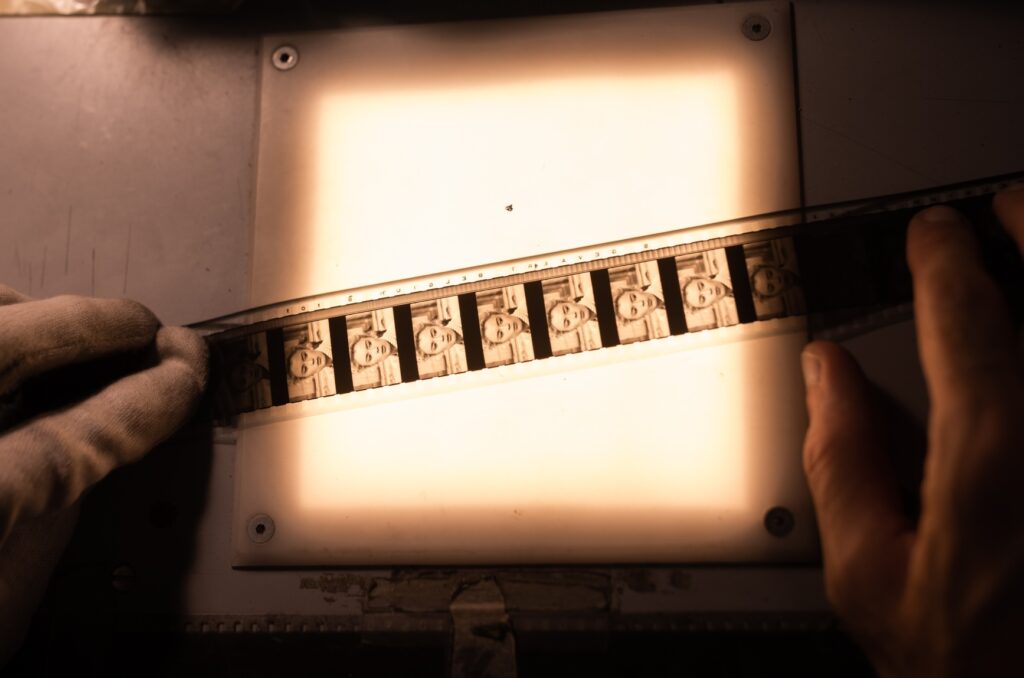
A first restoration project in the 1990s led by the Dutch archive at Haghefilm lab transferred the 68mm films onto 35mm. In 2018, BFI – National Archive, again in collaboration with Eye Filmmuseum and Haghefilm, undertook the digital restoration of the BFI’s Biograph films and a selection of British made titles held at EYE. The size of the nitrate copies and their lack of transportation perforations, made rostrum shooting the best method of image capture of each individual frame by a digital camera at 8K.
Bryony Dixon