
Film notes
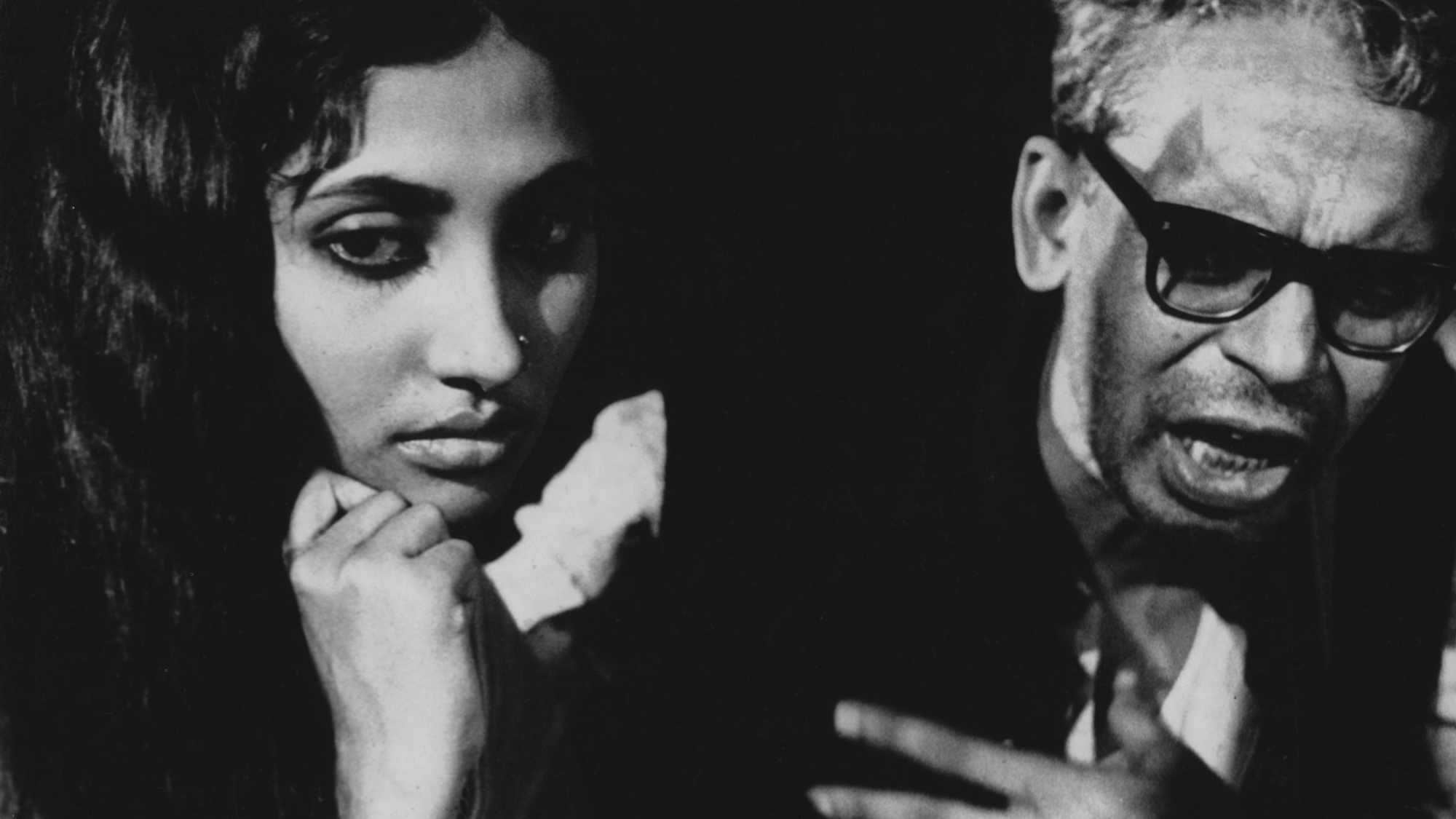
Set during 1971, the film starts with a shot of an old man in a desolate shack and three masked dancers in a desert-like space. With no narrative causality, he recurs thrice. He embodies a Jungian Sage – transcendental wisdom rendered immobile and powerless – signifying the spirit of India observing moral decay and collective catastrophe. This opening sets an ominous tone, structuring the film’s epic melodrama format while immediately establishing its symbolic, experimental, and confrontational character.
In this final film, Ritwik Ghatak himself performs as Nilkantha Bagchi, an alcoholic intellectual and artist, asserting his commitment: “to raise money for alcohol, I will lie or even steal, but for name or fame… I’ll not let a word of untruth escape my mouth.” As Geeta Kapur notes, this “mock-autobiography” transforms Ghatak’s self into a historical signifier shaped by both author and character. Nilkantha’s final line, “One has to do something,” echoes a Marxist author, Manik Bandyopadhyay. Through self-representation and intertextual citations, Ghatak inscribes the voices of the colonised, the absent subject, into history, Kapur argues. Ghatak’s candid self-criticality, Kumar Shahani clarifies, is not narcissism but critique that holds himself equally responsible for the crisis in the homeland, imagined as the “mother”. As an artist, he felt an urgency to act in a political context in which silence is no option, despite his failing health, extreme hardships and near homelessness.
Sanghita Sen