Film notes
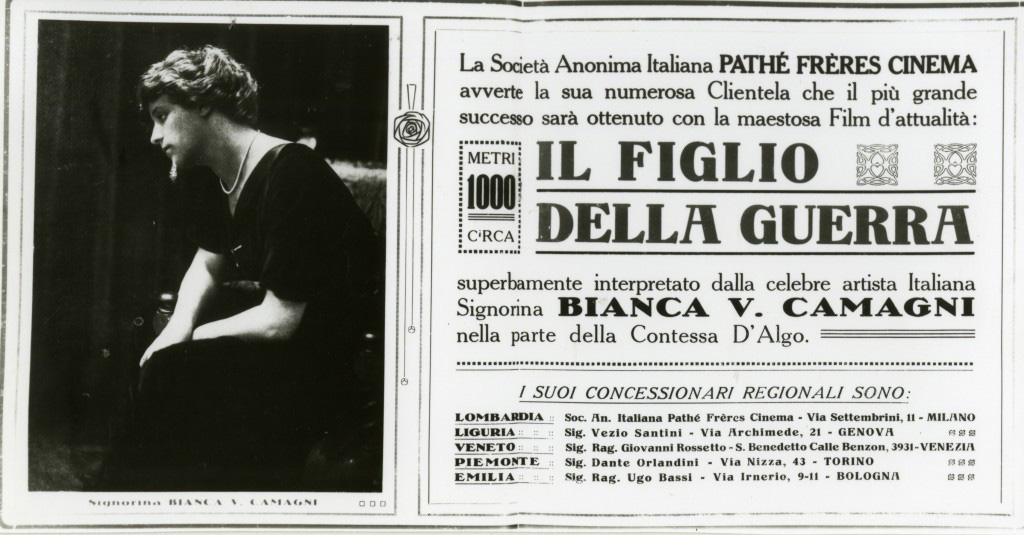
In 1916, three years after the release of Ma l’amor mio non muore (Love Everlasting, 1913), Lyda Borelli’s first screen appearance, the Italian Diva film was without doubt the most productive and influential genre, with scores of young actresses launched by minor and major production companies, and foreign artists like Dianne Karenne, Fabienne Fabrèges and Helena Makowska finding excellent job opportunities. To realize how many actresses also wrote and directed films in 1916 comes as a real surprise. All works directed in 1916 by Bianca Virginia Camagni, Dianne Karenne and Elettra Raggio are lost; it’s our good luck that films that survived, like Il figlio della guerra, scripted by Camagni, and Signori giurati…, scripted by Fabrèges, are interesting enough. In fiction films, war appears transposed, removed to the past as in Guazzoni’s Madame Tallien, or foregrounded as in Il sopravvissuto by Augusto Genina, a pièce of propaganda with the homefront as target audience. Genina, aged 24, took much praise for the mise-en scène in June 1916 when La signorina Ciclone premiered, a divertissement by the fashionable writer Lucio d’Ambra. In times of war, comedy thrives. Rodolfi and Gigetta released fourteen or more short and medium-length installments of their comic series in 1916 alone. And had the Futurists produced a first-rate film comedy instead of their manifesto, it would figure in this programme.
Mariann Lewinsky