Film notes
Apart from his films, Gaston Velle has left us that rarest of documents, an autograph filmography. Ordered by production company, it lists five (of the presumably thirteen) vues fantasmagoriques he made in 1902 for Louis and Auguste Lumière, fifty of his perhaps sixty créations cinématographiques for Pathé frères (1903-1913) and sixteen of the probably thirty films he made in Rome, in 1906 and 1907, during his spell as directeur artistique of Cines. Velle summarized the missing titles with indications like “plus more such short films”, “and various other films”, or “other films and general technical collaboration”, and he singled out three groups of films: Greatest Successes, Music Hall Numbers, and First Stencil Films.
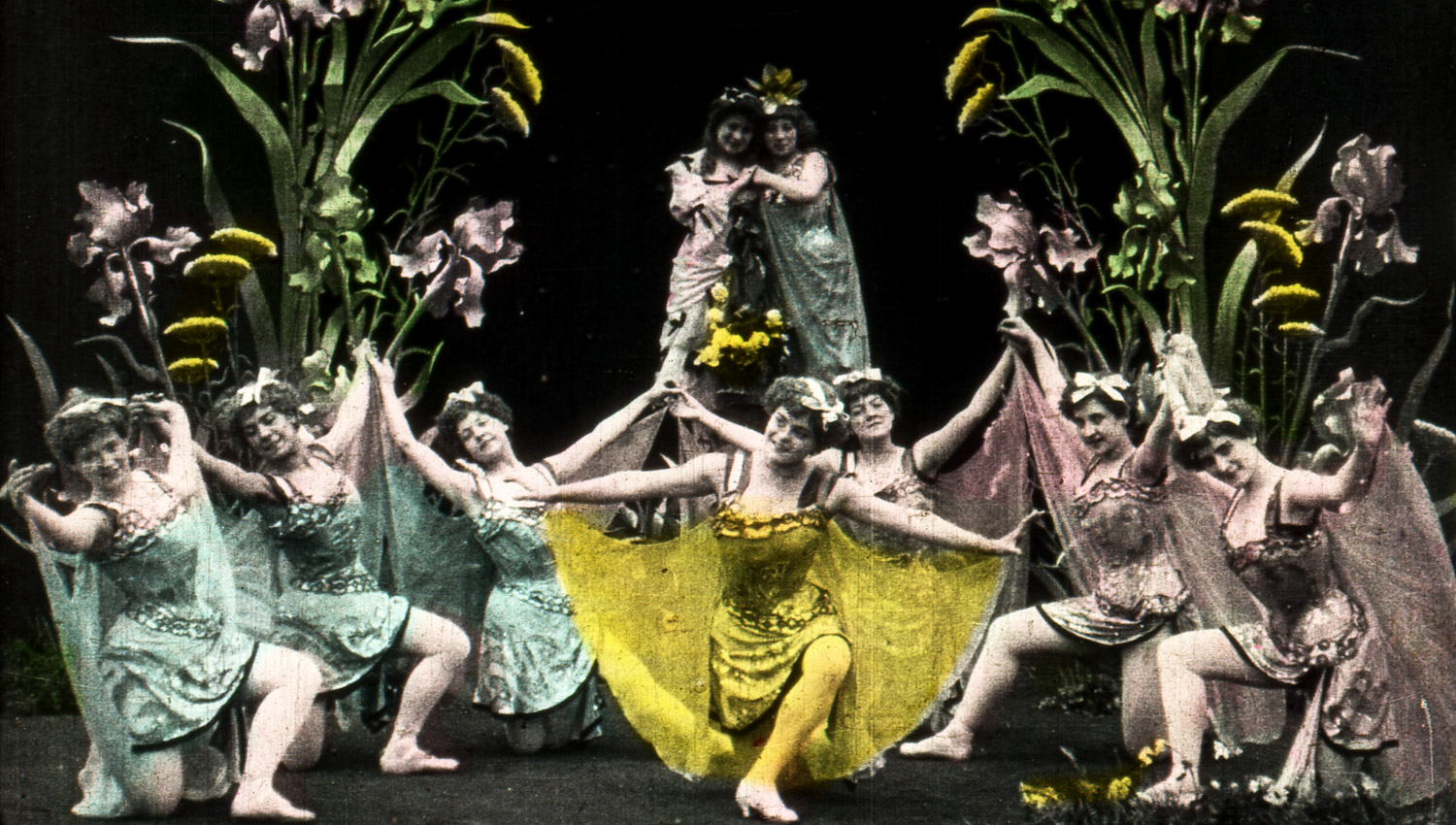
Among his Music Hall films of 1904 are scènes de danses et acrobatiques with stellar performers such as the Dahlias doing a Danse plastique and a very early Valse apache four years before Mistinguett and Dearly’s hit version at the Moulin Rouge. Velle himself appears as a magician in several of his films; while classed as scènes à trucs et transformations they document what was undoubtedly his style as a stage performer (maybe even containing movements and routines of his father, Joseph). And seeing your hero move and smile is always a treat.
Like dances and magic acts, the féerie had a long stage tradition before becoming a film genre. La Rose d’or was performed in 1838 in Paris “with the most sumptuous decors and costumes and natural water fountains”. Velle annotated his 1910 version with an asterisk as one of the “Greatest successes”. Among other titles he marked are La Valise de Barnum, Un drame dans les airs and the charming féerie La Ruche merveilleuse – but not the film that is the greatest favourite with modern audiences, La Peine du talion.
Please take note that the films listed here will not be screened together in one programme session but at different times during the week of the festival – before or after the feature films scripted by Mary Murillo. We have included a beautiful film by Segundo de Chomón and propose to identify it, on the basis of the description in the Pathé catalogue and the decorative frame of Iris germanica, as El iris fantastico (1912) which would make it one of the last of its kind, the scène à truc et transformation, the genre in which Gaston Velle excelled. It was formerly identified as Les Tulipes (1907) by Segundo de Chomón or as Le Faune (1908) by Gaston Velle, but the Pathé catalogue descriptions do not fit, and no tulips are to be seen in the film.
Mariann Lewinsky