
Film notes
“I went to the woods because I wanted to live deliberately. I wanted to live deep and suck out all the marrow of life, to put to rout all that was not life, and not when I had come to die discover that I had not lived.”
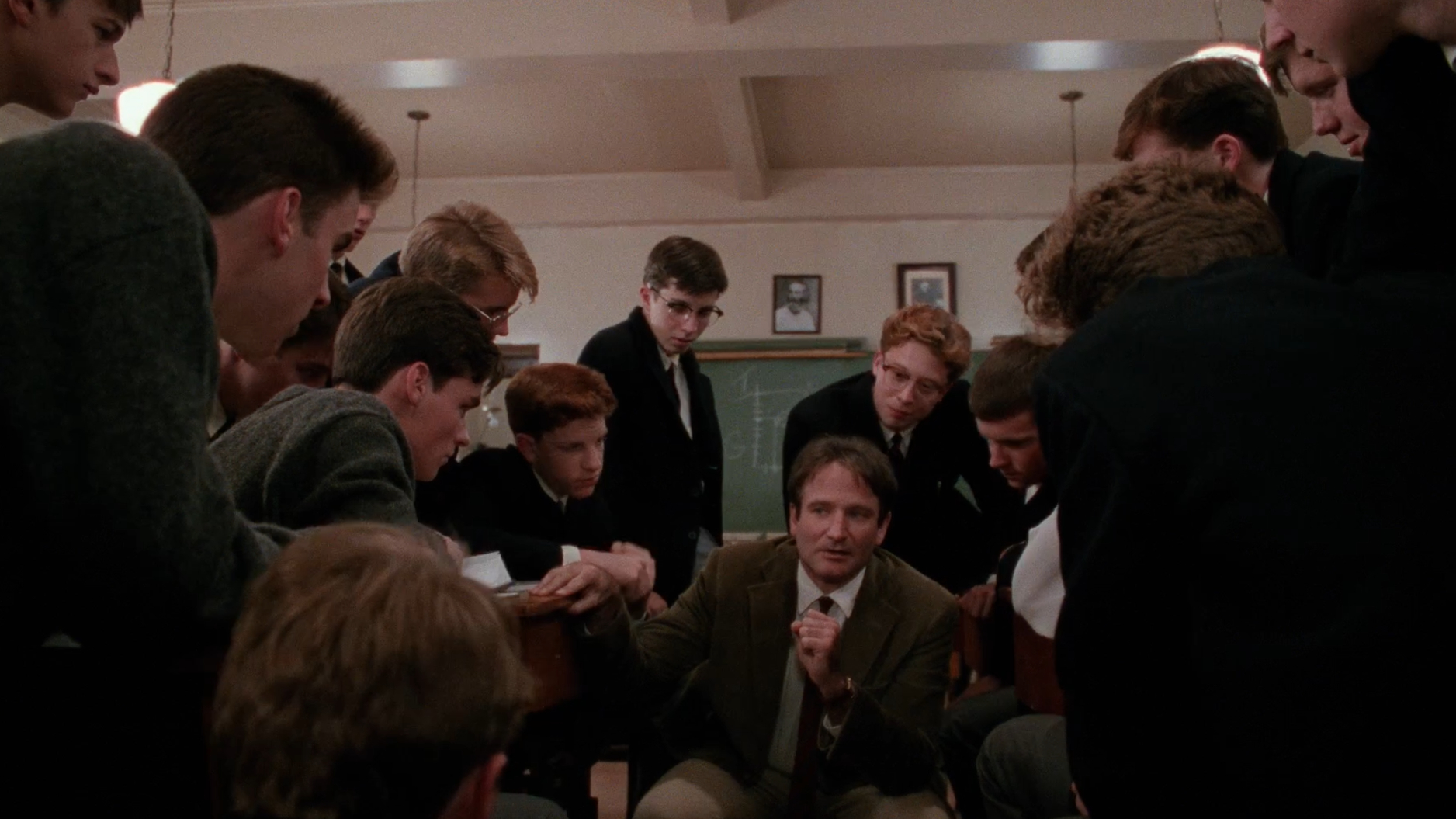
This extract from Thoreau’s Walden opens the meetings of the Dead Poets Society, which gives the film its title. Or, to quote Horace, “Carpe diem” – which in turn inspired the title for its Italian release. This is the heart of the teachings of Professor Keating, who in 1959 arrives to teach literature at Welton Academy, where he himself had studied as a young man. Through poetry, Keating urges his students to achieve independence of thought and to shun conformity by searching for their own Whitmanesque “barbaric yawp”. This is not an easy task in an oppressive and elitist institution such as Welton, where poetry is measured by Cartesian coordinates and outdated and inflexible educational ideas reign. “Tradition, Honor, Discipline, Excellence” are the four pillars on which the iron convictions of teachers and parents rest – without a thought for those most directly affected, the students themselves. Keating exposes a crack in this worldview, for we are on the verge of the 1960s and outside the walls of the college, everything is already changing. Peter Weir paints a powerful picture of education as a means of emancipation. But the film is above all a coming-of-age story. If Keating is the motor of change, at the helm are the group of students who adopt his principles and seek out their own path through the world. Teenagers crushed by expectations and rules. And if, despite its solemn name, the Dead Poets Society is merely a means of sharing their passions and readings, reviving it is ultimately a subversive act. Thus the scene of its inauguration, with the boys’ night-time escape, is visually and aurally unsettling. It is no coincidence that the meeting place is a cave; architecturally, its primitive atmosphere contrasts with the ordered classicism of the school. Dead Poets Society is, in the end, another Picnic at Hanging Rock – another institution, another closed world embedded in rules and traditions. And then disintegration, the emergence of the irrational – there mysterious and elusive, bound to the natural element; here mediated by poetry, which is more restrained, human, cultural.
Alice Autelitano