
Film notes
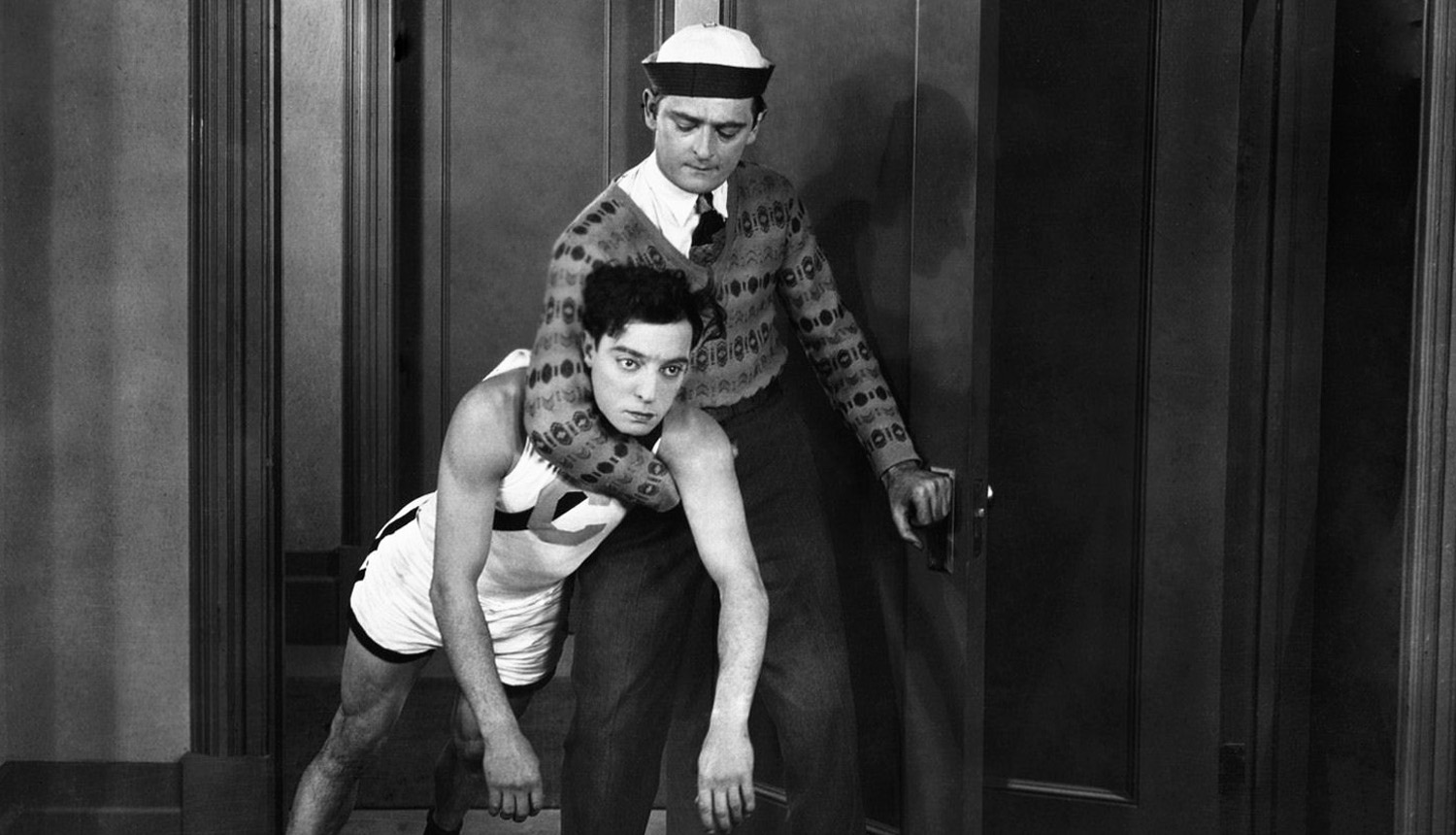
Here is Buster Keaton with his latest film, the wonderful College. Asepsis. Disinfection. Freed from tradition, our gaze revels in the juvenile, tempered world of Buster, the great specialist in fighting sentimental infections of all kinds. The film is as beautiful as a bathroom, as vital as a Hispano-Suiza. Buster never tries to make us cry, for he knows that cheap tears are outdated. He is not, however, a clown who makes us roar with laughter. Not for a minute do we stop smiling, not at him but at ourselves – smiling at health and Olympian force.
In cinema, we always contrast Keaton’s monotonous expression with the infinitesimal variations of a Jannings. Filmmakers overdo it with Jannings, multiplying his slightest facial contractions to the nth degree. For him, suffering is a prism cut into a hundred facets. […]
Buster Keaton’s expressions are as modest as, for example, a bottle’s; the dance floor of his pupils is round and clear, but there his aseptic spirit does pirouettes. The bottle and Buster’s face have infinite points of view.
Few are those who know how to accomplish their mission in the rhythmic, architectural workings of a film. It is the editing – film’s golden key – that combines, comments on, and unifies all these elements. Can greater cinematic virtue be reached?
Luis Buñuel, “Cahiers d’Art”, n. 10, 1927, in An Unspeakable Betrayal. Selected Writings of Luis Buñuel, University of California Press, Oakland 2000