
Film notes
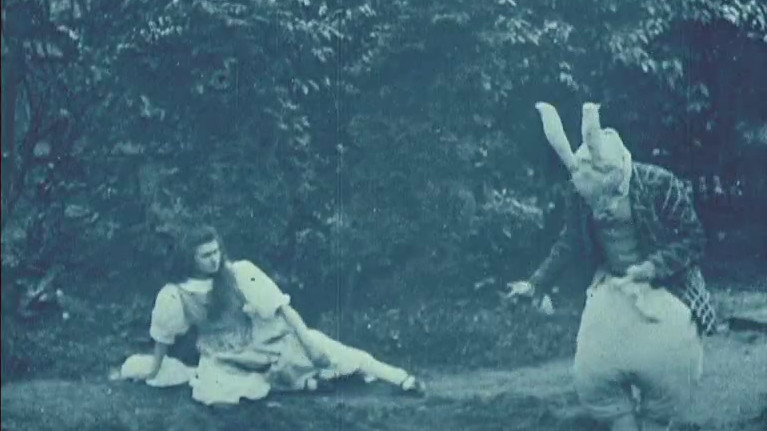
Britain’s pioneers continued to produce films in 1903 much as they had for the previous couple of years. Film fashions shifted gradually – factory-gate films were out, narrative films were in – otherwise it was business as usual, documenting royal occasions such as the lavish parades of the Delhi Durbar, sporting occasions including the Gordon Bennett motor races in Ireland and touristic scenes such as frenetic traffic in the city of London. The staple diet of the film show, trick films and comedies continued to roll out. One major change though, was Charles Urban’s defection from Warwick to set up his own business, the Urban Trading Company, which would grow to be a successful filmmaking concern. In this year he established a new series called the Unseen World reproducing the marvels of nature filmed by the Urban-Duncan Micro-Bioscope. This was a serious attempt at an encyclopaedic approach, offering the world’s knowledge to the public in film form. Few of the films survive but we do have two spoofs of his earnest endeavour – one by Urban himself showing the scientist F. Martin Duncan as a professor, horrified to discover cheese mites in his lunch and the other by the Hepworth Company reproducing this scenario but subtly challenging the authenticity of Urban’s microscope footage by substituting mechanical bugs. Cecil Hepworth also had a hit that year with two films, based on political cartoons, that argued either side of Joseph Chamberlain’s polarising Free Trade reforms (arguably the Brexit of its day). John Bull’s Hearth fights the pro-reform corner, but exhibitors could book whichever film suited their audience’s political affiliations. Other important innovations were the longer running times and increasingly complex narratives of films such as Frank Mottershaw’s A Daring Daylight Burglary and William Haggar’s Desperate Poaching Affray, which famously influenced Edwin Porter’s The Great Train Robbery. Another is the use of colour that we see in King of Coins (see the first programme of this section) and in Hepworth’s astonishing 16-scene Alice in Wonderland, which survives only in very damaged but tinted form.
Bryony Dixon