Film notes
Century of Cinema: 1901 – Near and far
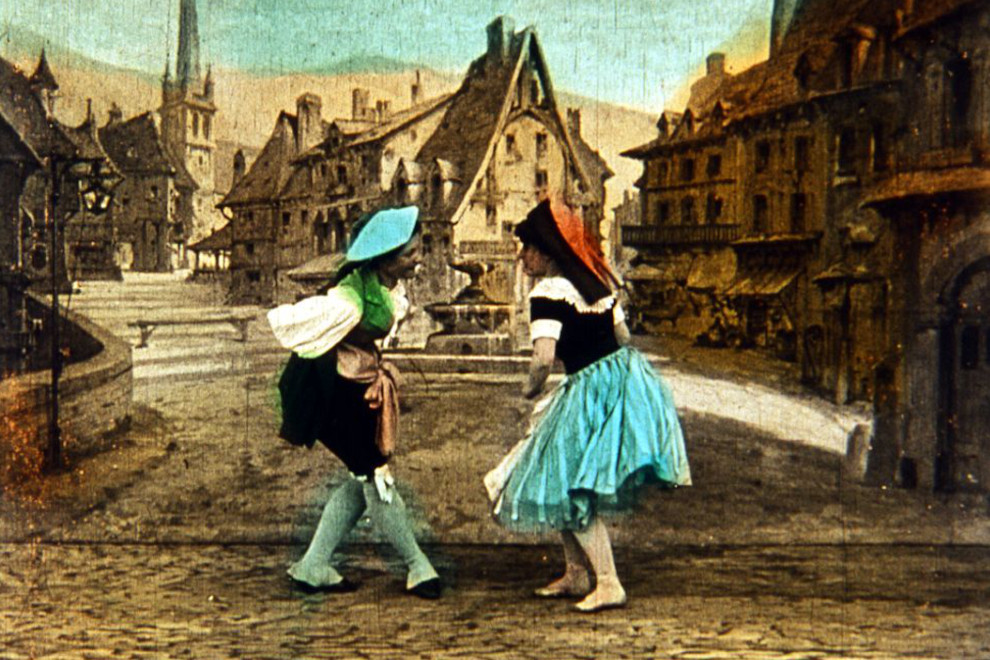
In a panorama (later shortened to pan) the field of vision changes in a continuous flow of time. Such views were shot from tramcars, trains or ships in motion, and the irresistible effect of the constantly changing frame combined with a seemingly subjective camera produces a miracle: we are on the sea front of Morecambe in 1901, riding a tramcar, and little boys are running along to keep up with our pace. Delighted, we follow the crowd into a fairground Bioscope or a Cinematografo Gigante and there see films from 1901 with a totally different impact. No immediate pleasure transports us into an effortless appreciation of scenes (from an opera, says the catalogue) peopled by monks and dolls, of a Danse Basque (says the title), or of animated tableaux vivants, inspired by Quo vadis? (read the novel, if you haven’t yet). Like the little girl in the fairytale trying to open the door of the glass mountain, we need special tools to get close to these films, and your kit should include a taste for acquired tastes, a curiosity about how stage arts were absorbed by cinema and how fiction entered into film, plus a background knowledge courtesy of a few names and titles of songs and operas.
Die Puppe (1919) by Lubitsch was based on an opéra-comique premièred in 1896, and three numbers in the Lumière catalogue of 1901 are Italian productions by transformist Leopoldo Fregoli. We all know Alice Guy but who was the composer of the divertissement-pantomime Jeanne or Jane Vieu? She studied with Massenet and published about 100 works. It might be a good idea to try to pair her successful La Belle au bois dormant (1902) with a screening of the Sleeping Beauty from 1902… Researching Quo vadis? can take you in numberless directions: Poland, Nero, the Nobel prize, adaptations from literature and paintings, and gladiatormania, just to start with.
Mariann Lewinsky
Century of Cinema: 1901 – Mitchell & Kenyon: the rules of the game
In 1994, the discovery of 800 film reels during demolition work in Blackburn, Lancashire, made Mitchell & Kenyon, a film production company active in Northern England, a familiar name for experts and aficionados of early cinema. From 1897 until 1913, the two founders of this enterprise, James Kenyon (1850-1925) and Sagar Mitchell (1866-1952), produced mostly non-fiction ‘actuality’ films either on their own initiative or commissioned by local businesses or travelling showmen. According to the BFI’s Patrick Russell, their films can be grouped into a few basic categories: factory gate scenes, films relating to sporting events, records of local processions, phantom rides filmed from trams and street scenes. One of the attractions of the collection is the fact that many of the films capture working- class life and culture. Today, the focus of many Mitchell & Kenyon films on working environment, street life and leisure activities gives us an idea of the life of different social classes in Britain at the beginning of the 20th century. The films by Mitchell & Kenyon selected for this programme combine glimpses of the daily life of blue-collar workers, white-collar workers and schoolchildren with fiction films made by other production companies (Pathé and the Williamson Kinematograph Company). These fiction films are movies that the people appearing in the Mitchell & Kenyon films might have seen in 1901, in a fairground cinematograph, along with the “Local Films For Local People” (the duo’s advertising slogan).
Karl Wratschko