
Film notes
1899: A SHOW AT THE STUDIO IN ASNIÈRES
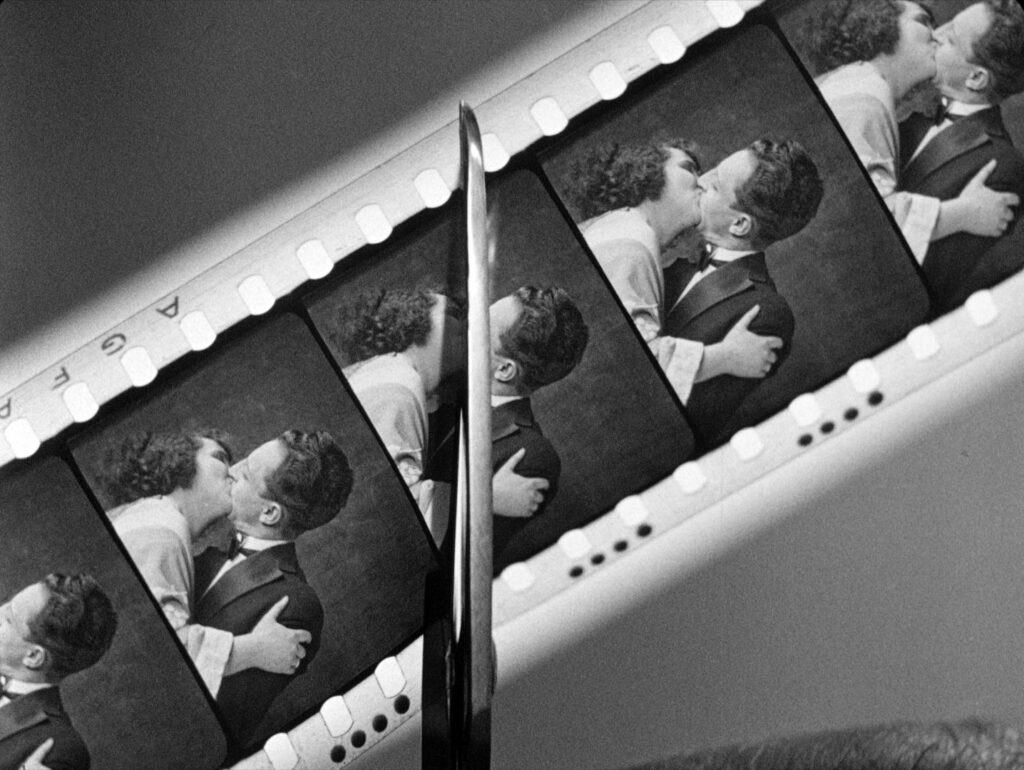
Everybody who had a say in the matter, from Léon Gaumont to Laurent Mannoni, the eminent historian of technical history of cinema, agreed that Auguste Baron had a revolutionary idea. He worked, starting in 1895, on a system to record sound and moving image synchronically by means of a ‘graphophonoscope’. There was never a public screening, however, which makes experts doubt that he ever achieved satisfying results. Baron himself admitted to one weak point: the wax cylinders used for recording sound could not be reproduced. What remains is an impressive collection of his drawings, about 700 of them, some pieces of the machinery and some 70 films now in the Archives français du film of the CNC, many of them in a unique 50mm format, with one perforation per frame. If you read French and are interested in learning more, Laurent Mannoni and Giusy Basile-Pisano have published an exhaustive study on the life and work of Auguste Baron (“1895. Revue d’histoire du cinéma”, n. 26, 1998). Viewing his films, most of them very short, I was struck by the quality of the dancers, singers, actors, and of their charming, lively performances. The research by Basile-Pisano and Mannoni revealed that Berthe Théodore, Baron’s wife, was a professional actress and musician and that Baron himself occasionally worked as a musician and in the Casino de Paris as an electrician for the ‘projections lumineuses’. He knew show-business well, and so our programme is organised as a spectacle.
Mariann Lewinsky
August Baron’s surviving films entered into the CNC collection upon its creation (1969) thanks to Jean Vivié, its first director and one of the first great historians of cinematographic technology. To celebrate the 50th anniversary of these acquisitions, CNC has digitally restored the Baron films selected for Il Cinema Ritrovato. Where possible (Chanteuse en robe longue sur scène and Danseuse en robe longue sur un tapis), the original 35mm negatives were scanned in 8K. Due to the fragile state of the other films, the 35mm interpositives or safety duplicates were scanned in 2K. The projection speed has been set at 16 fps.
