Film notes
To follow, a meeting with Viktoria Schmid.
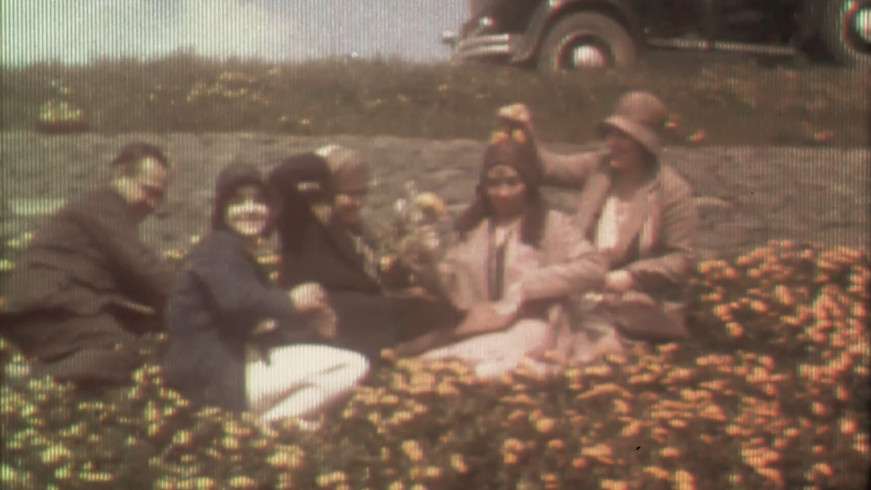
Colour can be obtained through additive and subtractive systems. The first of the additive systems to be introduced were lenticular and were used by Kodak and later Agfa in their 16mm safety stock. Three examples from 1931 and 1932, digitised in different ways, reveal surprising, previously unseen images. Martin Châteauvert’s projected “telecinema” transports us to a floral Dutch landscape – and it is just a short step from flowers to fashion. Ernst Göhner’s film of the Lichtspiel reveals the colours of Morocco and the faces of both locals and tourists and is reproduced here thanks to a system that combines film scanning and AI by way of specially designed software. The third example, from the Cinémathèque suisse with thanks to the work of Simon Lund, reveals an “exotic” gaze: it looks like a journey around the world, but we are actually just outside Paris, at the 1931 Colonial Fair. A short Agfacolor from the Cinémathèque de Bretagne takes us to Yugoslavia in 1935. Another (regular mosaic) additive system is Dufaycolor and Normandie Images provides us with two films that reveal the colours of the Normandy countryside, from green pastures to flowerbeds in the towns.
Mirco Santi
All the films in this programme were made using colour separation techniques, each one involving a slightly different procedure. Warrah by Arthur & Corinne Cantrill is realised by the three-colour separation technique of shooting three apparently similar scenes on three colour film negatives and printing them together afterwards. During the shooting of NYC RGB, filmmaker Viktoria Schmid carried out triple exposures on one colour film negative and shot every take in three different moments using a different filter each time. In Tall Arches III Doris Chase filmed a dance performance choreographed by Mary Staton and overlaid several monochromatic recordings in the optical printer and used different filters in this last step (at least I think she did it that way – maybe we can verify that at the screening). In this way she created colourful silhouettes that fit into each other perfectly and appear as multiple colourful shadows of the dancers. In all the three films of this programme the depiction of the passing of time plays a significant role.
Karl Wratschko
In collaboration with
