[MOVIE]
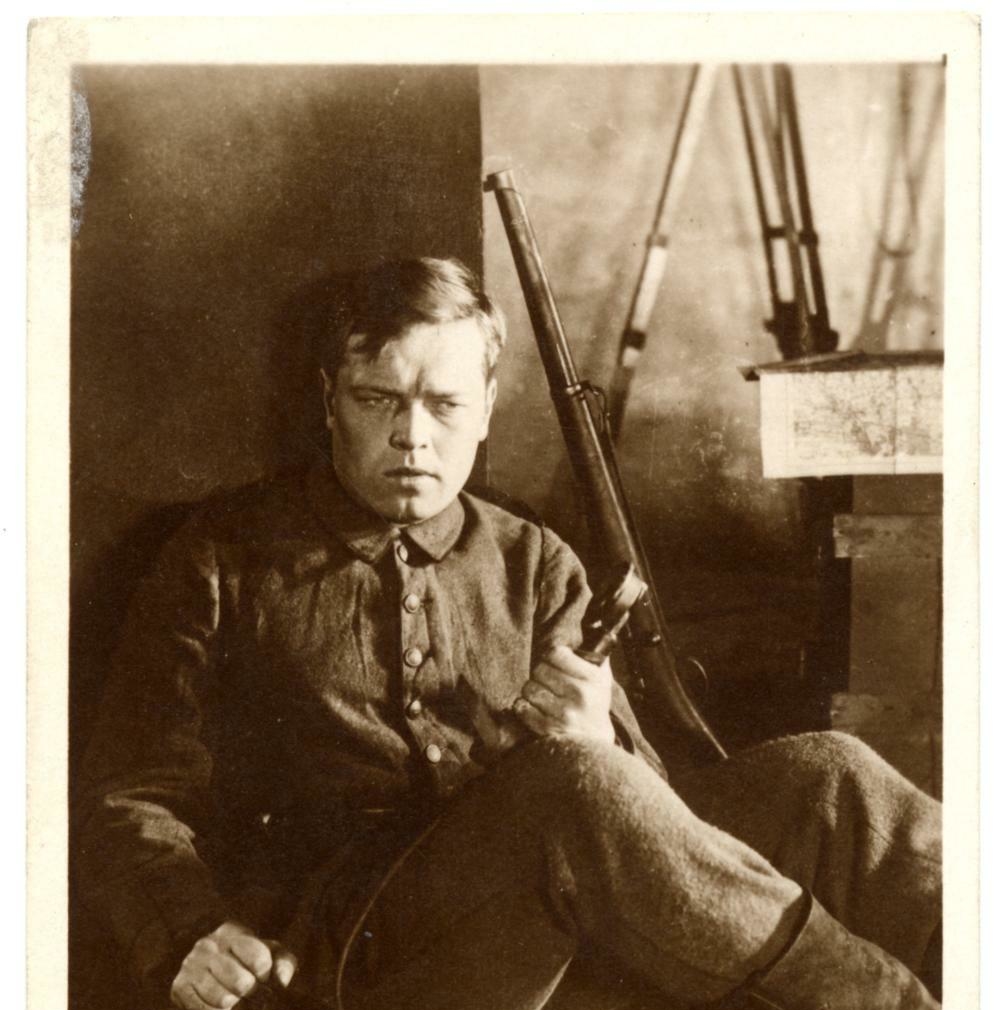
F.: Georges Million, René Batton; M.: Raymond Lamy; Ass. R.: Thomy Bourdelle; Int.: Jeanne Marie-Laurent (la madre), Suzanne Bianchetti (la moglie), Albert Préjean (il soldato francese), Hans Brausewetter (il soldato tedesco), Thomy Bourdelle (l’ufficiale tedesco), Maurice Schutz (il vecchio maresciallo), Pierre Nay (il figlio), Jean Dehelly (il giovane soldato), Daniel Mendaille (il marito), Antonin Artaud (l’intellettuale), André Nox (il cappellano militare), José Davért (il vecchio contadino), Berthe Jalabert 35mm. L.: 1822 m. D.: 89’ a 18 f/s. Bn.
Edition History
Dedicated to “all the martyrs of the most terrifying of all passions, war”, Verdun, visions d’Histoire presents itself as a circumstantial account of the infamous battle fought between February and October of 1916. The film is not a matter of a simple report: within the main story, Poirier inscribes the destiny of fictional characters, often with their tragic journeys mixed with real figures of the battle of Verdun. Constructed around three «visions» (Power, Hell, Destiny) that correspond with the phases of the battle, Verdun, visions d’Histoire is simultaneously a film-monument and a film-memory. A film-monument, because Léon Poirier dedicated eleven months – from summer 1927 to spring 1928 – to shooting it, on the actual locations of the battle. For it he assembled the troops of the French Army, reused trenches which had been silent for more than ten years, and called on the General Staff. The film’s premiere took place at the Paris Opéra on 8 November 1928, almost exactly ten years after the Armistice. This gala showing was a sign of the symbolic importance that the film had for the public of the time. Former servicemen and the many witnesses of various kinds of the War saw for the first time a realistic representation of the inferno of the war, depicting the suffering of both soldiers and civilians. In this sense, Poirier’s film is a fundamental testimony of the trauma created by the Great War. The film-monument pales, however, before its place as a film-memory. Surely a merit not to be neglected of Verdun, visions d’histoire is precisely the ability to show this transformation.
Restored by L’Immagine Ritrovata, Verdun, visions d’histoire is presented in a print conforming to that of the first public showing on 8 November 1928, accompanied by the original score composed by André Petiot.
Christophe Gauthier



Restoration carried out at L’Immagine Ritrovata in 2006, from an interpositive printed at Gosfilmofond and preserved at the Cinémathèque de Toulouse by Xavier Berthet. Original score by André Petiot, arranged by A. Bernard, performed on the piano by Hakim Bentchouala Golobitch
After some hesitation I decided, for commercial reasons, to add sound to Verdun, visions d’histoire which I had shot as a silent film in 1927. In my opinion the result was not satisfactory. The silent film, which portrayed the battle and evoked its psychological, human and domestic repercussions, became a ruthlessly arid documentary. I was forced to remove all the symbolic characters (the Mother, the Son, the Husband, the Bride, the Farmer) that broadened the battle and transformed it into tragedy, because I refused to give a real voice to symbols.
In brief, the collective, heroic and painful soul that I had tried to evoke from the courageous suffering of the combatants had completely materialized. (…) Between the silent Verdun and the “noisy” Verdun there was the same difference as there is between a painting and a photograph: the first suggests, the second reproduces. (…) I have seen tears shed during screenings of the silent Verdun, visions d’histoire and never did a mother cry when watch- ing the sound version of Verdun, visions d’histoire. The illusion had been destroyed with cannon shots.
Léon Poirier, 24 images à la seconde, Mame, 1953