[MOVIE]
Edition History
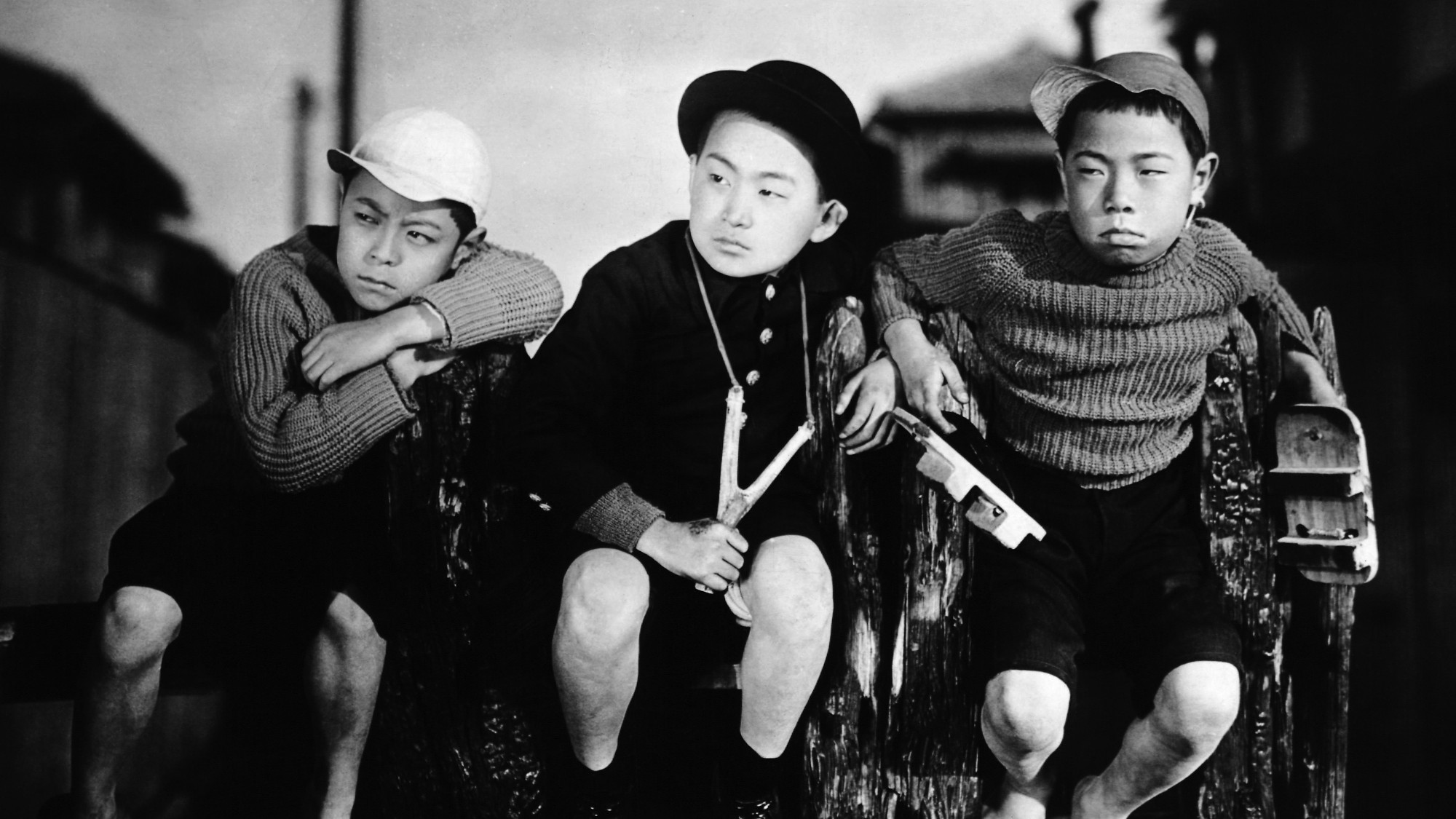
Subtitled “A Picture-Book for Adults”, this is a film à thèse, an unusually explicit demonstration of a lesson. Most Ozu films of whatever period have an elusiveness of connotation that Umarete wa mita keredo… almost wholly lacks. By means of its organizational unity and stylistic control, the film achieves great didactic rigor.
The film is built around the social use of power. As the boys rise in the neighborhood gang, their father reveals more of his subordination at work. In the world of the boys, power comes from age, brains, and brawn. If the big bully beats up the brothers, they must coax the still bigger delivery boy into punishing him. In one scene, after a tiny gang member picks up a dropped bun, another boy, only slightly bigger, wrests it from him. Ozu often lines the boys up by height, diagramming their pecking order. The sons, both tyrants, know that power need not be exercised fairly, but they cannot grasp that not everyone has an equal chance to acquire it in the first place.
To the boys’ belief that ability comes from mythical sources (raw pigeon eggs), the film juxtaposes the fact that in the world of the grownups power is implacably social, derived from money and position. Iwasaki is neither strong nor smart; he is just the boss. The brothers’ illusion is that all power can be won through straightforward abilities, as they are able to take over the gang by outfighting the others. The sake-shop boy has already given them one lesson: he beats up the bully for them because their parents buy beer, but he won’t beat up Taro because his father buys sake. In the climactic scene, when Yoshii is asked why he must bow to his boss, he explains that they depend upon Iwasaki. Ryoichi replies: “I’m stronger than Taro and I get better grades.” After their fight, and during their reconciliation the next morning, the younger brother clings to the old premise: he will grow up to be only a lieutenant general because the older brother is to be general. Yet the hunger strike ends, as if the boys’ recognition of the need for survival has reconciled them to the need to obey. “If he didn’t pay me,” the father had said, “then you couldn’t go to school – you couldn’t eat.” The film preserves the protest against the established order while dramatizing the necessity of submission.
David Bordwell, Ozu and the Poetics of Cinema, Princeton University Press, Princeton, NJ 1998

Remastered in 4K in 2023 by Shochiku at IMAGICA Entertainment Media Services and Shochiku Media WorX laboratories from a 35mm print preserved at Harvard Film Archive and a 16mm dupe negative preserved at Shochiku. Colour correction supervised by Masahi Chikamori.
“Generally regarded as Ozu’s first masterpiece, Umarete wa mita keredo… is the most stylistically assured of his surviving early works. His control over comic performance (especially the delightful acting-in-unison of the two brothers) and his carefully timed editing makes the film remarkably rigorous. His characteristic low camera height and deep space set objects and figures hovering in various zones of space. In the opening scene, for instance, the low camera position and the decoupage make father, driver, and boys float free of the earth. Only the truck’s wheel is grounded. In a richly reflexive gesture, Ozu even parodies himself in Iwasaki’s home movie. Random shots of streets and boats in Iwasaki’s footage evoke the landscapes of earlier and later Ozu works. (These shots make Iwasaki’s audience yawn!). The camera position in the second reel recalls the slightly higher camera placement in Ozu’s preceding films. All this artistry is put at the service of a rather didactic theme. Subtitled, A Picture-Book for Adults, this is a film à these, a lesson in the social use of power. As the boys rise in the neighborhood gang, their father reveals more of his subordination at work. In the world of the boys, power comes from age, brains, and brawn, so they cannot understand that adult power is implacably social, derived from money and position. The brothers’ illusion is that all power can be won through straightforward abilities, as they are able to take over the gang by outfighting the others. The script began as a social comedy, and a satiric tone is preserved in the various rituals of power that are compared.
Ozu brings out the developing situations through his typical use of parallel events: two visits to the boss’s house, two trips to school, two pauses at the railroad crossing, two eatings of pidgeon eggs, and so on. Virtually every scene echoes and counterpoints another. Some comparisons are brought to our attention through the lateral camera movements that link school and office, linking drilling boys to bored salarymen. Ozu, subtly balances the boys’ perspective with that of the adults. Most of the plot is restricted to what the boys know, so that for instance, we share the boys surprise when Yoshii follows them to school. This restriction is most powerful when they discover Yoshii’s capers for Iwasaki’s movie. After the fight between father and sons, however, the narration shifts openly to the adults’ frame of reference. As the boys sleep, the father fletches out his whiskey bottle and muses on his failure. For the first time, we see the parents alone and discussing their lives. Yoshii moves from self-assured pragmatism to self-justifying shame. He and his wife look in on the brothers and ask: ‘Will they lead the same kind of sorry lives we have?’. After so severe a restriction of the boys’ ken, this gradual unfolding of Yoshii’s attitudes and doubts puts the home-movie scene in a more encompassing perspective. Yoshii grovels because he can do nothing else”.
(David Bordwell, Les cahiers du muet, n. 23, 1993)