[MOVIE]
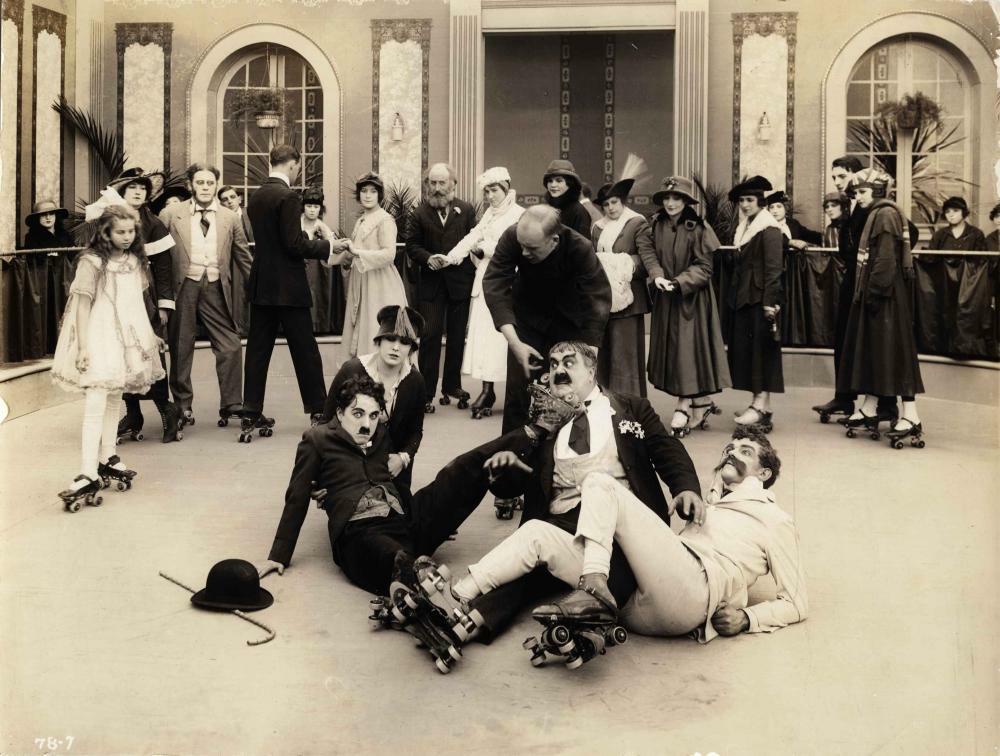
T. It.: Charlot A Rotelle / Charlot Al Pattinaggio; Scen. E Mo.: Charles Chaplin; F.: Roland Totheroh; Int.: Charles Chaplin (Cameriere Pattinatore), Edna Purviance (Ragazza Chic), James T. Kelley (Padre), Eric Campbell (Sig. Stout), Henry Bergman (Sig.Ra Stout/Cliente Arrabbiato), Lloyd Bacon (Ospite), Albert Austin (Chef/Pattinatore), Frank J. Coleman (Direttore Del Ristorante), John Rand (Cameriere), Charlotte Mineau (Amica), Leota Bryan, Charlotte Mineau (Amiche Di Edna); Prod.: Charles Chaplin Per Lone Star Mutual; Pri. Pro.: 4 Dicembre 1916; 35mm. D.: 24′. Bn.
Edition History
Da: Blackhawk Collection
The Rink was Chaplin’s eighth film at Mutual, and was one of the greatest public successes thus far, demonstrated by the now famous letter sent by the manager of the Princess Theatre in Piqua, Ohio to the offices of the Mutual Corporation: “We presented your picture entitled The Rink, featuring Charles Chaplin last night. Persistent laughter and shouting on the part of the audience brought down most of the house. We have been showing pictures many years without loss of life or damage to property: chunks of plaster fell off the ceiling and part of the floor collapsed. The Rink has proved a menace to real estate improvement, and the result of one day’s run has cost us considerable outlay in repairs. We enclose plasterer’s and carpenter’s bills. We would appreciate a check by return”. The story in The Rink takes place in two distinct settings: a restaurant and a skating rink, allowing Chaplin to show off a wide range of his strengths. In the first part the comedy flows, as in many of his films, when Chaplin assumes a role of responsibility or authority. As Bazin observed: “Society has a thousand good rules that are nothing more than a system eternally feeding off itself. That’s how it is, particularly when it comes to how society deals with how we eat. Chaplin could never behave appropriately in this context. He’ll always put his elbows in the plates, pour the soup in his lap, etc. The ultimate expression of this is surely when he himself is the waiter”. In the second part his ease, grace and amazing physical agility in the ice skating ‘dance’ leave audiences speechless. His static ‘shimmy’ with the cocktail shaker alone makes the film a gem.

Restored in 2012 by Fondazione Cineteca di Bologna at L’Immagine Ritrovata laboratory, in collaboration with Lobster Films and Film Preservation Associate
The mechanics of the directing were simple in those days. I had only to know my left from my right for entrances and exists. If one exited right from a scene, one came in left in the next scene; if one exited towards the camera, one entered with one’s back to the camera in the next scene. These, of course, were primary rules. But with more experience I found that the placing of a camera was not only psychological but articulated a scene; in fact it was the basis of cinematic style. […] Placement of camera is cinematic inflection. There is no set rule that a close-up gives more emphasis than a long shot. A close-up is a question of feeling; in some instances a long shot can effect greater emphasis. An example of this is on one of my early comedies, Skating [The Rink]. The tramp enters the rink and skates with one foot up, gliding and twirling, tripping and bumping into people and getting into all sorts of mischief, eventually leaving everyone piled up on their backs in the foreground of the camera while he skates to the rear of the rink, becoming a very small figure in the background, and sits amongst the spectators innocently reviewing the havoc he has just created. Yet the small figure of the tramp in the distance was funnier than he would have been in a close-up.
Charles Chaplin, My Autobiography, Simon & Schuster, New York 1964
Restored by Cineteca di Bologna at L’Immagine Ritrovata laboratory, in collaboration with Lobster Films and David Shepard. Other elements from Academy of Motion Picture Arts and Sciences, CNC – Archives Françaises du Film e Library of Congress
New score composed by Antonio Coppola and performed live by Orchestra del Teatro Comunale di Bologna
Half-brother Sydney Chaplin’s interest in, support of, and enthusiasm for Charlie’s career began with Charlie’s debut as Billie the pageboy in Sherlock Holmes in 1905. Charlie wrote in his autobiography that Syd “read the part to me and helped me to memorize the lines… [He] had so zealously coached me that I was almost word-perfect”. Later, in America, with his Mack Sennett/Keystone Studios contract fulfilled in the fall of 1915, Syd decided to again devote his energies to Charlie’s career. It is well-known, for instance, that Syd was the prime negotiator for Charlie’s history-making Mutual Films contract in 1916, resulting in $670,000 for the first year. Perhaps less well-known is that Syd seems to have had a significant influence on both the choice of storylines and bits of comedic business used in the films of the Mutual period (1916-1917). In this session, we will explore the close relationship between Syd’s experience as one of Fred Karno’s London Comedians in the English music hall (skills acquired and scenarios written and performed) and traces of that experience as discernible in three Chaplin Mutual films: The Pawnshop (1916), The Rink (1916), and The Cure (1917).
Lisa Stein

and David Shepard