[MOVIE]
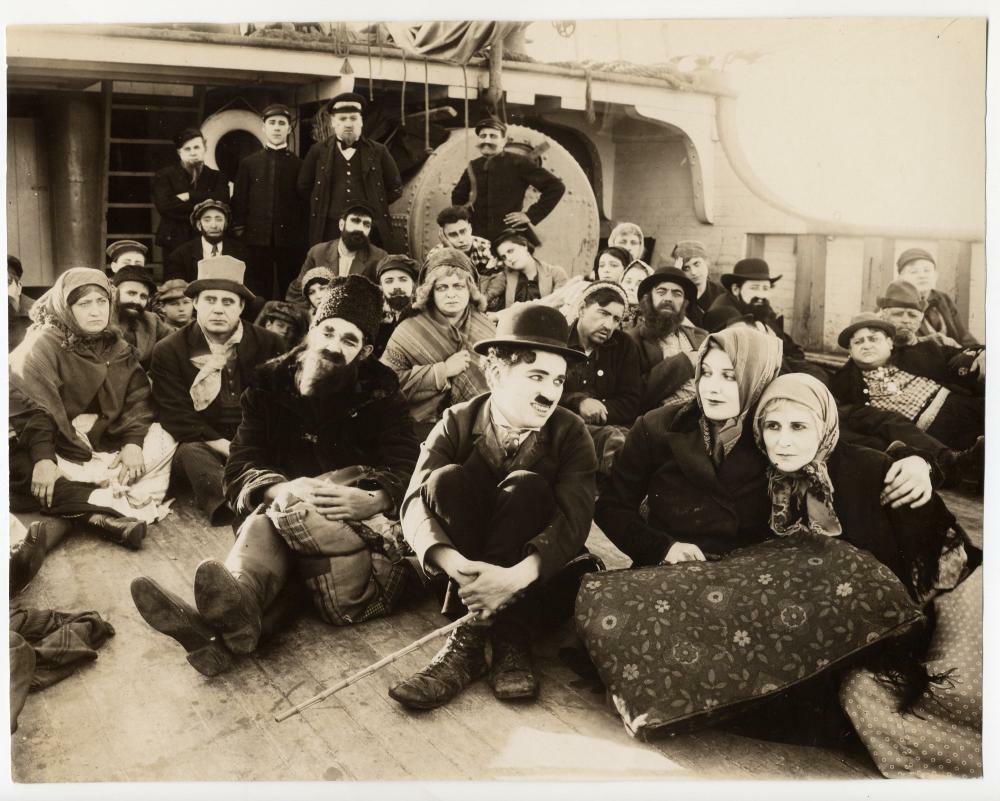
T. It.: L’emigrante; Sog., Scen.: Charles Chaplin; F.: Roland Totheroh; Mo.: Charles Chaplin; Int.: Charles Chaplin (Un Emigrante), Edna Purviance (Un’emigrante), Kitty Bradbury (Madre Della Ragazza), Eric Campbell (Capocameriere), Albert Austin (Emigrante Slavo / Cliente Al Ristorante), Henry Bergman (Donna Slava / Pittore), Loyal Underwood (Emigrante Piccolo Piccolo), Stanley Sanford (Giocatore D’azzardo Sulla Nave), James T. Kelley (Uomo Malconcio Nel Ristorante), John Rand (Ubriaco Senza Soldi), Frank J. Coleman (Ufficiale Di Bordo / Proprietario Del Ristorante), Tom Harrington (Impiegato Addetto Alle Licenze Dimatrimonio); Prod.: Charles Chaplin Per Lone Star Mutual; Pri. Pro.: 17 Giugno 1917 35mm. D.: 30′ A 18 F/S.
Edition History
Beloved by Elia Kazan and Francis Ford Coppola – the former an immigrant and the latter a first generation American – as well as directors from across the globe, including Ousmane Sembène and Satyajit Ray, The Immigrant is one of the most powerful portraits of immigration of the past century, and probably the most personal work, closest to the heart and biography of its creator: “The Immigrant touched me more than any other film I made. I thought the end had quite a poetic feeling”, wrote Chaplin in My Life in Pictures. Emigrating twice, first from his native England to seek his fortune, and again, after being named a persona non grata, from his adopted United States, Chaplin’s American life began, as it did for millions of other Europeans, in New York, at the Statue of Liberty, where in The Immigrant a title card reads: “Arriving in the Land of the Free”, while passengers are shoved and herded together like cattle. Chaplin wrote of those early days of isolation and alienation, before the euphoria of starting a new life could take root, in one of the most lovely passages of My Autobiography: “The first day I felt quite inadequate. It was an ordeal to go into a restaurant and order something because of my English accent – and the fact that I spoke slowly. So many spoke in a rapid, clipped way that I felt uncomfortable for fear I might stutter and waste their time. I was an alien to this slick tempo. […] On the Avenue that first day many looked as I felt, alone and isolated; others swaggered along as though they owned the place”. Autobiographical issues aside, The Immigrant is most of all a film that, seen within the context of Chaplin’s body of work, expresses the identity of his character best: forever displaced, marginalized, excluded, someone who experiences and sees the world differently from everyone else (“with what eyes does Charlie Chaplin view the world?” Ejzenštejn asked himself), the wanderer and the eternal suspect described by Hannah Arendt: the Tramp is, by definition, an immigrant. In just over twenty minutes, with a firm hand and a more deliberate step than in his previous films, Chaplin finds the perfect balance between lyricism, humanism, social polemics and irrepressible comedy.

Restored in 2012 by Fondazione Cineteca di Bologna at L’Immagine Ritrovata laboratory, in collaboration with Lobster Films and Film Preservation Associated
The Immigrant is a seminal piece for Chaplin and his body of work in terms of its humanity and its violent polemic captured in the famous take of the arrival of immigrants to New York. […] The arrival described in his movie is not only emblematic of his own direct (perhaps) experience, but also of that of hundreds of thousands of men and women who had landed in the United States over the previous thirty years. […] Chaplin’s work for Mutual in 1916-1917 includes various masterpieces (The Pawnshop, Easy Street, The Immigrant) which are some of his most powerful social commentaries. […] The Tramp arrives in the United States expecting the promised land, a symbol of freedom and infinite possibilities, only to find a closed and puritanical society that discriminates against new immigrants using the traditional weapons of oppressors: egotistical wealth, religious and political intolerance, violence in the service of the privileged. In other words, the Tramp, the small Jewish immigrant chased from Europe by the pogroms, finds in the United States a society where Jews, left wing sympathizers, and the poor are automatically filed away as suspicious characters. Given the persistence with which this society harassed Chaplin during his stay in America, it is no surprise that he would continue his satire even after his astonishing professional and social success had shielded him from material, if not moral, concerns, and provided him with the possibility to integrate. But Chaplin would never integrate because he is the epitome of the wandering Jew, the luftmensch incapable of putting down stable roots in a specific location: all his life he would remain a temporary immigrant.
Marcel Martin, Charlie Chaplin, Seghers, Paris 1966
Restored by Cineteca di Bologna at L’Immagine Ritrovata laboratory, in collaboration with Lobster Film and David Shepard
New musical score composed by Timothy Brock and performed by Orchestra del Teatro Comunale di Bologna
In the case of his next film, The Immigrant, the surviving out-takes enable us to follow in even greater detail the progression in Chaplin’s ideas. This comic masterpiece, whose qualities of irony and satire and pity survive intact into the next century, took a bare two months to make from start to finish. The Cure had been released on Chaplin’s twenty-eighth birthday and he began his new film immediately in an effort to catch up on his production schedule. He had probably already begun production when he told an interviewer: “I have also long been ambitious to produce a serio-comedy, the action of which is set in the Parisian Quartier Latin. This theme offers unbounded scope for the sentimental touch which somehow always creeps into my stories. But the trouble is to prevent that touch from smothering the comedy end. There’s so much pathos back of the lives of all true bohemians that it is hard to lose sight of it even for a moment and the real spirit of that community is far too human and deeply respected by the world at large for me to even think of burlesquing it”. The Immigrant clearly started out to be this film (…) In a few takes around number 763 Chaplin invented a scene which was outrageous in its irony, and to this day remains astounding. As the sequence appears in the finished film, we see a distant view of the Statue of Liberty. A title announces “Arrival in the Land of Liberty”. On the deck of the boat the huddled masses stand – and the immigration authorities suddenly arrive to throw a rope around them, as if they were so many cattle».
David Robinson, Chaplin: His Life and Art, Collins, London, 1985.

Print Restored At L’immagine Ritrovata In 2008 In Collabo-Ration With Lobster Films And David Shepard