[MOVIE]
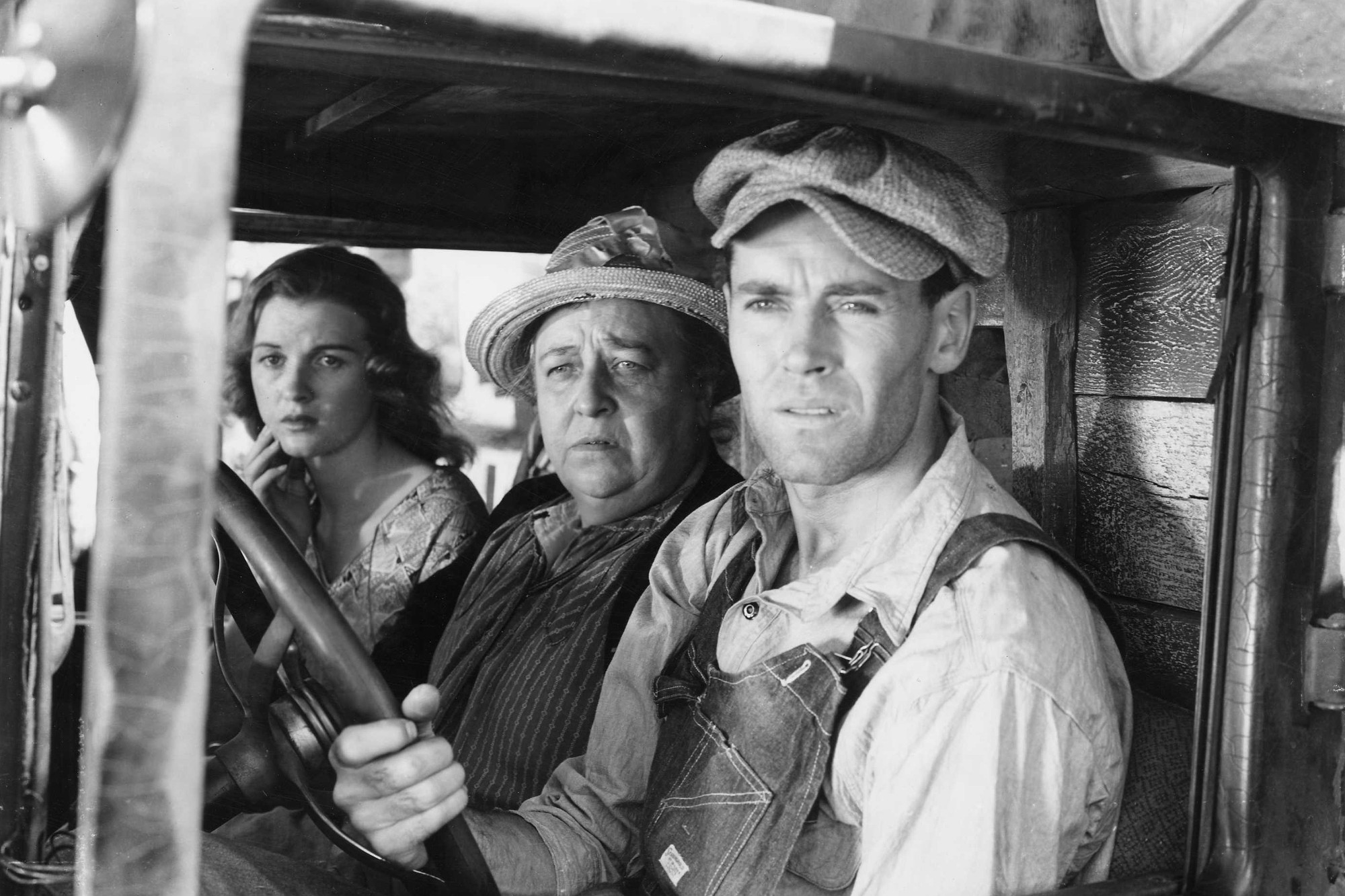
Sog.: from the eponimous novel (1939) by John Steinbeck. Scen.: Nunnally Johnson. F.: Gregg Toland. M.: Robert Simpson. Scgf.: Richard Day, Mark-Lee Kirk. Mus.: Alfred Newman. Int.: Henry Fonda (Tom Joad), Jane Darwell (mamma Joad), John Carradine (Casy), Charley Grapewin (nonno Joad), Dorris Bowdon (Rosasharn Rivers), Russell Simpson (papà Joad), O.Z. Whitehead (Al Joad), John Qualen (Muley Bates), Eddie Quillan (Connie Rivers), Zeffie Tilbury (nonna Joad). Prod.: Nunnally Johnson, Darryl F. Zanuck per 20th Century-Fox Film Corp. DCP. D.: 129’. Bn.
Edition History
Having passed his trial by fire, young Mr. Lincoln figures he’ll go on a bit, “maybe to the top of that hill”, while a thunderstorm gathers. A year later, the outlaw Tom Joad leaves our field of vision in much the same manner. The book he has sprung from is John Steinbeck’s The Grapes of Wrath (1939). And the actor who plays him will, another 40 years later, make a private drawing of that opened book, with a magnifying glass highlighting one paragraph: “On the highways the people moved like ants and searched for work, for food. And the anger began to ferment”. From the journal of Bertolt Brecht, 22 January 1941: “We see the film of Steinbeck’s The Grapes of Wrath. You can still see that it must be a great book, and the entrepreneurs probably did not want to ‘take all the strength out of it’. […] The whole thing is an interesting mixture of the documentary and the private, the epic and the drrramatic [sic], the informative and the sentimental, the realistic and the symbolic, the materialistic and the idealistic”. From the writings of Andrew Sarris, 18 October 1973: “After being overrated in its time as a social testament, it is now underrated both as a Hollywood movie (not glossily mythic enough) and as a Ford memento (not purely personal enough). What does stand up to every test of time, however, is Henry Fonda’s gritty incarnation of Tom Joad, a volatile mixture of prairie sincerity and snarling paranoia. […] His physical and spiritual stature is not that of the little man as victim, but of the tall man as troublemaker. His explosive anger has a short fuse and we have only his word for it that he is tough without being mean. Indeed, it is mainly his awkwardness in motion that suggests his vulnerability. His putatively proletarian hero becomes ominously menacing in that shadowy crossroads where social justice intersects with personal vengeance”. From the songbook of Bruce Springsteen’s The Ghost of Tom Joad, 21 November 1995: “Highway patrol choppers comin’ up over the ridge. […] Welcome to the new world order. Families sleepin’ in the cars in the Southwest. No home no job no peace no rest”.
Alexander Horwath

by concession of Park Circus
“I’ve done my damnedest to rip a reader’s nerves to rags,” John Steinbeck told the publisher of The Grapes of Wrath; “I don’t want him satisfied.” These are not sentiments one expects Hollywood to endorse, especially at Shirley Temple’s studio. Yet such was the impact of Steinbeck’s novel that Darryl F. Zanuck, Twentieth Century-Fox’s production chief, was swiftly able to oversee an adaptation more faithful than any observer expected. American critics approached ecstasy on the film’s release. Frank Nugent (The New York Times) immediately detected a masterpiece. Steinbeck himself thought it a “hard, straight picture in which the actors are submerged so completely that it looks and feels like a documentary film”. All this was understandable. In 1940 the experience of the Dust Bowl migration, experienced by Steinbeck’s fictional Joad family, was still raw. And the film’s qualities are undeniable. Fierce sun and shadow and Gregg Toland’s finesse make for extraordinary photography, but nothing coalesces into pretty pictures. You can’t shake off the grim reality of the Joad jalopy rattling down Route 66 towards exploitation and degradation in California’s promised land.
Yet we don’t have to be like the film’s screenwriter Nunnally Johnson, who said his assignment made him feel he was “carrying the Holy Grail”. The Grapes of Wrath is a film of tensions and contradictions. Some points made are needle-sharp, others are muffled. Toland’s piercing imagery of sky, flat plains, and road can suddenly give way to actors in the studio, trapped inside that hollow space that all cycloramas impose. And reality does get compromised. The government-run migrant camp belongs in heaven, with its Roosevelt-lookalike leader benign, unruffled, and always in clean white pants.
Where in all this is John Ford? Not in the sharper socio-political elements lifted from Steinbeck’s book. His heart is with Tom Joad and Ma, the migrants’ community spirit, and his actors. In Henry Fonda’s Tom moral fervour, brashness, and decency are powerfully blended. Physically, Jane Darwell bears no resemblance to Steinbeck’s Ma, thin and pinched. Ford’s version is an indomitable Mother Earth, given to sentimentality in cadence if not in the words actually uttered. Yet in many key scenes there is nothing suffocating about her; certainly not when she wistfully toys with her earrings in a faded mirror, or ponders how to feed her family as well as a camp’s starving children. Compromises and blips accepted, The Grapes of Wrath can still hit the bull’s eye.
Geoff Brown