[MOVIE]
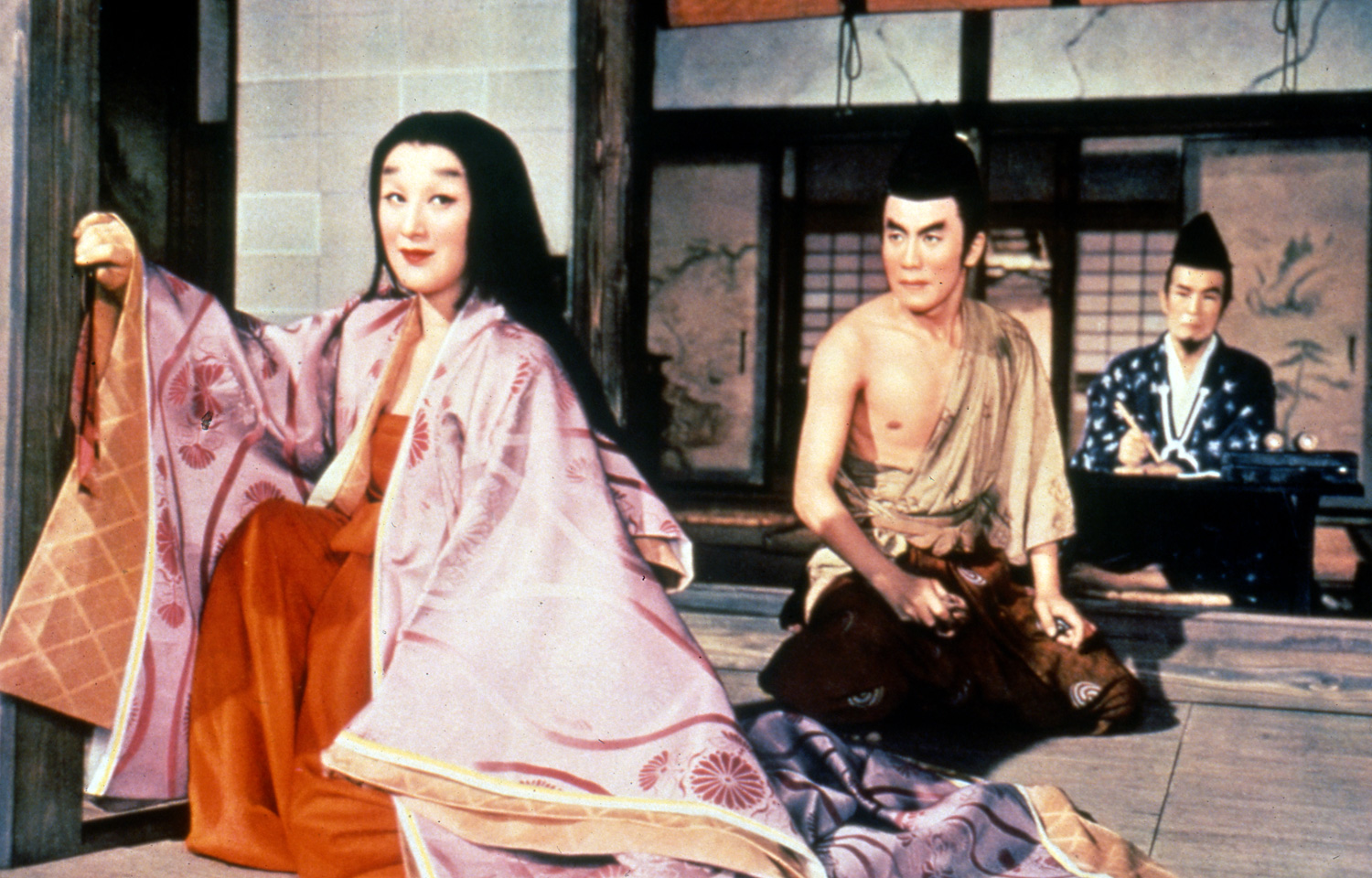
Sog.: dal romanzo omonimo di Eiji Yoshikawa. Scen.: Masashige Narusawa, Hisakazu Tsuji, Yoshikata Yoda. F.: Kazuo Miyagawa. Scgf.: Hiroshi Mizutani. Mus.: Fumio Hayasaka. Int.: Raizo Ichikawa (Kiyomori), Narutoshi Hayashi (Torodai), Tatsuya Ishiguro (Tokinobu), Michiyo Kogure (Yasuko), Yoshiko Kuga (Tokiko), Akitake Kono (Heiroku), Tamao Nakamura (Shigeko), Shunji Natsume (Imperatore Toba), Ichijiro Oya (Tadamori), Mitsusaburo Ramon (Ryokan). Prod.: Daiei. DCP. Col.
Edition History
Mizoguchi made only two films in colour, both in 1955, the year before his death. While Yokihi (Princess Yang Kwei Fei) was a co-production with the Hong Kong based Shaw Brothers and retold a famous historical incident from medieval China, Shin Heike Monogatari was a domestic production set in Japan at the end of the Heian era, a time when the country was racked by civil war between the rival Taira and Minamoto clans. Based on a novel by Eiji Yoshikawa, a writer famous for his revisions of literary classics as well as for an epic novel based on the life of renowned swordsman Musashi Miyamoto, it is a retelling at more than one remove of the medieval epic Heike Monogatari (Tales of the Taira Clan), which relates the decline and fall of the Taira Clan. In place of the medieval original’s stress on impermanence and karmic retribution, Mizoguchi brings to his film the confident rationalism of the early postwar era.
The film is one of Mizoguchi’s most beautiful and decorative films, but its style is also supremely functional, with the colour expertly used to convey mood and tone. According to cinematographer Kazuo Miyagawa, Mizoguchi “always used colour as an element in the overall design. For instance, Kiyomori, before leaving for battle, is very angry; at this time, the gate behind him is a ferocious red. Red was the colour for anger. Blue, for sadness, just as much as black”. When the film was screened in the United States, New York Times critic Eugene Arthur praised its “lyrical pastel compositions”, and noted that “the cruel bald monks, the violent warriors, the weak and frightened ruling aristocrats are as vividly differentiated by the shades of their costumes as by their primitive behavior”.
Mizoguchi’s penultimate film was a key early step in another illustrious career: that of star Raizo Ichikawa, seen here in his second film. With his good looks and sensitive yet charismatic persona, he would go on to be a leading Japanese star until his untimely death from cancer in 1969.

Restored by National Film Center
<!--
@page { margin: 2cm }
P { margin-bottom: 0.21cm }
-->
Mizoguchi made only two films in colour, both in 1955, the year before his death. While Yokihi (Princess Yang Kwei Fei) was a co-production with the Hong Kong based Shaw Brothers and retold a famous historical incident from medieval China, New Tales of the Taira Clan was a domestic production set in Japan at the end of the Heian era, a time when the country was racked by civil war between the rival Taira and Minamoto clans. Based on a novel by Eiji Yoshikawa, a writer famous for his revisions of literary classics as well as for an epic novel based on the life of renowned swordsman Musashi Miyamoto, it is a retelling at more than one remove of the medieval epic Heike Monogatari (“Tales of the Taira Clan”), which relates the decline and fall of the Taira Clan. In place of the medieval original’s stress on impermanence and karmic retribution, Mizoguchi brings to his film the confident rationalism of the early postwar era.
The film is one of Mizoguchi’s most beautiful and decorative films, but its style is also supremely functional, with the colour expertly used to convey mood and tone. According to cinematographer Kazuo Miyagawa, Mizoguchi “always used colour as an element in the overall design. For instance, Kiyomori, before leaving for battle, is very angry; at this time, the gate behind him is a ferocious red. Red was the colour for anger. Blue, for sadness, just as much as black”. When the film was screened in the United States, “New York Times” critic Eugene Arthur praised its “lyrical pastel compositions”, and noted that “the cruel bald monks, the violent warriors, the weak and frightened ruling aristocrats are as vividly differentiated by the shades of their costumes as by their primitive behavior”.
Mizoguchi’s penultimate film was a key early stage in another illustrious career: that of star Raizo Ichikawa, seen here in his second film. He would go on to be a leading Japanese star until his untimely death in 1969.