[MOVIE]
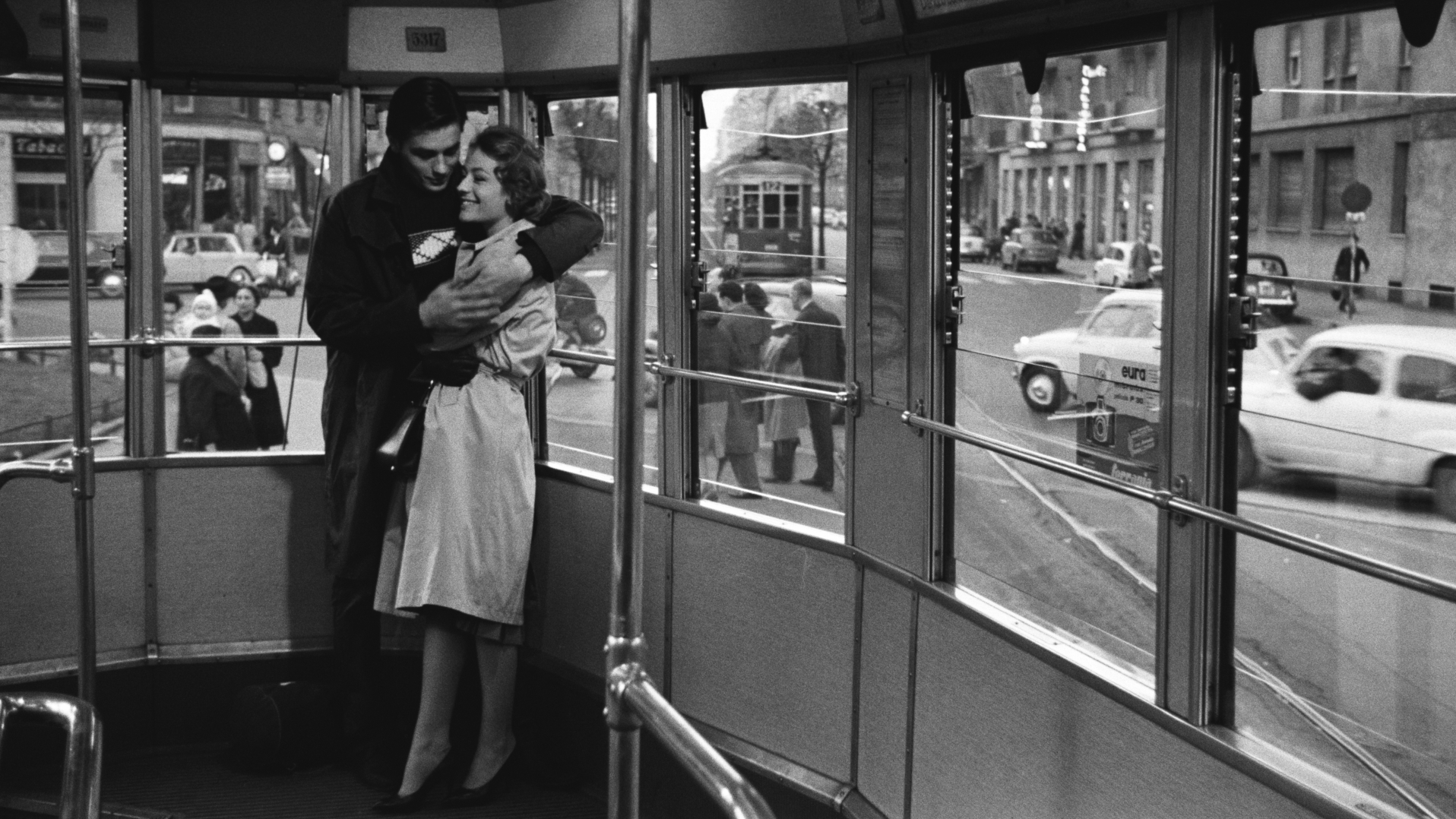
Sog.: Luchino Visconti, Vasco Pratolini, Suso Cecchi d’Amico. Scen.: Luchino Visconti, Suso Cecchi d’Amico, Pasquale Festa Campanile, Massimo Franciosa, Enrico Medioli. F.: Giuseppe Rotunno. M.: Mario Serandrei. Scgf.: Mario Garbuglia. Mus.: Nino Rota. Int.: Alain Delon (Rocco Parondi), Annie Girardot (Nadia), Renato Salvatori (Simone Parondi), Katina Paxinou (Rosaria Parondi), Roger Hanin (Duilio Morini), Paolo Stoppa (Cerri), Suzy Delair (Luisa), Claudia Cardinale (Cinetta Giannelli), Spiros Focas (Vincenzo Parondi), Max Cartier (Ciro Parondi), Corrado Pani (Ivo), Rocco Vidolazzi (Luca Parondi). Prod.: Titanus, Films Marceau · DCP. Bn.
Edition History
Dear Visconti, I have just seen Rocco e i suoi fratelli in a cinema on Second Avenue. The emotion was overwhelming. As Luca walked into the distance against the clear backdrop of Milan, there were, in the cinema, several people crying. When the lights came up, we – several friends and I – sat in silence, without looking at one another, unable to utter a single word, while all around us you could hear the same comment: “Wonderful”. Then we left, still unable to speak, and when we looked each other in the eye, we all felt a strong urge to embrace, a piercing desire to survive somehow – in the best way possible – the three hours we had just sat through.
Romano Giachetti, Luchino Visconti. Epistolario 1920-1961, edited by Caterina d’Amico de Carvalho and Alessandra Favino, Edizioni Cineteca di Bologna, Bologna 2024
Today, Rocco e i suoi fratelli is considered one of the masterpieces of Italian cinema. Yet during its making and after its release, it was opposed in every way possible by the forces of the then-government, becoming a matter on which Italian public opinion clashed. In a climate of heated political fervour and profound change, Visconti feels the need to take up once again, as he had in his earlier films, the question of society, beginning from “La terra trema – my interpretation of I Malavoglia – of which Rocco is almost the second episode”. Although hailed upon its release as Visconti’s return to neorealism, it is notthat at all: Rocco e i suoi fratelli is a tragedy in five acts, each of which takes the name of one of the sons (Vincenzo, Simone, Rocco, Ciro, Luca). It is the exploration of the individual fates of the five Parondi brothers, where each one will choose his own destiny. Favoured protagonists are, once again, the vanquished, but here the defeated are not just individuals: a civilisation is about to be annihilated. Italy, Visconti observes, is a divided country, the Southerners coming North are not brothers, but foreigners. The Milan given to us by the Milanese Visconti, observing it through migrant eyes, is an expressionist, inhospitable, hazy city where the public housing, the gyms and the parks are theatrical backdrops, devoid of humanity. Milan, the city of the North, the most advanced city in the country, is the home to irreconcilable social conflicts and is above all a cursed city, one that changes people for the worse. The final extreme long-shot of Luca walking away from the gates of the Alfa Romeo factory and from the progressive speeches of his employed brother Ciro, seems to leave no doubt as to what Visconti really thinks. Encapsulated in progress devoid of history, like the great Renaissance paintings we see entrapped inside the television screen, Italy and what remains of the Parondi family are moving towards a future without roots or beauty.
Gian Luca Farinelli



Restored in 4K by Cineteca di Bologna in collaboration with Titanus, TF1 Droits Audiovisuels and The Film Foundation at L’Immagine Ritrovata laboratory, from the original 35mm camera negative. Several parts of the negative were so badly damaged by mold that they had to be replaced with sections from a vintage dupe positive. After the film’s debut at the Venice Film Festival in 1960, two shots were cut by order of the public prosecutor’s office and the board of censors. In this restored version, both sequences are been recovered. A previously removed scene from the last reel, found in the firstgeneration print preserved by ASAC, has also been included. Grading supervised by director of photography Giuseppe Rotunno. Funding provided by GUCCI and The Film Foundation
Today, Rocco e i suoi fratelli is considered one of the masterpieces of Italian Cinema. Yet during its making and after its release, it was opposed in every way possible by the forces of the then Government, becoming a matter on which Italian public opinion clashed, and was split. At the beginning of the 1960s, the Italian political scene sees the centre-right government in crisis and the growth of the Socialist Party. The social and cultural transformation that society is undergoing is behind a political change that will bring about, in 1962, the first centre-left government. It is at this crucial moment that there is an explosion of ideological conflicts, violent reactions and debates between conservatives and progressives. The cinema becomes a major battleground.
In this climate of heated political fervour and profound change, Visconti feels the need to take up once again, as he had in his earlier films, the question of society, beginning from “La terra trema – my interpretation of I Malavoglia – of which Rocco is almost the second episode”.
Starting from the work of Giovanni Testori, Visconti filters it with many, diverse suggestions; he is inspired by Joseph and His Brothers by Thomas Mann (from which the film’s title is modelled) and uses character traits taken from The Idiot by Dostoevskij. But he also draws on many elements from Southern Italian literature; besides Verga, Christ Stopped at Eboli by Carlo Levi, Contadini del Sud by the Lucanian poet and writer Rocco Scotellaro, to whom the director will pay homage in the name of his protagonist. This assemblage of multiple, and at times contradictory literary sources reaches its melting point in the melodrama, and in Visconti’s predilection for absolute contrasts.
Although hailed upon its release as Visconti’s return to neo-realism, it is not that at all: Rocco and His Brothers is a tragedy in five acts, each of which takes the name of one of the sons (Vincenzo, Simone, Rocco, Ciro, Luca), it is the exploration of the individual fates of the five Parondi brothers, where each one will choose his own destiny.
Favoured protagonists are, once again, the vanquished, but here the defeated are not just people, it is a civilisation about to be annihilate. The theme of a family self-destructing in an internecine struggle between brothers, which will further be explored in La caduta degli dei and was in some way present in La terra trema, is one of the centres of the film and is mainly dealt with by Visconti in the dramatic contrast between Rocco and Simone, and the killing of Nadia. The extent of his enormous talent is on show in the principal scenes, the violent clashes and in the tight dialogue, particularly those between the three protagonists, complementary characters whose tragic presence constantly expresses the difficulty of living in the North, in an inhuman society. The film alsorecounts, for the first time, the struggle between the Milanese and the Southerners. Italy, Visconti observes, is a divided country, the Southerners coming North are not brothers, but foreigners. As he will write when presenting it, the film follows the fortunes “of a humanity and a civilisation which, having had but crumbs from the great feast of the so-called economic miracle of Italy, is still waiting to come out from a moral and spiritual isolation founded on a typical Italian prejudice that continues to keep the south of Italy in an inferior condition compared to the rest of the nation”. The Milan given to us by the Milanese Visconti, observing it through migrant eyes, is an expressionist, inhospitable, hazy city where the popular housing, the gyms and the parks are theatrical backdrops, devoid of humanity. Milan, the city of the North, the most advanced city in the country, is the home to irreconcilable social conflicts and is above all a cursed city, one that changes people for the worse.
The final extreme long-shot of Luca walking away from the gates of the Alfa Romeo factory and from the progressive speeches of his employed brother Ciro, seems to leave no doubt as to what Visconti really thinks: encapsulated in progress devoid of history, like the great Renaissance paintings we see entrapped inside the television screen, Italy and what remains of the Parondi family are moving towards a future without roots or beauty.
Gian Luca Farinelli
Restored in 4K by Cineteca di Bologna in association with Titanus, TF1 Droits Audiovisuels and The Film Foundation at L’Immagine Ritrovata laboratory. Restoration with funding provided by Gucci and The Film Foundation.
Several areas of the negative were so badly damaged by mold that they had to be replaced with sections from a vintage dupe positive. After the film’s debut at the Venice Film Festival in 1960, two shots were edited by order of the public prosecutor’s office and the board of censors. In this restored version, both sequences are unabridged. A previously removed scene from the last reel, found in the first-generation print preserved by ASAC, is also included in the restoration. The color correction work was supervised by Giuseppe Rotunno, the film’s original director of photography.