[MOVIE]
Edition History
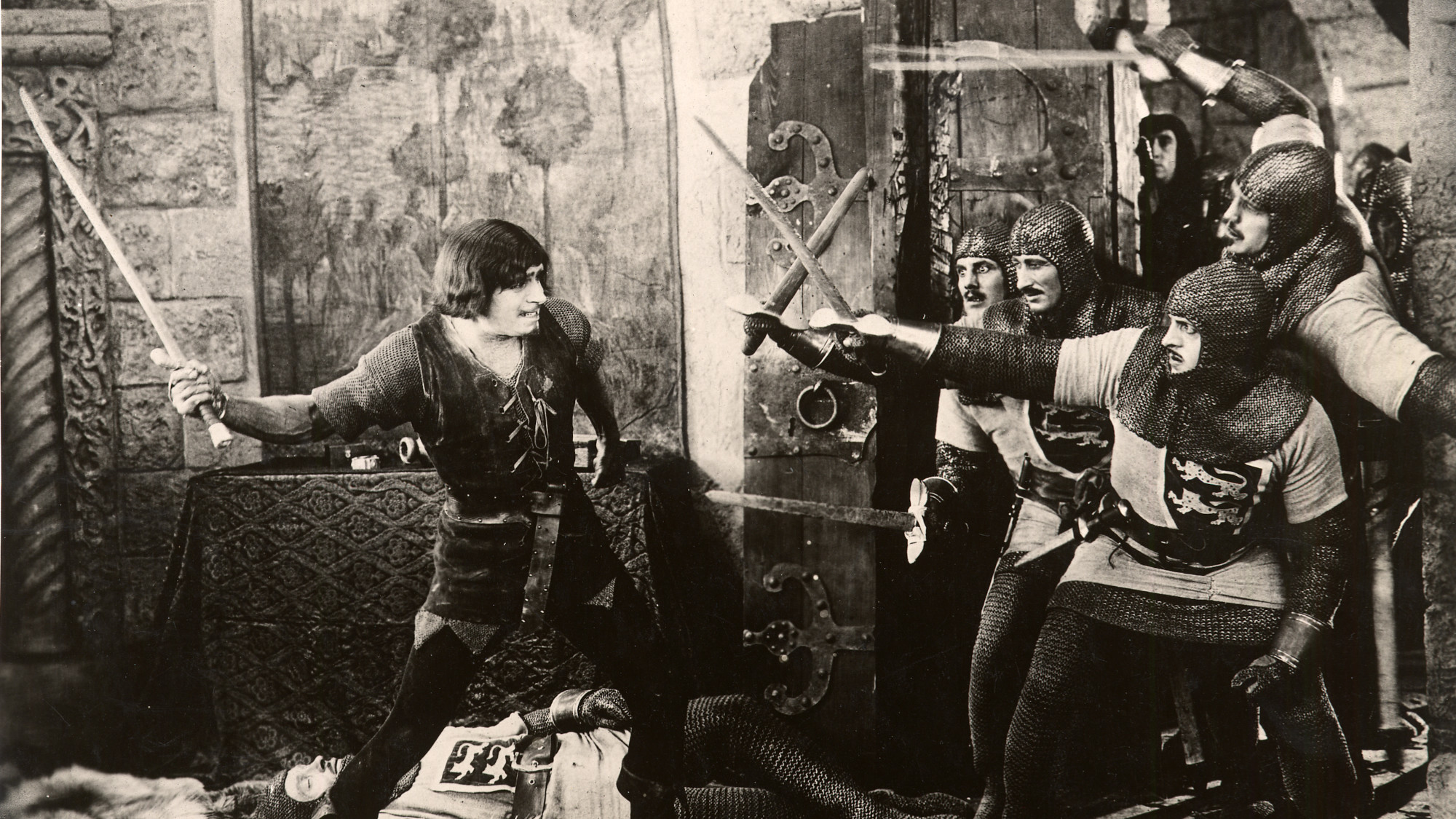
One of the most popular films of 1922, featuring the beloved rebel from Sherwood Forest – a character who had captured artists’ imaginations for centuries, inspiring medieval balladry and celluloid fantasy – was an odd take on its subject. It takes 70 minutes of screen time for the good-humoured, if stiff, Earl of Huntingdon (played by Douglas Fairbanks) to transform into Robin Hood – a long wait, though fairly well rewarded. In the meantime, director Allan Dwan keeps the audience engaged with his epic-scale reconstruction of court life, aided by Arthur Edeson’s painterly matte shots, and the fine sets, some of which were designed by Frank Wright (son of the famed architect).
Dwan plays with the contrast between the film’s two halves and gradually shifts the narrative away from the tiresome mannerisms of fair ladies and gallant gentlemen to the uninhibited joy of the people. The tyranny and pillage of England in the absence of King Richard is shown, as in medieval engravings, with graphic brutality; this hardly prepares the viewer for the exuberant, even slapstick action that follows. With no prior history, the heavily armoured Huntingdon is all of a sudden a master archer wearing Mitchell Leisen-designed tights, in which he slides down a 12-metre-long curtain and challenges Newton’s law of gravity. The characters, dwarfed by the massive sets, are liberated as their bodies start to navigate space through gymnastics and the genius of mechanical engineering. Once again, Fairbanks’s moustached grin gives life to this ballet of swords.
Every subsequent depiction of Robin Hood, including the Technicolor delight from 1938 by Michael Curtiz and William Keighley (which also borrows Alan Hale from the silent version), has stolen something from Doug and Dwan. But where else, except in silent films, could one cast Wallace Beery as King Richard of England without worrying about the roughneck gentleman slurring his lines in a Missouri accent?
Ehsan Khoshbakht

Restored by MoMA with funding provided by The Celeste Bartos Fund for Film Preservation at Cinetech laboratory, from a nitrate duplicate negative preserved at MoMA
“Robin Hood (1922) carried the same scenario credits, except that this time Fairbanks appeared under his pseudonym of Elton Thomas (his two middle names). This was the first film designed by Wilfred Buckland, who came from Belasco’s theatre, working with Langley and Robert Fairbanks, whose engineering skills were often the valuable foundation for the physical marvels which Fairbanks performed with such apparent ease after meticulous preparation. (Tables on which he had to leap, for instance, were cut down precisely to the point where no effort would be visible in the accomplishment). Fairbanks in fact revealed that he was himself keenly aware of the danger that his character could be dwarfed by the wrong setting. The castle in Robin Hood, 90 feet high and with an interior so large that it could only be lit by sunlight, is thought still to be the largest set ever built in Hollywood. It was contructed during Fairbanks’ absence in New York, and on his return he told Dwan (according to Dwan’s account, quoted by Kevin Brownlow in The Parade’s Gone By), ‘I can’t compete with that. My work is intimate. People know me as an intimate actor. I can’t work in a great vast thing like that. What would I do in there?’. Dwan showed him, by demonstrating the slide Robert Fairbanks had devised for the scene where Robin Hood, cornered on a blacony 40 feet above ground, leaps over the edge and appears to slide to safety down the fold of an enormous drape”.
(David Robinson, The Hero, cit.)