[MOVIE]
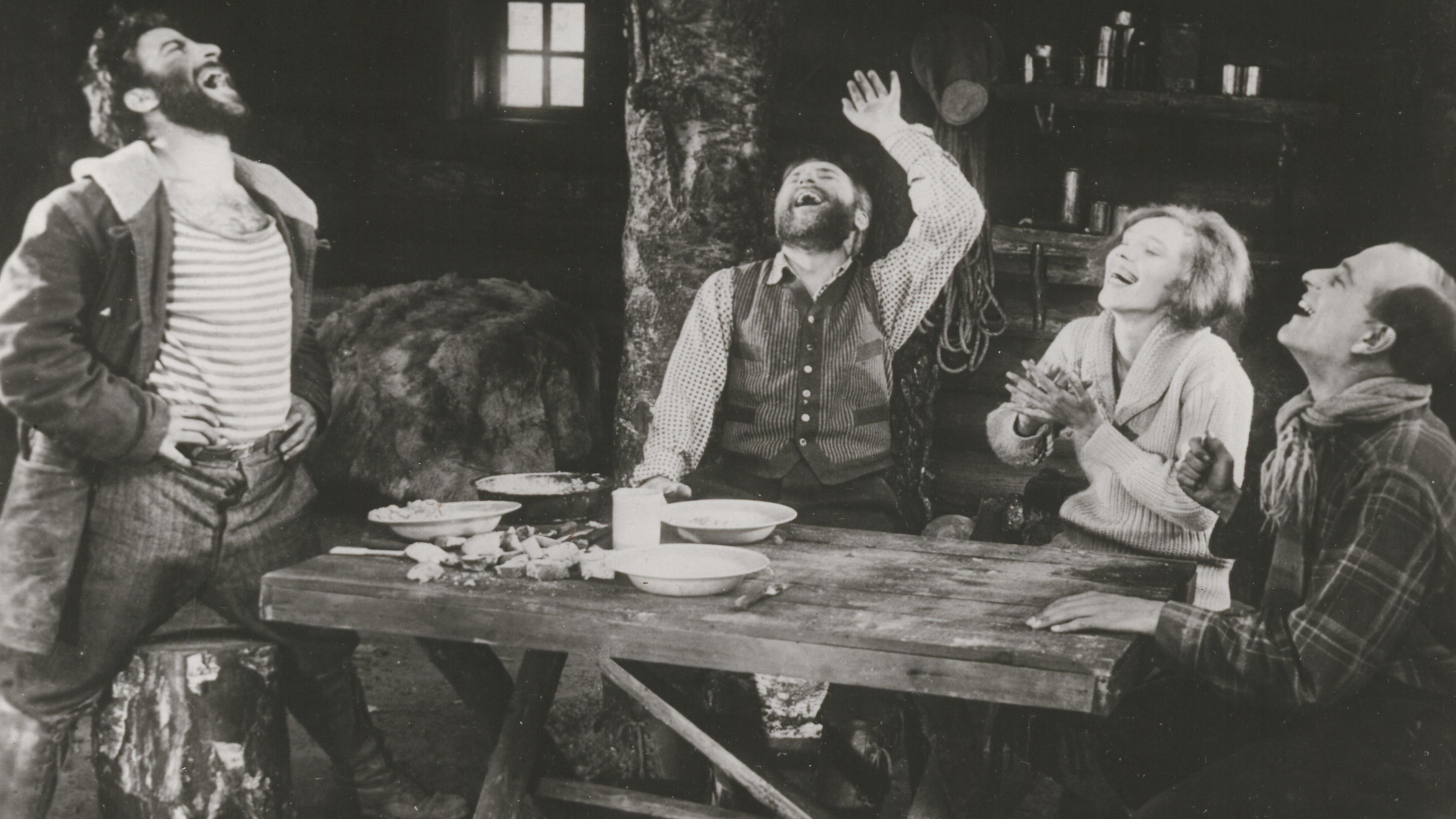
T. alt.: Dura Lex; Sog.: dal racconto di Jack London “The Unexpected”; Scen.: Lev Kulešov, Viktor Šklovskij; F.: Kostantin Kuznecov; M.: Lev Kulešov; Scgf.: Isaak Mahlis; Int.: Aleksandra Hohlova (Edith Nilsen), Sergej Komarov (Hans Nilsen), Vladimir Fogel’ (Michael Deinin), Porfirij Podobed (Detci), Petr Galadžev (Herke); Prod.: Goskino 35mm. L.: 1656 m. D.: 81’ a 18 f/s. Bn.
Edition History
The idea for this film was born in response to the all-Soviet campaign for “economizing resources.” To cut production costs, the scenario based on Jack London’s story envisaged a small number of characters and reduced the action to a few locations and a single set. Despite this purposeful minimalism and a somewhat unconvincing representation of Yukon (filmed in the early spring near Moscow) the tragic magnitude of this film speaks for itself, and it was precisely this sense of soberness that Kuleshov wanted his film to convey. Upon its release, the film caused controversy and criticism which would have repercussions in Kuleshov ‘s creative career in the 1930’s.
Ekaterina Hohlova

The mathematical precision of every gesture and movement contributes to the total effect of each character and episode. Kulešov taught his workshop that the hands, arms and legs are the most expressive parts of the film actor’s body and we can observe that their movements create as much of the film’s tension as does the facial expression. The same intensity of ‘performance’ by Hohlova and Fogel’ that amazed critics only proved how correct was Kulešov’s avoidance of ‘performance’. Even Šklovskij, who had worked in all stages of the film’s preparation, confessed, “Kulešov made more out of the film than I expected.” To paraphrase Edmund Wilson’s estimate of Turgenev, Kulešov in one film had perfected “the modern art of implying social criticism through a narrative that is presented objectively, organized economically, and beautifully polished in style”.
Jay Leyda, Kino, George Allen & Unwin, 1960