[MOVIE]
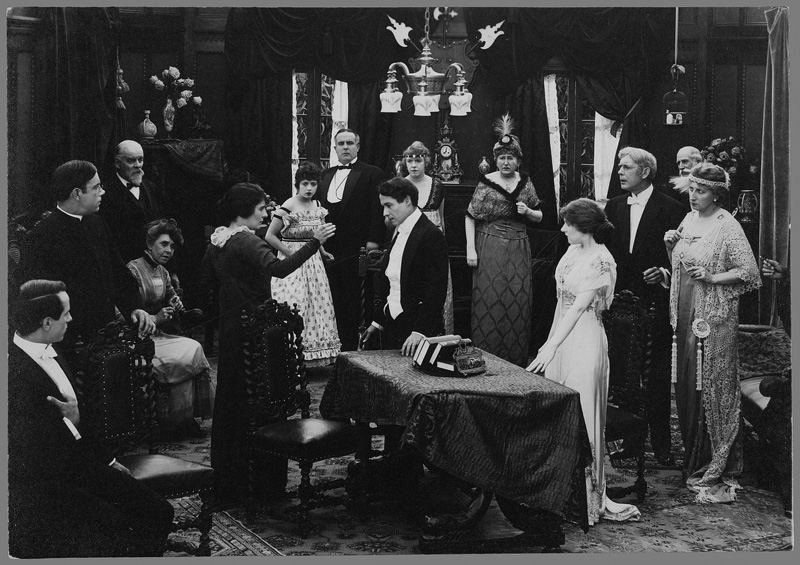
T. it.: Le colonne della società; Sog.: dal dramma “Samfundets stotter” (I pilastridella società, 1877) diHenrik Ibsen; Int.: Henry B. Walthall (Karsten Bernick), Mary Alden (Lona Tonnesen), Juanita Archer (Betty), George Beranger (Johan Tonnesen), Josephine Crowell (madre diKarsten), Olga Grey (Madame Dorf); Prod.: Raoul Walsh per Fine Arts Film Company; Pri. pro.: 27 agosto 1916 35mm. L.: 1088 m.; D.: 52′ a 18 f/s. Imbibito / Tinted.
Edition History
Pillars of Society is adapted from a drama by Henrik Ibsen, “probably the world’s best playwright” according to the instructive caption at the beginning, which reveals the basic premise of the plot: hypocrisy is the worst vice of the bourgeoisie, and only Truth and Liberty are the true pillars of correct social order. The truth is, when Ibsen wrote Pillars of Society in 1877, he wasn’t yet the world’s greatest playwright (A Doll’s House, Ghosts, and The Woman From the Sea were written one after the other in the following years), and his debut ‘social drama’ is hardly a masterpiece. Nevertheless, its tangled web of family melodrama – with missteps, faults, and unlikely redemptions – was largely appreciated: the first onscreen adaptation was in 1911, another followed in 1920, which served as a vehicle for the English stage star Ellen Terry (with the plot re-shaped to revolve almost entirely around the character of Mrs Bernick, the protagonist’s mother), and yet another version appeared in 1935 Germany – one of the first films by Detlef Sierck, who would later become Douglas Sirk. And Walsh? Walsh, in 1916, was in the middle of his Hollywood climb. Pillars of Society can’t boast “the dramatic power of Regeneration” (Paolo Cherchi Usai), the redemption tragedy with Anna Q. Nilsson directed by Walsh the year before, but it does show a confident composition and even a grasp of international culture, especially with regards to the detailed, overloaded, and rather grim set design that gives it the look of a Northern European melodrama (perhaps with a slight touch of parody?). The screenplay by Frank E. Woods, known for his collaboration with Griffith on A Corner in Wheat and Birth of a Nation, re-aligns the timing that Ibsen laid out as a series of flashbacks, making it easier to follow the adventures of this man without qualities – more fearful than corrupt – dominated by a series of interesting feminine figures, a circumstance that will reappear in Walsh’s later, more virile and auteurish films: here our hero, secretly engaged to a neighbor, goes to enjoy the good life in Paris where he is seduced by an actress who overshadows him in both stature and temperament, then returns and, forced by his mother as well as economic and social reasons, decides to marry the sister of his secret fiancée – who justifiably rewards him with a good slap and, from then onwards, looms over him like a severe guardian angel of his questionable morality… More than once source indicates that the film was ‘supervised’ by David W. Griffith. If so inclined, one could also suspect that the film anticipates or shares the same atmosphere of DeMille’s moral dramedies, which will examine marriage, adultery, and money in terms of social structures – with an higher degree of irony and modernity.
(Paola Cristalli)

Print restored by The Library of Congress at L’Immagine Ritrovata laboratory from a nitrate positive tinted print
Norwegian shipping magnate Karsten Bernick prides himself on his value to society, and forgets that, in order to maintain his high standing, he has to rely on lies and dishonesty. Years before achieving wealth and social status, he had an affair with Madame Dorf, resulting in a daughter. At the time, Karsten, who was about to leave the Country, convinced his brother-in-law Johan to accept responsibility as the child’s father. Later, when Madame Dorf died, Karsten adopted the child, but remained terrified that one day the child might find out the truth. Years later Johan decides to return to Norway hoping to clear his name. Desperate that his secret will be revealed, Karsten decides to kill Johan by putting him on his most unseaworthy ship. But the plan backfires when Johan boards a different vessel, and Karsten’s son Olaf stows away on the unsafe one. Fate favors the rescuers, who are able to save Olaf, but Karsten, unable to continue lying, finally confesses to being his adopted daughter’s real father.
Note: The Thanhouser Co. made a short film of Ibsen’s play in 1911, and Douglas Sirk directed Stuztzen der Gesellschaft, a German adaptation of the play in 1935 for R.N. Film der Ufa.
Kim Tomadjoglou, American Film Institute

Print restored by the Library of Congress at L’Immagine Ritrovata from a nitrate positive tinted print