[MOVIE]
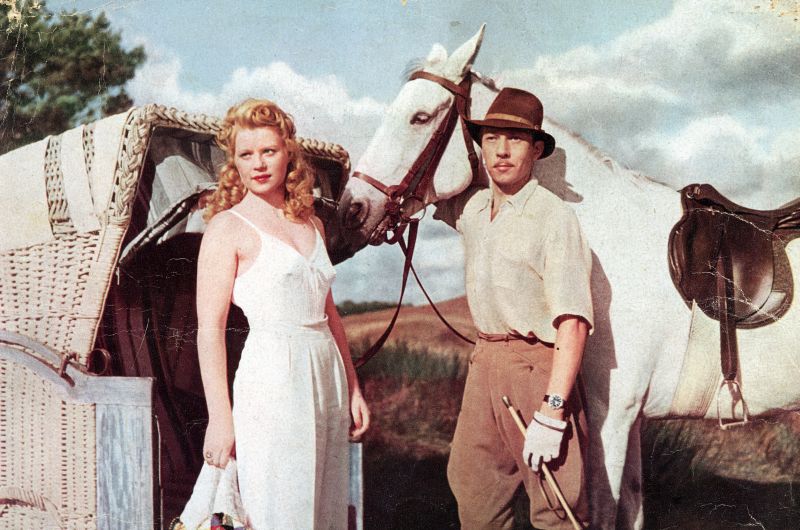
Sog.: dal romanzo di Rudolf G. Binding; Scen.: Veit Harlan, Hans Radtke; F.: Bruno Mondi; Mo.: Friedrich Karl von Puttkamer; Scgf.: Eric Holder; Mu.: Hans-Otto Borgmann; Su.: Heinz Martin; Int.: Carl Raddatz (Albrecht Froben), Kristina Söderbaum (Äls Flodéen), Irene von Meyendorff (Octavia Froben), Franz Schafheitlin (Matthias), Ernst Stahl-Nachbaur (Terboven), Otto Treßler (Senatore Froben), Annemarie Steinsieck (Sig.ra Froben), Edgar Pauly (domestico), Charlotte Schultz (bambinaia), Ludwig Schmitz, Frida Richard (Sig.ra Steinhamp), Paul Bildt; Prod.: Universus Film (UFA); Pri. pro.: 2 ottobre 1944
35mm. L.: 2552 m. D.: 93′. Col.
Some could claim that the film has a Nazi ideological background, nonetheless, form wise Opfergang is one of the most beautiful melodramas of the 1933-1945 period. It is true that the characters are overly characterized: but are not they systematically so in this genre of film? Curiously enough, the theme of adultery is the film’s main argument, even though a subject of this kind was not particularly welcome among Nazi themes. As a result, Harlan goes as far as implicitly accepting this “ménage à trois” when, almost at the end of the film, Octavia goes in her husband’s stead to see Aels. All of this is part of the great mélo tradition, which lacks nothing: opulent homes, the heroine playing the piano in a middle-class interior… Perhaps Harlan, who evades all warlike ideology in this film, should be chastised for certain childish effects; it is, however, a typically Germanic work that adheres to popular themes, which are not necessarily our own. Shot in 1944, in the midst of all the chaos, the film provided a kind of sublimated dream that was a last refuge for the German spectator, who was living a true nightmare for which he was partially responsible.
Daniel Collin, Guide des films, edited by Jean Tulard, Robert Laffont, Paris 1990