[MOVIE]
Sc.: Charles Chaplin. F.: Roland Totheroh, Ira Morgan. In.: Charles Chaplin (l’operaio), Paulette Goddard (l’orfana), Henry Bergman (il padrone del ristorante), Chester Conklin (il capomeccanico), Stanley J. Sanford, Hank Mann, Louis Natheaux (i ladri), Allan Garcia (il direttore della fabbrica), Lloyd Ingraham (il direttore della prigione), Stanley Blyston, Sam Stein, Juana Satton, Jack Low, Walter James, Dick Alexander, Dr. Cecil Reynolds, Myra McKinney, Heinie Conklin, John Rand, Murdoch McQuarrie, Wilfred Lucas, Edward le Saint, Fred Maltesta, Ted Oliver, Edward Kimball. P.: Chaplin – United Artists. 35mm. L.: 2400 m. D.: 88’ a 24 f/s
Edition History
“Modern Times is the film of the twentieth century, a creation encompassing happiness and nightmare, freedom and alienation, man’s condition and point of view on what was happening around him in the time he was living”, wrote Peter von Bagh. “It is masterfully minimalist, a film that opens new horizons, a leap into the unknown and cruelty”.
That cruelty was new and Kafkaesque. The adversary is not a bully or the local police, who in the end are still human, but something larger as Ejzenštein noted, “The big one beats the little one. He is beaten up. At first man by man. Then more man by society.” The perfect point of convergence between the character of the Tramp and collective history, Modern Times flawlessly combines Chaplin’s humanism with his previous film work. When asked about his new role as a political filmmaker, Chaplin answered, a few months before the movie’s release, “I do not intend to deal with any political or social issue with my film. My heroes are factory workers. My character is man. I never christened him; he does not have a name: he is man”.
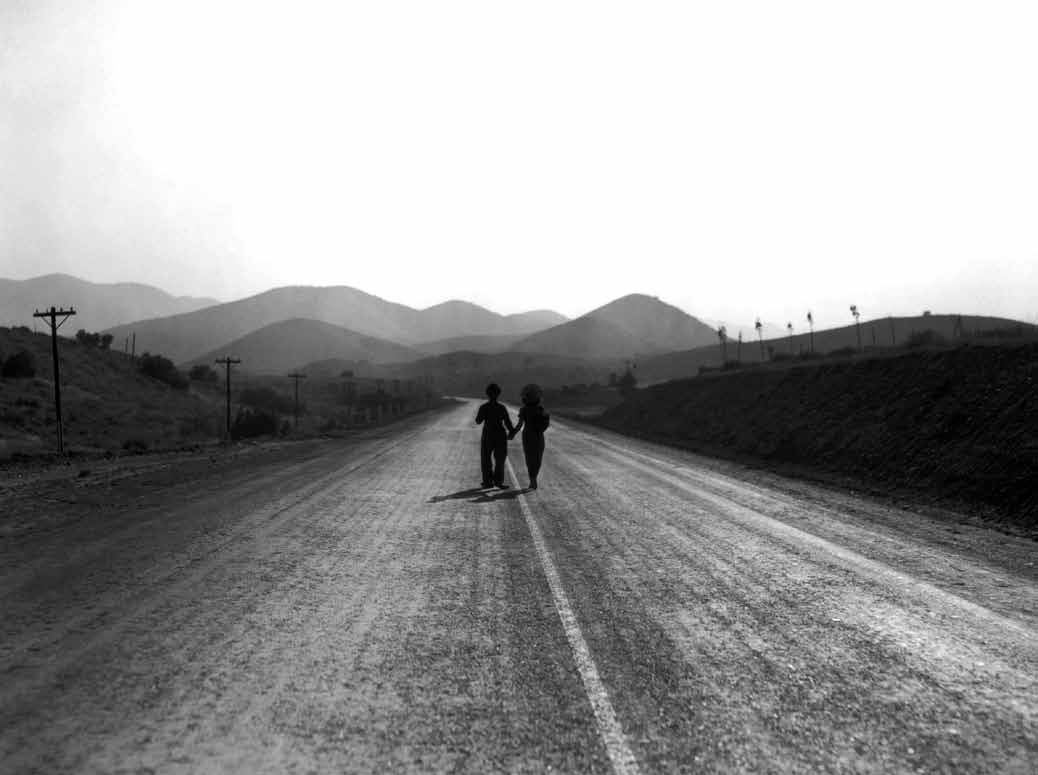
According to the opening title, the film’s purpose is to tell a “story of industry, of individual enterprise – humanity crusading in the pursuit of happiness”, and that purpose is crystallized in two symbolic images that, if put in a time capsule, could illustrate the twentieth century to those who were not born in it: the Tramp/factory worker stuck in the gears of the machine is – “ both a hand-painted landscape of the modern soul and a psychiatric close-up. A cubist tableau” – while the Tramp and the Gamin on the road – for von Bagh – is probably the most complete image of human happiness ever created on screen.
Cecilia Cenciarelli
Restored by Cineteca di Bologna and The Criterion Collection at L’Immagine Ritrovata laboratory. Music composed by Charles Chaplin, restored and directed by Timothy Brock
“Chaplin in Modern Times made a model-demythicization of homo technologicus, opposing himself to it in the only way that appears possible; that is, as the survivor of a preindustrial humanity. Having entered into a factory Chaplin contradicted technology (and thus made it become part of his linguistic-expressive world), since he, surviving from another civilization and conserving its customs, madly and comically emphasized the inexpressiveness of the world of technology. The stylistic technique of Modern Times, in my opinion, has not been surpassed. Theoretically it could be said that such a contradiction (the expressiveness of Chaplin against the inexpressiveness of the machines) should be ideologized today by presenting the expressive man no longer as survival but as evolution: it was (a manual would say) the point of view of the worker – elaborated and complicated, so far as we are concerned, by the writer – who has projected into reality, demystifying it, the capitalistic industrialization of the world: so it should still be the point of view of the worker to demystify technicization”.
Pier Paolo Pasolini, Comments on Free Indirect Discourse (1965) (extract), in Id., Empirismo eretico, Garzanti, Milano, 1972

Music by Charles Chaplin, conducted by Timothy Brock, played by Orchestra of Teatro Comunale di Bologna
Chaplin usually noted down the ideas to be developed in the film, both by imagining the general atmosphere of the situation and by describing in detail the gags and the characters’ entrances on scene, their movements and their facial expressions. Hundreds of typed pages document the incessant work of revising and perfecting the film, showing what it means to “think up and plan a film”. The Story Notes, presumed to have been written between 1931 and 1934, give an account, though somewhat fragmentary, of the various stages the story went through and of later modifications made in many scenes in the film2. Analysis of these documents thus allows for the first Chaplin gags on “modern” to be recovered, free from even the slightest mediation or compromise.
By looking at the production report, a precious document where day by day shooting was recorded and described in detail from October of 1934 to August of 1935, it can instead be seen how Chaplin’s initial ideas managed to pass unscathed through the cogs of the “great production machine”.
Afterthoughts and notes written in the margin of a scene – which philologists would define as “authored variants” – enrich the Story Notes, as well as the cutting continuity and the list of intertitles, bringing to light a sort of “work before the work”.
Among the documents found in Paris, some of them show different titles. One story that has much in common with the definitive version of Modern Times is entitled The Commonwealth. The copious meanings of “Commonwealth” make the word quite suited to the ironic intent of the film: in addition to the primary meaning “confederation, independent community” (a body of people politically organized into a state), in the past the term was used to designate “public well-being” (common-wealth where wealth stands for well-being)!
It seems that Chaplin enjoyed the use of paradox, as he chose The Masses as the second variation on the title, even though the protagonist of the events is an often marginalized tramp who finds himself, involuntarily and completely by chance, representing the working class or being integrated into a group.
Social attention is just as present in the film as it is in the scripts that precede it, but a lively interest in the economic system and its traps can be discovered in the examined documents.
The Story Notes for Modern Times state: “Fade in on telegram which reads: Market price of bananas ruinous, due to oversupply. Destroy new shipment”. A man near the ship is reading the telegram. He then throws it down and begins to follow the order. The Gamine picks up the telegram and reads it, then deciding to steal the fruit to feed herself as well as distributing it to the children at the port, something we also see in the film except that the telegram scene is cut! This changes notably the sense of the theft. (…) Elaboration – the “variant” game – is not limited to a simple polishing job. It is instead a constantly moving creation, which can be identified through new and decisive intuitions. The poetic idea of the film is gained moment by moment, on the page, through the words, then in the images, while filming. (Anna Fiaccarini, in Cinegrafie, n. 13, 2000)
Composing film music is a time-consuming, often unrecognized art form that only a handful of people on earth in 1935 were doing very well. Yet his music, seamlessly woven into the fabric of the film’s imagery, is elemental to the film’s long running success. Chaplin had achieved a miracle in his score to Modern Times.
To notate his music, he engaged various arrangers and orchestrators who would in turn write down his thematic material and orchestrate it to his exacting standards. The color of the orchestration was very clear in Chaplin’s mind, and it took great efforts to ensure what was down on paper correlated with what he, as composer, had in mind. Regardless of which arranger he was working with on any given film, there is a running line throughout. (…) The score to Modern Times is the most strong, complex, and innovative score in his entire opus. It is a vast palette of musical intricacies and bold symphonic statements that mirror not only the film’s content, but musically symbolize its message (Timothy Brock, in Cinegrafie n. 13, 2000)