[MOVIE]
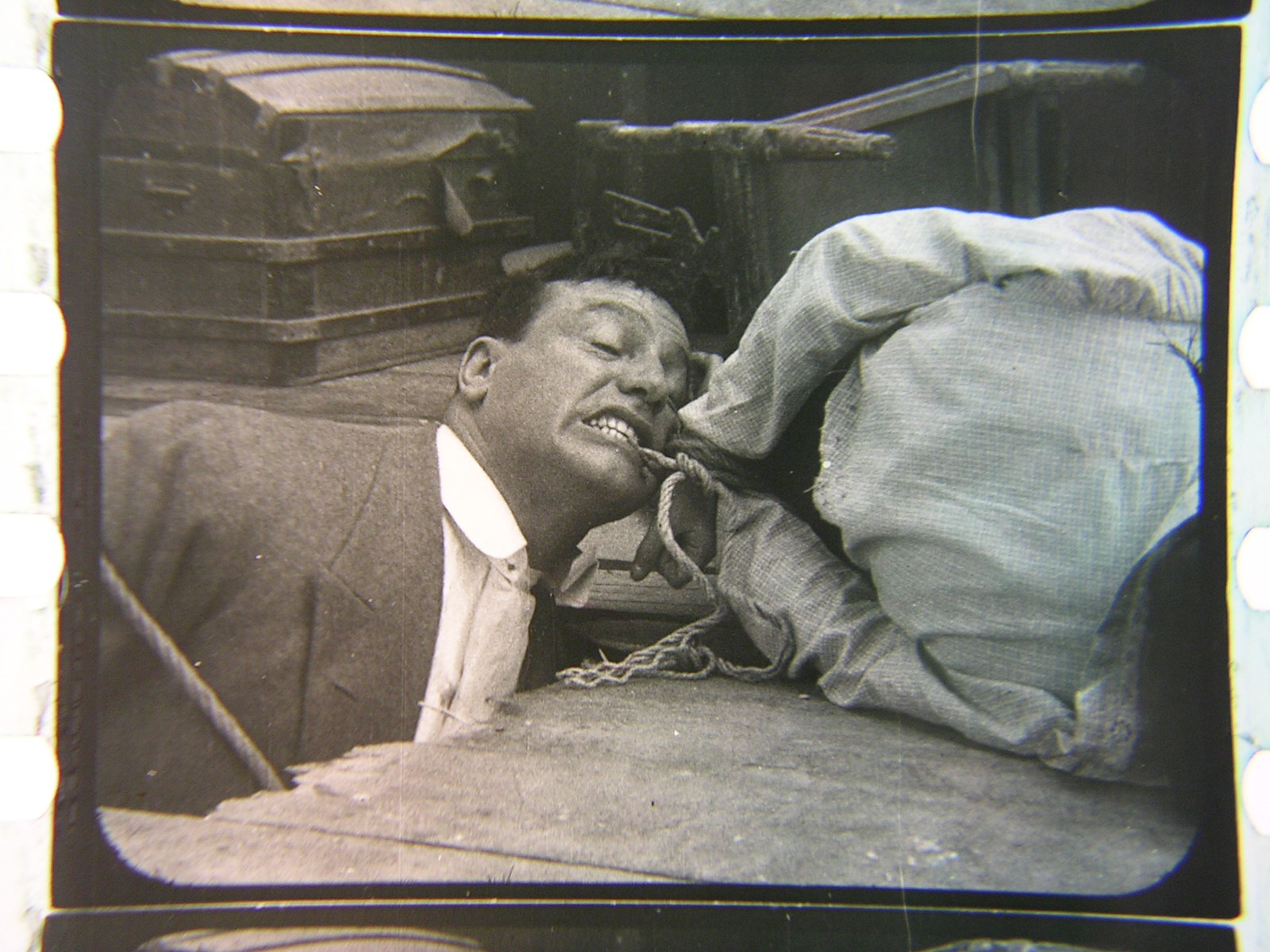
F.: Augusto Battagliotti, Giovanni Tomatis; Sup. R.: Giovanni Pastrone; Int.: Bartolomeo Pagano (Maciste), Leone Papa (Ercole), Clementina Gay, Amelia Chellini, Didaco Chelli- ni; Prod.: Itala Film 35 mm. L.: 1350 m. D.: 65′ a 18 f/s. Tinted, toned.
Edition History
The black slave in Cabiria defeated the king and his troops, winning the sympathy of audiences around the world. Sudden fame brought actor Bartolomeo Pagano the honor of a film all his own, in accordance with the commercial reasoning of the modern technique of making spin offs. In the first film of the series Maciste trades his leopard skin for a double-breasted suit, changes race and social status, and becomes a bourgeois actor of 1910s Turin. A girl chased by a mysterious group of bandits hides in a movie theater showing Cabiria. She is struck by Maciste’s deeds. If he was able to set straight so many wrongs on the screen, why couldn’t he do the same in real life? The next day a mysterious letter arrives at Itala Film… The film was a success and launched a long series that would make Maciste a legend of Italian popular imagination.
Stella Dagna, Claudia Gianetto

Print restored in 2006 at L’Immagine Ritrovata from a nitrate positive preserved by the Nederlands Filmmuseum, as part of a project for the enhancement and preservation of silent films produced in Turin promoted by the Museo Nazionale del Cinema and the Cineteca di Bologna. The Italian intertitles have been reconstructed using the censorship card, production books, and photographic sheets preserved by the Museo Nazionale del Cinema. Tones have been made with Desmetcolor.
Ever since his second appearance (…) the role of the strong-man had been completely transformed. As the title shows, he has earned the status of main character, has become autonomous, and has liberated himself from all conditioning beyond (and above) his own will. Having gotten rid of the frills of the history film, the hero of might, played by Bartolomeo Pagano, gets involved in a contemporary adventure. In order to escape from shady followers, a pursued girl (the first of a long series of heiresses in strongman films) takes shelter in a cinema, where Cabiria is being shown. Believing in the strength of Maciste, whom she had seen in action on the screen, she goes to Itala-Film to ask the good giant to protect her from the wicked guardian who wants to strip her of her inheritance. Thanks to this meta-linguistic astuteness, the framework (within which our strongman was presented in Maciste as a character of Cabiria) becomes the space of a possible world, in which the hero has the power to enter (and to exit): other universes beyond the real one are accessible to him. In other words, this obviously fictitious character (living on a film screen) is also the hero who protects the young and unlucky heiress, and thus an unusual character who is able to take the myth beyond the limits of the given story. This is a device that allows Maciste to become a true mythical hero of the masses, as will happen much later on with Superman.
Monica Dall’Asta, Un cinéma musclé (Yellow Now, 1992)


From a nitrate positive preserved by the Nederlands Filmmuseum, as part of a project for the enhancement and preservation of silent films produced in Turin promoted by the Museo Nazionale del Cinema and the Cineteca di Bologna. The Italian intertitles have been reconstructed using the censorship card, production books, and photographic sheets preserved by the Museo Nazionale del Cinema in Turin