[MOVIE]
Sc.: Robert e Frances Flaherty. F.: Richard Leacock. M.: Helen van Dongen. Mu.: Virgil Thompson (eseguita dall’Orchestra di Filadelfia diretta da Eugène Ormandy). In.: Joseph Boudreaux, Lionel le Blanc, Frank Hardy. P.: Robert Flaherty per la Standard Oil Company. 35mm. L.: 2220m. D.: 80’ a 24 f/s.
Edition History
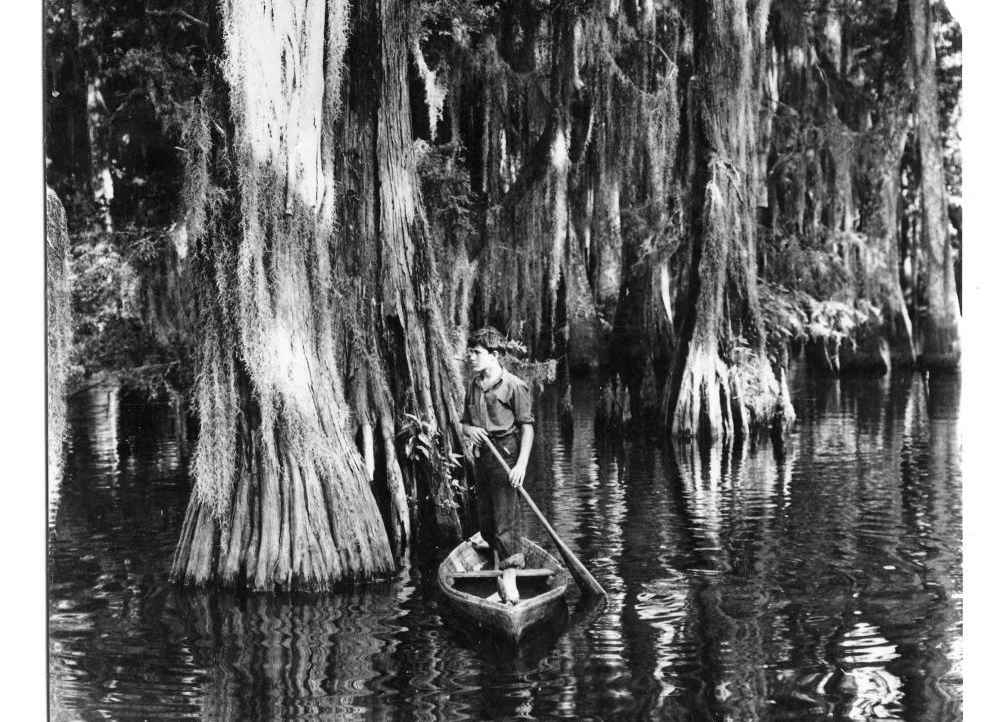
Robert Flaherty’s last film is a fitting culmination to a long career. It is less a documentary about the Cajun people of Louisiana’s bayou country, than an autobiographical film about Flaherty himself. From the viewpoint of a Cajun boy the film reveals the mysteries of the bayou wilderness, portrayed as an enchanting world of fantasy, filled with beauty and danger. The film is a poetic reflection of Flaherty’s youth, in which he explores his own lifelong relationship to the wilderness and natural environment, and to the people who live there. The opening sequence is one of the most celebrated in film history. Shots of alligators, magnificent birds, floating lily ponds, slithering snakes, and other wildlife and flora are given unity, continuity, and a sense of graceful movement. (…) The film’s visual beauty is so effective that it overshadows the sponsor’s message [ndt: Standard Oil of New Jersey]. Oil drilling technology, first seen as an unknown threat to the tranquillity of the bayou, in the end appears benign, leaving the impression that the unspoiled wilderness is safe. (…) Louisiana Story remains an enduring work of art for its sheer visual beauty, though some have argued its qualifications as a documentary, due to the manipulation of events depicted. Among films essentially based in reality, however, it remains one of the most succesful collaborations of all time, with an impressive amalgamation of talent in direction, photography, editing, writing, and music.
William T. Murphy, Louisiana Story, in International Dictionary of Films and Filmmakers 1. Films, edited by Tom Pendergast and Sara Pendergast, St. James Press, Farmington Hills 2000

“In 1943, Standard Oil, which was amazed by the success of Nanook, decided that petroleum held a similar attraction for the filmmaker and that it had all the elements to produce just the same result. This belief led to a handsome contract – the entire financing of a film with no technical limitations placed upon the director, who was to own the rights to the film and to distribute it as he pleased – and all of this without any acknowledgement of their generosity in the title sequence.
This undertaking, which had to praise the heroism of petroleum workers and make them known to people throughout the world, could be seen as reflecting the English documentary school of 1928 as well as various aspects of the cinéma-vérité of the time. Standard Oil gave them complete freedom in the choice of the location for the filming of petroleum extraction, where they were to spend three months prior to filming”.
(Henri Agel, Robert Flaherty, Seghers, Paris, 1965).

Restoration curated by Library of Congress, Museum of Modern Art and UCLA Film & Television Archive