[MOVIE]
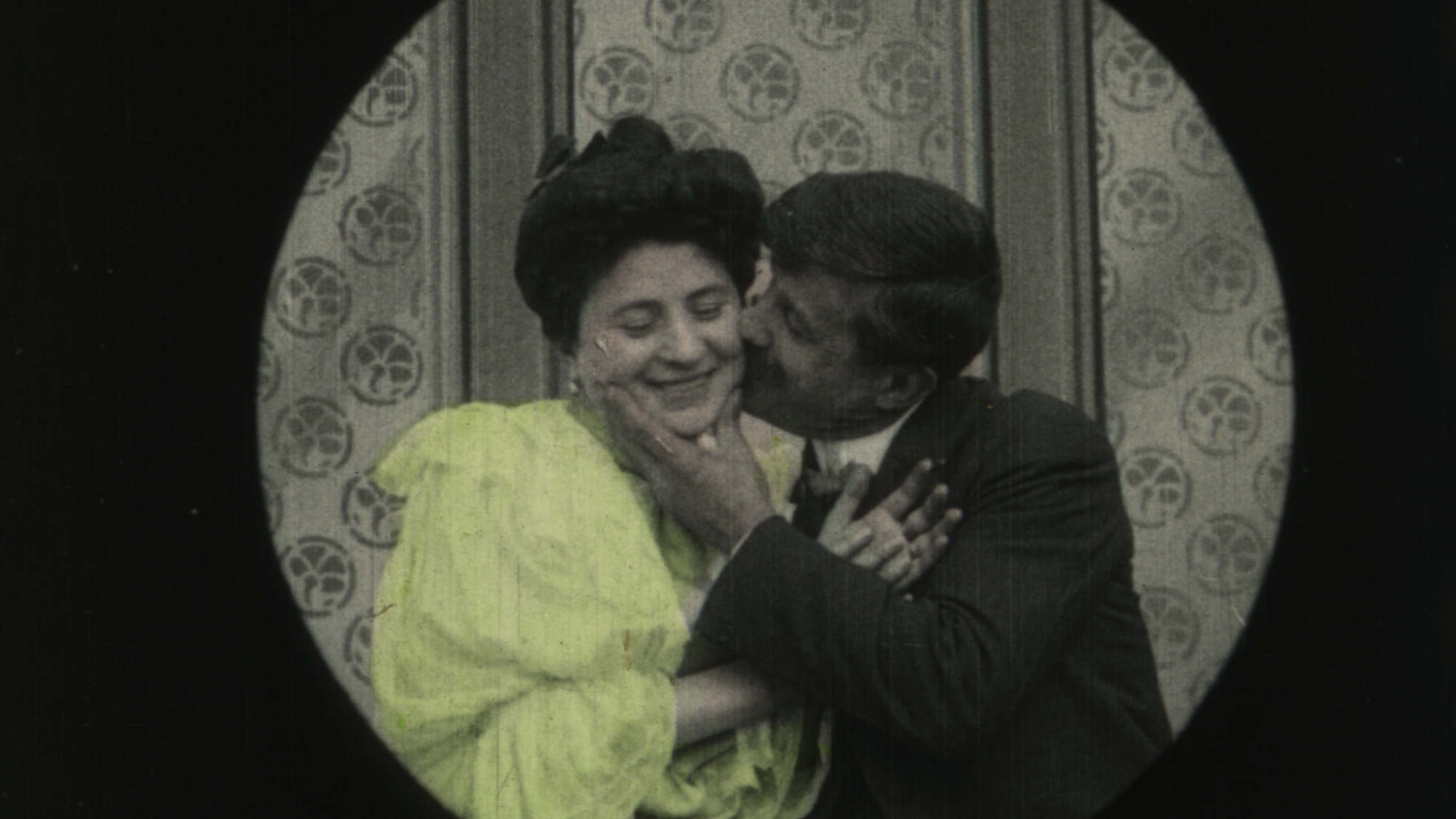
T. copia: Die drei Phasen des Mondes. Int.: Renée Doux. Prod.: Pathé Frères (scène comique, n. 1321), 35mm. L.: 41 m. D.: 2’ a 18 f/s. Col. (from a stencil-colored nitrate print)
Edition History


Time and narrative I
In 1905 Albert Einstein sat at his desk in Berne and formulated the theory of relativity. Again, what did that theory say? That time is relative? That time equals movement? That energy equals light multiplied by time squared? Or perhaps rectangled? “Energy plus time equals light moving in a rectangle…” – yes, that’s about right.
The panorama, with its camera movement, continually changes the image’s field in the continuous flow of time. In the transformations, a sub-genre of the scènes à trucs, changes occur in a fixed image field. The tricks of the scènes à trucs render these movements independent from real time, and in the simplest case, opposed.
Congruence with real time, continuity and discontinuity, are purely temporal structures, and one of them is inevitably given in any moment of a film. Besides temporal progression, the anticipation and relationships of cause and effect can install an internal organization of time, thus creating the time of the narrative.
Mariann Lewinsky