[MOVIE]
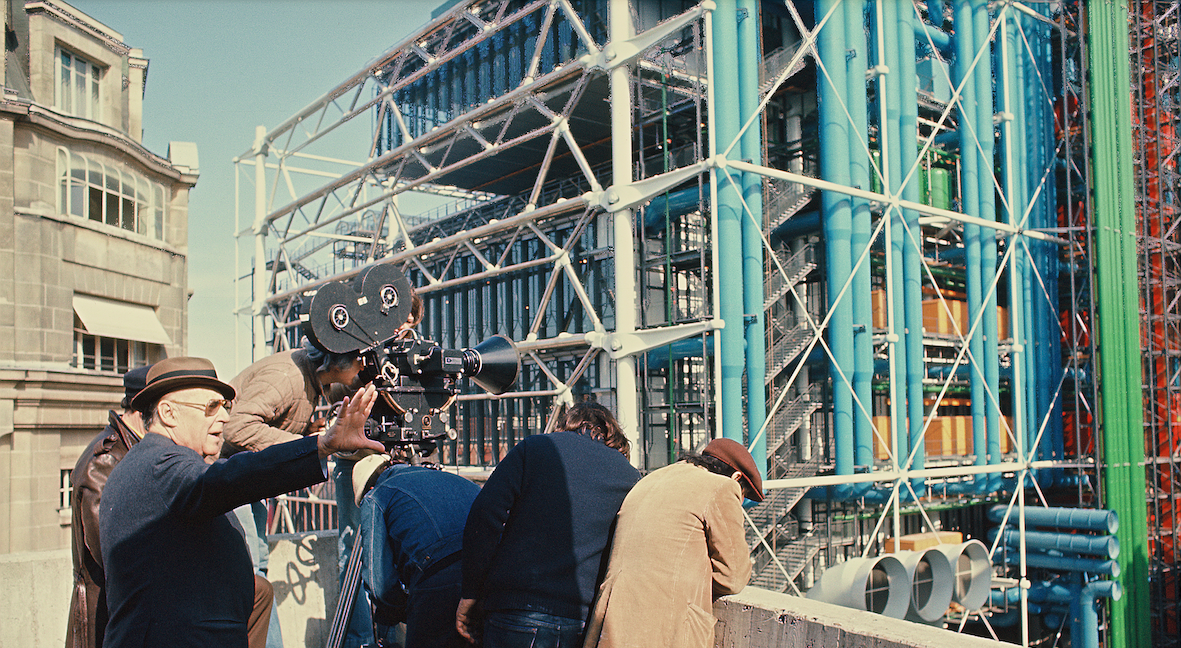
F.: Néstor Almendros, Emmanuel Machuel, Jean César Chiabaut. M.: Véritable Silve, Colette Le Tallec, Dominique Faysse. Prod.: Jacques Grandclaude, la Communauté de Cinéma (Création 9 Information) con la partecipazione del Ministère des affaires étrangères. DCP. D.: 57’. Col.
Edition History
From the first to last shot, movement on the screen never stops, in Rossellini’s personal care. Because he is the person directing it or, more precisely, zooming in on it. A technical invention that made a wish of his come true – one that he had had since Roma città aperta: to capture on film the perennial, vibrating anxiety of life in constant tension with existence.
We would like existence to be entirely ours, possess it, imagine it, build it, own it, find a place in it, and since it has a duration, it is a duration, the longest one possible.
Because life is – and only is – uncertainty. It is not duration; it is merely a succession of moments that happen randomly. And it invites a continuum of perpetual co-nascence.
This is how Rossellini filmed Centre Pompidou. First, a backwards zoom/dolly zoom of Paris rooftops. Then, entering like an intruder in that building of tubes and steel that conspires (jure) – swearing (injurie), people dared to say at the time – with the mind and the body of the famous capital. The zoom movement determines the movement of the curious, amused and skeptical population that takes possession of the place, of its multiple spaces, again animated and enlivened by the playful zooming. We visit the Centre, we wander through it, so to speak, with a camera that is more like a neighbor than a companion, intent on discovering, capturing or ignoring with us fragments or moments of wisdom that are shown to us. We cannot yet speak of knowledge. Only of acknowledgment, meaning recognition. The moving eye instantly catches a sculpture, a painting, a ‘modernity’ while the camera follows the filmmaker’s usual moves. And it rises and is elevated. To revelation. Twofold. Knowledge encounters wisdom for nourishment. And – the last shot, the last backward zoom/dolly zoom – the Centre Pompidou becomes part of Paris, imbues it with the spirit of modernity, enlivens the soul of the city and its country.
Jean Douchet
JACQUES GRANDCLAUDE
Digitally transfered at Studio L’équipe, Bruxelles thanks to the support of Fondation Genesium
(…) The singularity of Le Centre Georges Pompidou is the fact that it is a film without actors. Thus it serves as a revealer and as a magnifying glass, showing us Rossellini at work soley on the conception and creation of the shots. I imagine that on a set with actors everything pertaining to the relationship with technicians, the movement of the camera, the speed of travelling, the shots, etc. would be much less obvious. Here we see, in an almost experimental manner, a creative process perfectly leggible in all of its phases. We see Rossellini make all of his decisions in real time, carry out his choices, share them with his technicians, change them during filming. In short, we see with rare clarity not the exterior forms, but the act of creation in all of its steps, all of its components. I can’t think of a more pedagogica! film on what thinking of and creating a sequence entails. For the first time I understood in a concrete manner how a cineaste himself uses his famous camera (pancinor) to zoom during filming. Not blindly, as one would think considering that at the time no video control of the sequence being filmed existed. Rather, with great precision thanks to his perfect understanding of the lenses and of their effects. In these rushes we seem him select with great precision, for each of the camera’s postions during a trial run of camera movements, the focal length corresponding to the shot that he wants to obtain in that moment in the sequence. When the filming begins we can view his command of the zoom, not moved randomly but following precise references written in pencil on the zoom: he knows exactly what the cameraman is seeing at 30, 50, 80 mm. We discover a filmmaker completely at odds with the legends about his technical nonchalance, a director who knows and dominates all of the technical aspects of the creation of a film perfectly. A great technician and a great team player, capable of getting across his artis- tic decisions to all of the members of his équipe gently and with no external displays of authority.(…)
Alain Bergala, 17 maggio 2007
JACQUES GRANDCLAUDE