[MOVIE]
Sog.: Cesare Zavattini dal romanzo omonimo (1946) di Luigi Bartolini. Scen.: Oreste Bianconi, Cesare Zavattini, Suso Cecchi d’Amico, Adolfo Franci, Gherardo Gherardi, Vittorio De Sica, Gerardo Guerrieri. F.: Carlo Muontori. M.: Eraldo Da Roma. Scgf.: Antonino Traverso. Mus.: Alessandro Cicognini. Int.: Lamberto Maggiorani (Antonio Ricci), Enzo Stajola (Bruno Ricci), Lianella Carell (Maria Ricci), Elena Altieri (la patronessa), Gino Saltamerenda (Baiocco), Vittorio Antonucci (il ladro), Giulio Chiari (attacchino), Michele Sakara (il segretario alla beneficenza), Fausto Guerzoni (filodrammatico), Carlo Jachino (il mendicante). Prod.: Vittorio De Sica per Produzioni De Sica. DCP. D.: 90’. Bn.
Edition History
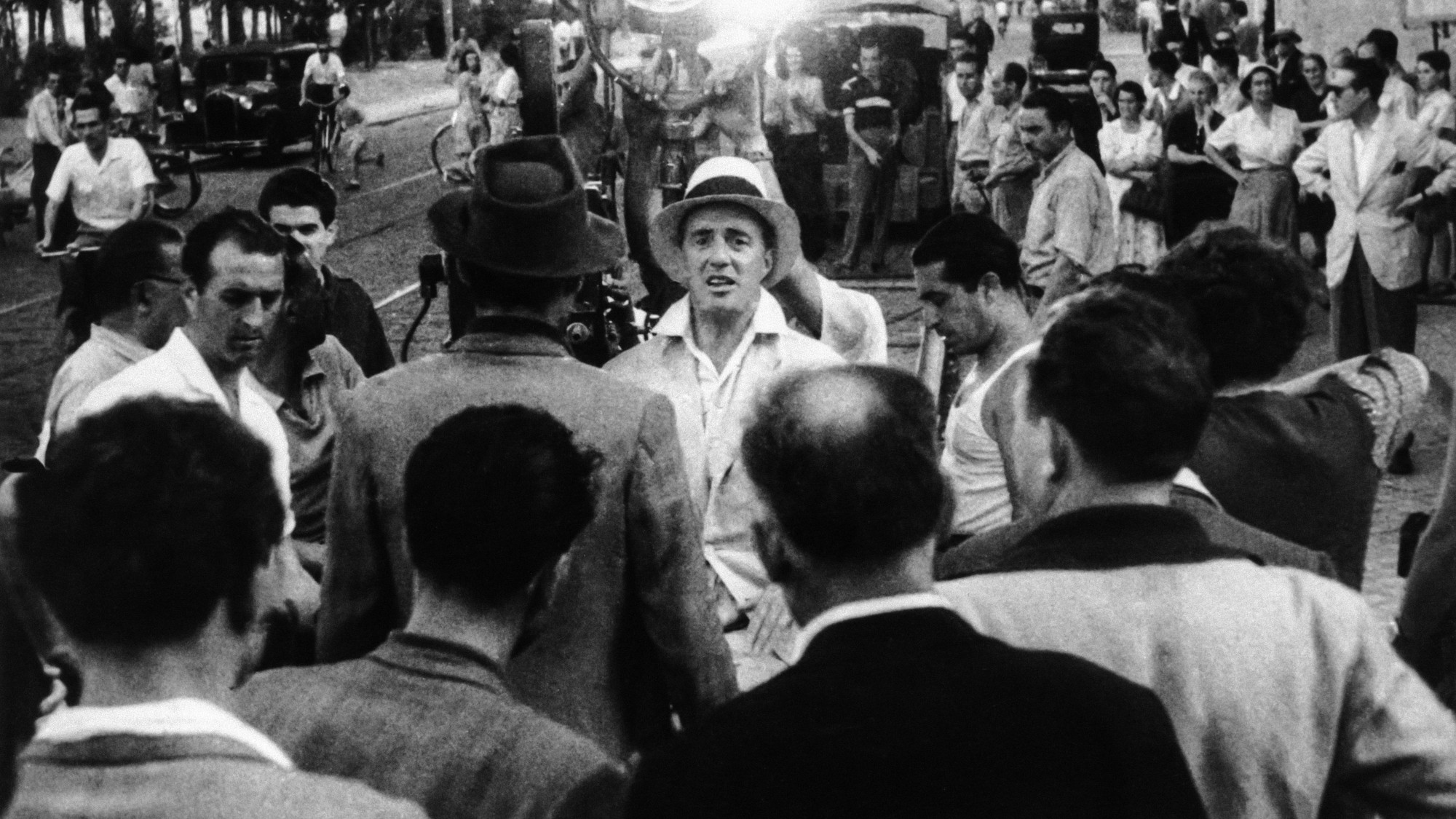
We travelled around a lot. We saw things we liked; we wrote about them. There is a lengthy diary on Ladri di biciclette, which Zavattini published somewhere. But the film was entirely written down. It was created in the streets and created around a table: both things are true. For example, the episode of the holy woman. She lived on via Nomentana, right in front of Villa Torlonia. We went there many times; we sat in on her sessions, and then we wrote the scene. Screenplays should be written with the director who will make the film in mind. Ladri di biciclette was written for De Sica, while thinking about De Sica. Who knows whether anyone else would have made it! Furthermore, it is through this contact with the director – discussing and, perhaps, even criticising his poetics – that the work of the screenwriter becomes more exciting, less mechanical. There were many screenwriters on each film, because we never really gave it a thought! Think of Ladri di biciclette. It all started with Zavattini and Amidei. Amidei withdrew because he did not find the film congenial and so they called me. And we wrote it: De Sica, Zavattini, Gerardo Guerrieri and me. And there was also the name of Gherardo Gherardi, a comedy writer I never met, and who was listed simply because De Sica had said “We will make the next film together” shortly before he died. Then we had to find an excuse to give a little money to an old friend, Franci. So in his name went, too! We simply did not give it a thought. Zavattini became excessively well-known, because many of us worked on Ladri di biciclette but in the end it seemed as if he alone had written it, because he was the one who theorised about it, gave interviews, wrote… We went around the city to confirm the places where the action would take place; then we would sit around a table in Zavattini’s house, a close-knit group. Then Zavattini’s fame and importance grew and this also led to a famous rivalry with De Sica, because Zavattini did not subscribe to the absolute supremacy of the director and instead strongly believed in the importance of the screenwriter, and in his own work above all.
Suso Cecchi d’Amico in L’avventurosa storia del cinema italiano. Da Ladri di biciclette a La grande guerra, Vol. 2, edited by Franca Faldini and Goffredo Fofi, Edizioni Cineteca di Bologna, Bologna 2011

Restored in 2018 by Cineteca di Bologna, Compass Film and Istituto Luce – Cinecittà in collaboration with Arthur Cohn and Euro Immobilfin at L’Immagine Ritrovata laboratory
My dear friend,
As you can imagine, they spoke enormously about your film to me on Sunday. I did not go because I was afraid of it being too wonderful. Sunday I received many phone calls. I was envious. I did not want to go and see it. Of course, then I went to the premiere at the Barberini cinema, hoping it would be a little less wonderful than they had told me. Instead, it is even more wonderful, but in a different way. You still repeat yourself, you are like Verdi and Chaplin: you do not think: you feel.
Years ago I told you that you did not understand anything, and I said many times geniuses do not understand anything because they feel, because they see. Now, I have just one thing to say to you. You ‘rise’, while We (all Italian directors) ‘set’.
Mario Soldati, letter to Vittorio De Sica, 26 November 1948
Ladri di biciclette certainly is neorealist, by ail the principles one can deduce from the best Italian films since 1946. The story is from the lower classes, almost populist: an incident in the daily life of a worker. […] Truly an insignificant, even a banal incident; a workman spends a whole day looking in vain in the streets of Rome for the bicycle someone has stolen from him. […] Plainly there is not enough material here even for a news item: the whole story would not deserve two fines in a stray-dog column. […] In itself the event contains no proper dramatic valence. It takes on meaning only because of the social (and not psychological or aesthetic) position of the victim. Without the haunting specter of unemployment, which places the event in the Italian society of 1948, it would be an utterly banal misadventure.[…] If Ladri di biciclette is a true masterpiece, comparable in rigor to Paisan it is for certain precise reasons, none of which emerge either from a simple outline of the scenario or from a superficial disquisition on the technique of the mise en scène.
The scenario is diabolically clever in its construction; beginning with the alibi of a current event it makes good use of a number of systems of dramatic coordinates radiating in all directions. […] The thesis implied is wondrously and outrageously simple: in the world where this workman lives, the poor must steal from each other in order to survive. But this thesis is never stated as such, it is just that events are so linked together that they have the appearance of a formal truth while retaining an anecdotal quality. […] Clearly, and I could find twenty more examples: events and people are never introduced in support of a social thesis – but the thesis emerges fully armed and all the more irrefutable because it is presented to us as something thrown in into the bargain. It is our intelligence that discerns and shapes it, not the film. De Sica wins every play on the board without ever having made a bet.
This technique is not entirely new in Italian films and we have elsewhere stressed its value at length both apropos of Paisan and of Germany Year Zero, but these two films were based on themes from either the Resistance or the war. Ladri di biciclette is the first decisive example of the possibility of the conversion of this kind of objectivity to other, similar subjects. De Sica and Zavattini have transferred neorealism from the Resistance to the Revolution.
André Bazin, What Is Cinema?, University of California Press, 1971
Restored in 2018 by Cineteca di Bologna, Compass Film and Istituto Luce Cinecittà, in collaboration with Arthur Cohn, Euro Immobilfin and Artédis at L’Immagine Ritrovata laboratory