[MOVIE]
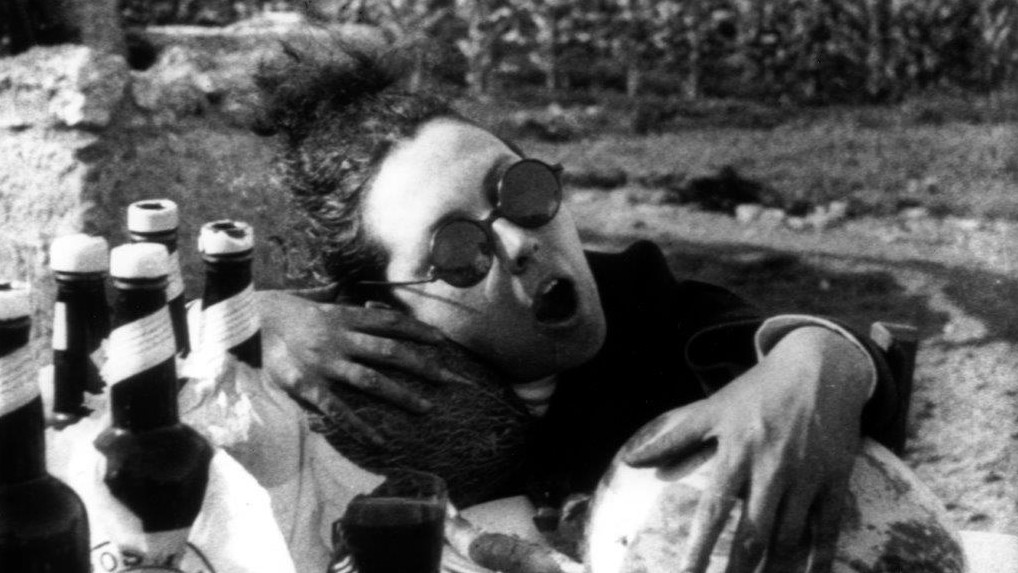
Int.: Musidora, Antonio Cañero. Prod.: Société des Films Musidora. 35mm. D.: 59’. Bn.
Edition History
Dearest Cinémagazine,
Here I am in the La tierra de los toros, finishing the edit, which is more complicated than the hardest Chinese puzzle. I hope I come out on top. This is the hardest and riskiest of productions. My latest stars (which are magnificent bulls) move and perform expressively. I “fought” them myself and I am proud of this beyond utterance. No one can say I used a stand-in for those scenes that my sex entitles me to turn down. Perhaps this will help us obtain, who knows, the right to vote some day. Dear Cinémagazine, more soon.
Musidora, “Cinémagazine”, n. 15, April 11th, 1924
For the last of her films, Musidora came up with an innovative scheme that was part live performance, part cinema: a total spectacle over which she reigned as film actress, chanteuse and theatre performer, a performance on screen and on stage, in comic mode, a set of Russian dolls, a self-deprecatingly fictionalised account of herself. Playing on her own image, Musidora settles her scores, with filmmaking as an art, with the press, with the star system and with her audience. She does so wittily, sincerely, quite naturally, with no sort of bitterness. Initially, the story was divided into five chapters: La vida de un ganadero (Life of a Breeder), La vispera de una corrida (The Eve of a Bullfight), El rejoneador (Bullfighter on Horseback), La fe Metamorfosis (Ugly Metamorphosis) and Epilogue. After 1922, a short and unsubtle version of the film entitled Una Aventura de Musidora en España, was included in her live Spanish performances. The story was written together with her love, Antonio Cañero, and co-funded by both. La Tierra de los toros is the only film in which Musidora is presented as sole director and author of an original drama. The film – starring Musidora and Cañero – is formally free, as free as its director, combining documentary and drama. For this reason, it remained a far cry from the commercial standards of its time, a fact that proved an obstacle in distributing the film. It was shown in Spain in February 1924. We have been hard pushed to discover any screenings at all in France, aside from one in Lyon on June 3rd, 1924.
Marién Gómez Rodríguez
On the occasion of this retrospective, a screening interrupted three times by a live performance, modelled on Musidora’s 1922 to 1924 shows, and performed here by Los Musidoros: Émilie Cauquy, Marién Gómez Rodríguez, Clément Lafite, Frédéric Tabet, Elodie Tamayo.
It is a great thing in life to come up with projects and see them happen, even if this takes time. And there is nothing more likely to generate projects than cinema, which offers a vast reservoir of ideas, wherein to search and sift and choose.
Musidora, “Le Film”, January 15th, 1920
Though no actual source testifies to Musidora’s live performances (no recordings survive, nor a detailed cue-sheet for a show improvised on a location-by-location basis), we do know that Musidora and Antonio Cañero’s live appearances were based on an original screenplay, as evidenced by the appearance of a stage manager in the release print. Generally speaking, we have felt free to reproduce an ambience, to retrace a geographical passion (Andalusia, Seville, Córdoba) and to imagine Musi’s fantastical, free-spirited presence as a filmmaker and as a woman in love. The ghostly nature of that presence is intended. Our idea was not to offer an interpreted version of Musidora’s persona but rather to depict the nature of her presence by a variety of means, with the clumsy precision of the archivists and researchers turned travelling players that we are. This fantasy is based on intimate records (letters), on archival matter (original screenplay, director’s notes), official publications (including articles and radio broadcasts) as well as entirely invented material (playing cards, rhythmical punctuations such as flamenco zapateos, jaleos and palmas, not to mention fans, mantillas and music-boxes). Words, sounds and projected images to make the heart beat faster.
Émilie Cauquy
After having produced and co-directed three feature length dramas in which she played the leading roles of more or less adventurous women, Musidora chose the comic mode for what turned out to be the final production of her company. Intended as a mixed stage and screen performance, it can be considered a self-ironic settlement with a film world, press and audience, which overlooked her aspirations as a filmmaker and which wished to confine her to dramatic parts highlighting her photogenic qualities. What makes this production particularly worthwhile, is that there is no bitterness in its tone. Instead, it offers a smart, at times sincere and always humorous contemplation on issues which Musidora had given serious consideration theretofore, such as filmmaking, star images, male and female bravery and romantic love. For instance, she presents herself as a filmmaker vain enough to believe that the actor of her choice, a bull fighter, would be pleased to act in her film. She also appears as the most ugly and clumsy would-be film actress, clearly taking great pleasure in acting the opposite of her photogenic star image. Her act of bravery consists of pulling a bull’s tail, with which she ridicules not only female heroism but also the alleged courage of the bull fighter whom she saves from the ferocious animal’s horns. And the romanticism of falling in love is spoofed by presenting it as a chase by the man for the woman. A more gracious farewell to a unique career as a celebrated star and a hardly accredited woman filmmaker in the French silent cinema no one else has bid.
“The mythical Musidora (Jeanne Roques 1889 – 1957) entered the pantheon of the French silent films where she is remembered as Irma Vep of the Vampires or the Diana Monti of Judex. Not a lot is known about her activities on the other side of the cine camera, and which seems was in no way inferior to her contemporary Germaine Dulac, the latter being the only one to be defined as the metteuse-en-scène of the silent period.
In 1916 Musidora had already directed a Jacques de Baroncelli’s adaptation of Minne from the novel The Naive Libertine by Colette. The film was never released due to economic difficulties which had obstructed its completion. She did not however give up, she improved her qualities as a film director producing the following on her own: Le Maillot noir (1917), La flamme cachée (1918) and Vicenta (1919), and the even more binding Pour Don Carlos (1920), filmed for the most part in Spain.
Due to being sentimentally attached to the toreador Antonio Cañero, she willingly accepted the offers which reached her from the Iberian peninsula to appear on stage. She stayed in Spain, as she herself said ‘in golden exile’ until 1926, that is until the relationship with Cañero finished and directed and acted in another three films: Una aventura de Musidora en España and Sol y Sombra (both 1923), La tierra de los toros (1924).
The latter is a sports documentary filmed in Andalusia and in the “plaza de toros” of San Sebastian for the bullfighting scenes. The film came out at the Teatro de la Comedia di Madrid in the presence of a sprightly Musidora along with an imposing Cañero. At that time this work was divided into five parts: La vida de un ganadero; La vispera de una corrida; La corrida, El rejoneador; La Fea; Metamorfosis, plus an epilogue” (Vittorio Martinelli)