[MOVIE]
Edition History
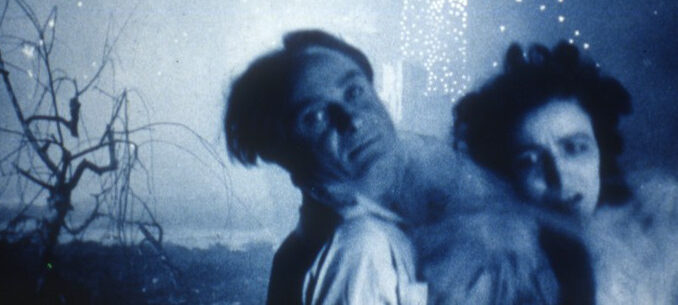
La Chute de la maison Usher is a rare example of a feature film that deploys the experimental film practices of its time. It is a film about time, where rapid acceleration and trance-like deceleration are just two of the numerous camera tricks Jean Epstein uses to create an eerie atmosphere. At the climax, the viewer may get the feeling that time has stopped completely and for ever and that he is experiencing a dream rather than watching a film. A rare experiment.
A complete nitrate print of La Chute de la maison Usher was discovered in the Komiya collection. Along with Gardiens de phare (Jean Grémillon, 1929) – the gorgeous print from the Komiya collection was screened in Bologna in 2012, and in Pordenone in 1992 and 2019 – it is one of the last films to have entered the collection.
Copies of La Chute de la maison Usher can be found in many archives in the world. There are different versions, a 24fps version with added sound made by Marie Epstein in 1963, a 35mm reconstruction carried out from the original camera negative and three original prints, and also this safety print from the Komiya collection, a duplicate on colour film stock of the original print with English intertitles distributed in Japan.
The question of identifying the original is always a difficult one – especially in film, where every print and every restoration has unique characteristics and qualities. Knowing different prints of the same work is important and every print should be considered as an original. For this reason we decided to screen La Chute de la maison Usher, a widely known work existing in Europe in several prints. This is a fabulous print with unique characteristics not be found in any other version.
In general we are advocates of always screening silent films with musical accompaniment. But in La Chute de la maison Usher Epstein works musically with images in such a sublime way, that it is worth experiencing this ‘musicality in images’ – at least one time – without added live music. Every one of its images is full of sound.
Karl Wratschko

La Chute de la maison Usher, inspired by Edgar Allan Poe’s themes, was produced and made by Jean Epstein in 1928 on nitrate print. In 1963, Marie Epstein made a duplicate on acetate, changing its speed from 18 to 24 frames per second, the pace of sound film. In 1979, for the picture’s broadcast on the French film television program Cinéma de minuit, Marie Epstein added sound to the film, commissioning Roland de Candé to make synchronized music, and produced a sonorized negative duplicate and various prints thereafter for distribution.
Emilie Cauquy
When French television asked me for LaChutedelamaisonUsherfor broadcasting it as part of the program Cinéma de minuit, I immediately thought of adding sound to it. Something unconditional lovers of the silence of silent films instantly criticized me for. I was almost accused of sacrilege, and I certainly would have been had I disturbed that silence with a single word. It should not be forgotten, however, that silent films were originally screened with musical accompaniment, whether an orchestra in first-run movie theaters, a violin and piano duo or even just a modest mechanical player piano in a small neighborhood cinema. Capable of being good or bad, the music that accompanied the picture could destroy it or make it sublime. The important thing was making the right choice. Just before his death, Jean Epstein intended to make a sound version of La Chute de la maison Usher, which never made it out of the planning stage. The image is constantly accompanied by a musical sound atmosphere that marries music with the noises of nature: the soft blowing of wind, the murmur of water and leaves, drops of rain, the creaking of wood, natural sounds made unusual and interrupted by silences that consequentially express their full dramatic value. They were only indications without further clarification. He did not complete the project, which he left behind unfinished in 1953. There wasn’t anything left for me to do but add sound to the silent version he had shot in 1928. First, original rhythm of the images had to be respected, especially important due to the dramatic slow motion, one of the film’s essential components. So the silent film’s pace of 18 frames per second had to be transposed into the sound projection pace of 24 frames per second using a delicate technical procedure that was completely successful, something that is rather rare. In the end, I asked Roland de Candé to create a musical score, and he composed it completely in tune with the spirit and core of the film.
Marie Epstein

Sonorized version restored in 1982
“La Chute de la Maison Usher, from Poe’s tale by the same title, cannot be considered an adaptation of a single literary text: for Epstein it represented the attempt to depict his impressions of Poe’s literary opus in its entirety by a single film. In effect, it is a sort of mix of several tales, besides the one by the same title, The Oval Portrait, Ligeia,Morella, The Man of the Crowd. Also Epstein made several changes on the tale chosen for his film, and the most relevant refers to the facts that he eliminated ‘the first-person narration, thus privileging an encompassing and oddily fluctuating narrative approach’. (Abel, 1984)
Screened in June 1928 in Studio 28,La Chute de la Maison Usher enjoyed an immediate success among critics and reviewers. For Jean Dreville the movie confirmed Epstein as “the true master of modern cinema, the most intuitive and serious of artists.” Afterwards,La Chute was the object of several misunderstandings: it was seen as a ‘Gothic’ film, marked by an innovative use of slow-motion and influenced by German Expressionism. However, because of these attempts to confine it into the rigid framework of a school or a genre, the structural features of the film have been often overlooked: ‘As for all fantasy literature,Usher makes ample use of evident epistemic ambiguity. Seeing and knowing are left unsolved up to the end of the film. Is Madeleine truly dead and therefore has Roderick just imagined her resurrection and rescue? Or rather has she just been sleeping until natural or supernatural forces woke her up, thus governing her fate? This narrative uncertainty is doubled by other uncertainties in the filmic discourse, not only as regards space-time continuity, but also as a function of rythm and structuring of figures of speach’. (Abel, 1984)
Gugliemo Pescatore,La Chute de la Maison Usher, inLa città che sale, Rovereto, Manfrini, 1990

The restoration was carried out at the Cinémathèque Belge’s laboratory, from the original camera negative and three original prints, all of them coloured, conserved by the Cinémathèque Belge, the SODRE archive and the Nederlands Filmmuseum.