[MOVIE]
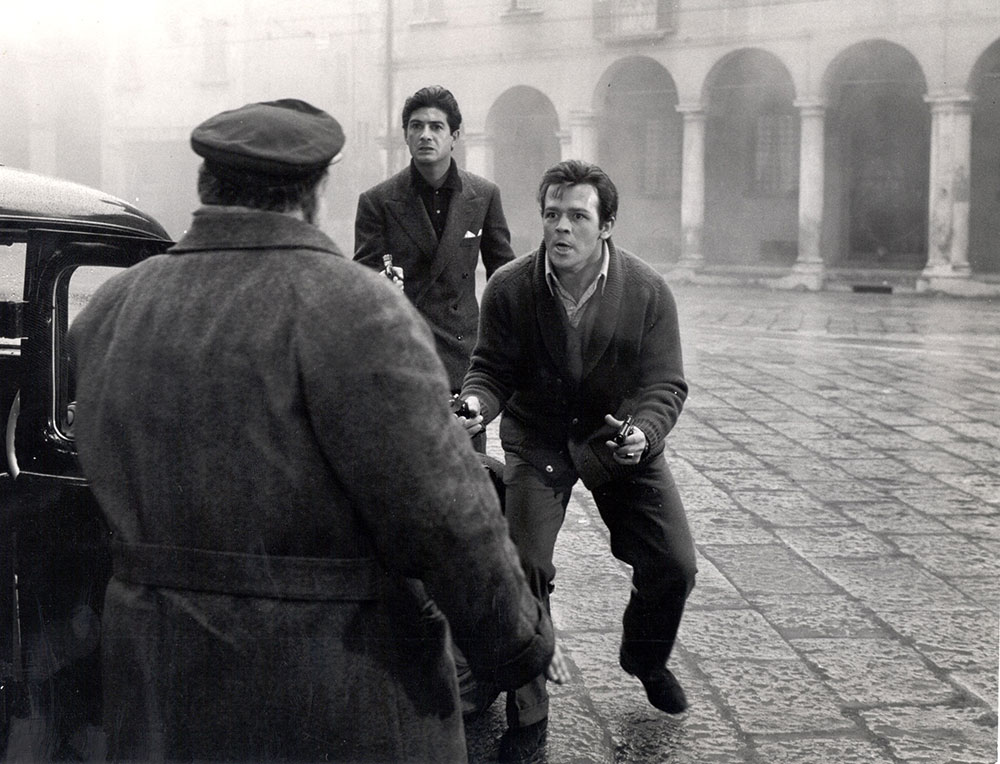
Sc.: Sergio Perucchi, Stefano Strucchi, Florestano Vancini, con la coll. di Federico Zardi. F.: Sandro D’Eva. M.: Tatiana Casini. Scgf.: Carlo Egidi. In.: Renato Salvatori (Casaroli), Jean Claude Brialy (Minguzzi), Tomas Milian (Gabriele), Gabriele Tinti (agente di polizia), Adriano Micantoni, Marcello Tusco, Calisto Calisti, Leonardo Severini, Michele Sakara, Mariella Zanetti, Marcella Rovena, Isa Quercio, Maria Grazia Marescalchi, Beatrice Altariba, Anna Mazzanti, Loredana Cappelletti, Yvette Masson. Dir. P.: Giorgio Morra. P.: Documento Film/ Le Louvre Films. D.: circa 93’. Videoproiezione / Videoprojection.
“Bologna relives the tragic noon shootout of 1950”: claimed the ads in the local papers prior to the release of Florestano Vancini’s film, twelve years after the actual fact shook the entire city. After having committed various robberies and crimes throughout Italy, one cold December morning a group of young gangsters, headed by Bologna native Paolo Casaroli, spread terror and death throughout the streets of Bologna while attempting to flee. Their attempted flight was as futile as it was bloody. Of the three main members only Casaroli himself survived, wounded during the shootout, then jailed, put to trial and condemned to life in prison. His other two friends had already committed suicide to avoid falling into the hands of justice. The film recalls the gang’s adventures and deeds: from the first meeting of the three through the dramatic ending to their camaraderie. There are two different editions. The first, as planned in the script, skillfully unravels the tale through a series of flashbacks, where the youngest bandit (Tomas Milian) thinks back on the entire adventure as he wanders about the city desperate and alone, before shooting himself inside a movie theater. The second version, which constitutes the official version of the film, was imposed by producer De Laurentiis who wanted to maintain more marked linearity in telling the events. This was supposed to make it more appealing to the public, at the expense of the narrative balance in certain points. The script was based on original documents (articles, interviews, photographs, trial papers, psychiatric evaluations), carryng out a factual reconstruction in order to interpret the happening from both a social and psychological point of view. The description of the Bologna surroundings is quite accurate: the winter streets covered in fog, the treacherous porticos, the brothels, the gangster hangouts (pool halls), but also the working class establishments, the bars and shops, the amusement park on the outskirts of town. Critics however judged the film’s socio-psychological pretences as not investigated sufficiently in depth, and labeled the film as “gangster Italian-style”. This definition, which was intended to highlight certain weaknesses, forty years later highlights one of the strengths of La banda Casaroli: the solidity and showiness typical of American action films goes perfectly with the description of the petty atmosphere in Italy in the Fifties, so much so that contemporary writer Carlo Lucarelli has repeatedly stated that he learned a lot from the way Vancini was able to make the chronicle of his time, often anything but spectacular, seem showy.
Paolo Simoni