[MOVIE]
Edition History
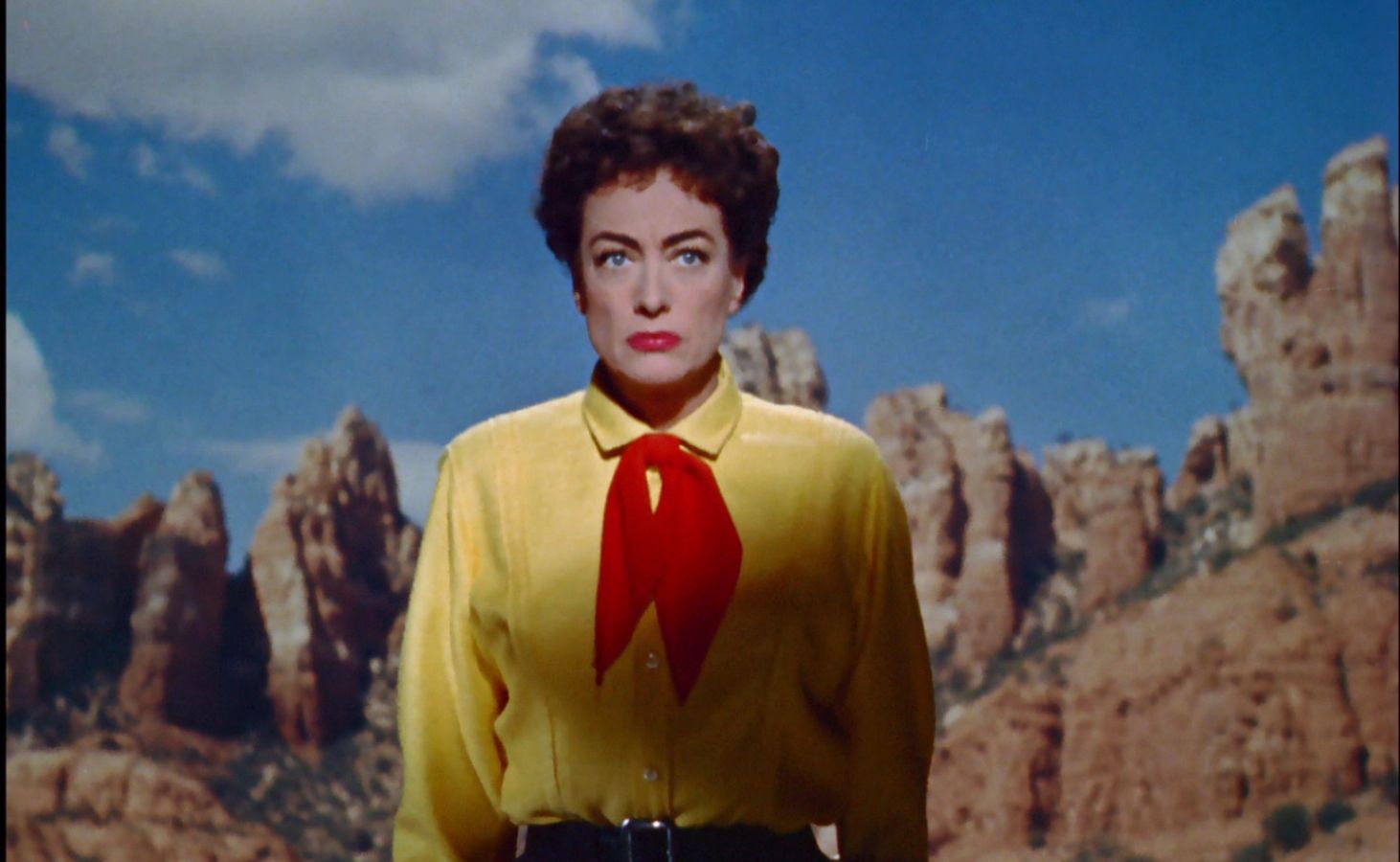
As Peggy Lee’s theme song Johnny Guitar played during the last lingering shots of the brand new Western, the audience left their seats in a state of confusion and disorientation. They had just seen an unclassifiable film.
Nicholas Ray stated that Johnny Guitar broke every rule of the western, and this happened during what was the genre’s greatest decade; the Western seemed to cover everything, or at least everything that cinematic means could express. The baroque style and the weird glow of Johnny Guitar stood out from all the rest. The production company stood out because it was marginal, and it is hard to imagine Johnny Guitar being produced anywhere other than at Republic Pictures.
Johnny Guitar was barely noticed in the USA, whereas in France it was regarded as a quintessential movie by a director about to achieve legendary status. Jean-Luc Godard said that Johnny Guitar’s imperfections made it the most beautiful film in the world. Jacques Rivette focused on Ray’s sunset obsession, his vision of solitude and maladjustment in a vortex of violence. For François Truffaut, Johnny Guitar was a Western dream, a fairy-tale enhanced by bizarre Trucolor.
In all its unruliness Johnny Guitar represents a summation of Nicholas Ray’s filmography. It is a ‘political’ reading of its time, an ‘existential’ western, an experimental colour film, a dazzlingly stylized melodramatic genre piece (with all the hallmarks of a completely willful opus), a crazy comedy about men – yet the true star is a woman.
A surprising balance is achieved in a style that uses Western paraphernalia sparingly and suggestively while the contemporary Cold War era is portrayed in a full-blown, satirically controlled vision. An organic, poetic whole emerges from disparate materials.
Peter von Bagh, in Elämää suuremmat elokuvat II [Films Bigger Than Life II], Otava 1993, edited by Antti Alanen

Courtesy of Park Circus. Restored in 4K in 2015 by Paramount at Technicolor and Deluxe laboratories from 35mm YCM separations
“He who one day realizes what remembrance is remains an eternal prisoner of one and the same remembering.” This quotation from Kierkegaard refers to the distinction proposed by The Banquet between remembrance and memory, and it was useful to me more than forty years ago in arguing the idea that the cinema of Nick Ray is a cinema ofremembrance. We know, for instance, that when Sterling Hayden asks Joan Crawford, “How many men have you forgotten?”, Joan Crawford does not respond to him with another question like “How many women do you remember?” but answers him in the same spirit and says, “As many as you remember?”. Or it could be, “As many as you. Remember?”. We discover, for example, that Turkey does not die because of his loyalty divided between Vienna and Kid, but because he is unable to find a place for himself (like Plato in Rebel without a Cause) in those years, months and days not shown in the film and that gave him the look in his eyes when he lived alone with the two and before the arrival of Guitar. For this reason he decides to shoot, after having been made to choose between “Dancing Kid” and Vienna, telling them, “You’ll miss me”. For this reason, the man who enters with music (memory) into that space of remembrance (Guitar, evidently) responds to him with still more violent gunfire, justifying himself by saying, “I had the feeling that the boy wanted to destroy the house”. He had done so already before and had destroyed much more than Turkey’s loves and betrayals, the reflection of other ones that are new only because all that is new is responded to and questioned. (…) To see the images of Johnny Guitar is to see the remembrance of them. For someone who sees the film for the first time, it is still a matter of seeing again. Because all the characters do nothing else. And what do they re-see? The five years which we do not see, of which we know nothing for certain, and which passed between Guitar’s leaving one saloon and his entry into another. The five years that have given Vienna bitterness, Johnny exhaustion, Kid despair, Emma frustration and hatred, Turkey the first unrequited love, and as a consequence, certain death. The five years that created these eyes, these voices, this time, this space. Each one sees them until they die, and those who survive (Vienna and Johnny) know that that they will not find another life “wherever they go”, “wherever they stand”. Is Johnny Guitar a film constructed as a flashback on an enormous ellipse? Or is it an enormous ellipse constructed on a flash that cannot come back? Or is it one and the same thing?
João Bénard da Costa, Nicholas Ray, Cinemateca Portuguesa – Museu do Cinema, Lisbon 2007.