[MOVIE]
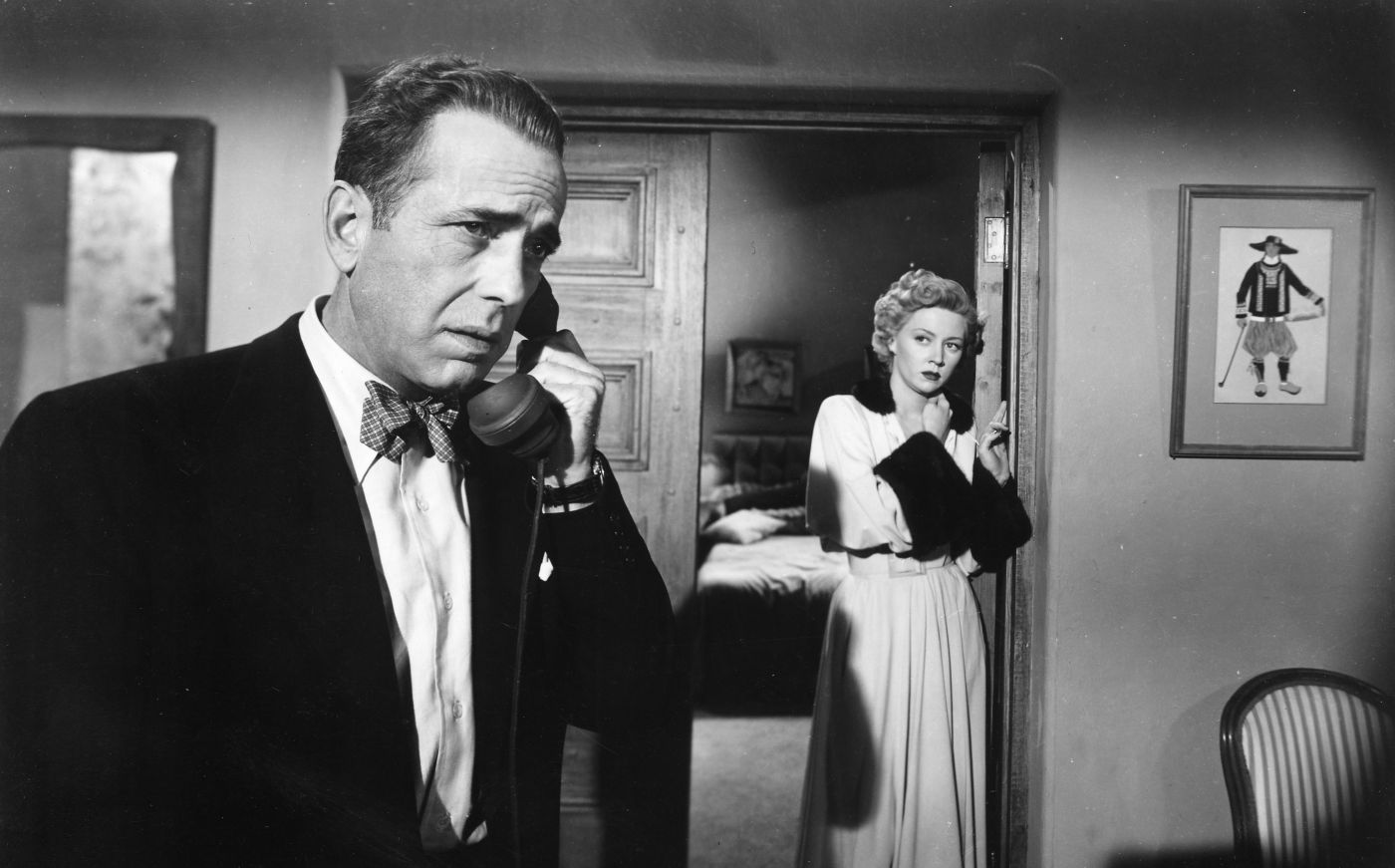
Sog.. dal romanzo omonimo di Dorothy B. Hughes. Scen.: Andrew Solt. F.: Burnett Guffey. M.: Viola Lawrence. Scgf.: Robert Peterson. Mus.: George Antheil. Int.: Humphrey Bogart (Dixon Steele), Gloria Grahame (Laurel Gray), Frank Lovejoy (Brub Nicolai), Carl Benton Reid (capitano Lochner), Jeff Donnell (Sylvia Nicolai), Martha Stewart (Mildred Atkinson), Robert Warwick (Charlie Waterman), Morris Ankrum (Lloyd Barnes), William Ching (Ted Barton), Steven Geray (Paul). Prod.: Robert Lord per Santana Pictures, Inc.. DCP. D.: 94’. Bn.
Edition History
I was born when she kissed me. I died when she left me. I lived a few weeks while she loved me.
Dixon Steele in In a Lonely Place, also quoted by The Smithereens in their song of the same name
Humphrey Bogart and Gloria Grahame are still within easy reach of film noir in In a Lonely Place. “He was much more than an actor: he was the very image of our condition. His face was a living reproach”, said Nicholas Ray about Bogart. In a Lonely Place is a reflection of post-war fractures. The war veteran Dix Steele has returned home and failed to revive his career as a screenwriter. The mythology of love is being rewritten – and it is full of sounds of paranoia. In female Gothic, an innocent woman enters the haunted palace of a man, but it soon turns out that they are perfect strangers. For men marriage is a continuation of war by other means. In a Lonely Place was produced by Humphrey Bogart’s Santana company, and it was Bogart who selected Nicholas Ray to direct. Never has Bogart’s body language been this compelling. His star myth is debunked – and a dangerous character is revealed. The film is a diluted version of Dorothy Hughes’s novel, yet faithful to its ambivalence; it has been changed to the benefit of a more profound unrest. Although we never visit the studios, In a Lonely Place is one of the greatest tales about Hollywood. HUAC and the black list are never mentioned, but In a Lonely Place is also about them.
Edited from Peter von Bagh’s posthumous papers (2014) by Antti Alanen
Nicholas Raymond Kienzle is an auteur in the best sense of the word. All his films tell the same story: the violent man who wants to renounce violence and his relationship with a morally stronger woman. Ray’s constant hero, the bully, is a weak man-child, when he is not simply a child. He is wrapped in moral solitude, always hunted, sometimes lynched.. […]
Insofar as we can divide filmmakers into two groups, the cerebral and the instinctual, I would certainly classify Ray in the second, the school of sincerity and sensitivity. […]
Ray is a kind of Hollywood Rossellini. […] Nicholas Ray lovingly fashions pretty little objects out of Hollywood. Down with the amateur! There are no Ray films that do not have a scene at the close of day; he is the poet of nightfall, and of course everything is permitted in Hollywood except poetry. […]
One can argue against Hawks and for Ray – or the other way around; one can condemn Big Sky in the name of Johnny Guitar or accept them both. But anyone who rejects either should never go to the movies again, never see any more films. Such people will never recognize inspiration, poetic intuition, or a framed picture, a shot, an idea, a good film, or even cinema itself.
François Truffaut, The Films in My Life, Touchstone, 1985

Courtesy of Park Circus. Restored in 2018 by Sony Pictures Entertainment at Roundabout Entertainment, Cineric, Inc., Deluxe Audio Services, L’Immagine Ritrovata laboratories, from a 35mm original nitrate picture negative
In August of 1950, the third Santana film, In a Lonely Place, was distributed, a film which would be counted among Bogart’s masterpieces. This too was directed by Nicholas Ray, but with a much greater commitment and sensitivity, giving the right sort of depth to this investigation on the violence contained in the plot. In truth, In a Lonely Place is Bogart’s only film that succeeds in getting close enough to the heart of the issue, which for the first time manages to break out of the restrictive conventions of the gangster genre. Bogart plays the role of Dixon Steele, a Hollywood screenwriter, once successful but currently unemployed and having a very hard time, due to both the contempt he holds for the values of the celluloid world, and the bad reputation he has gained with his sudden and dangerous fits of anger. […] This is the dark side, the negative equivalent of the emotional reticence of Sam Spade or of the obstinate neutrality of Rick. There is no latent heroism here, ready to triumph as soon as a nice girl or a difficult situation comes into play. This is authentic depravation, violence at its purest. It makes you wonder how much it holds true for Bogart the man, since the actor is too good at playing Steele, and since, as Raymond Chandler once said, «Bogart is always good at playing Bogart». […] «I took the gun out of Bogart’s hands», Nick Ray commented in regard to In a Lonely Place, thus lengthening the list of writers and directors who claim to have revolutionized his career. However, it may just be true that only he took the gun out of Bogart’s hands, and he let him make a good film. In any case, Warner Brothers didn’t waste a second to put the gun back in his hands, casting him in The Enforcer.
Jonathan Coe
Restored in 2001 by Sony Columbia