[MOVIE]
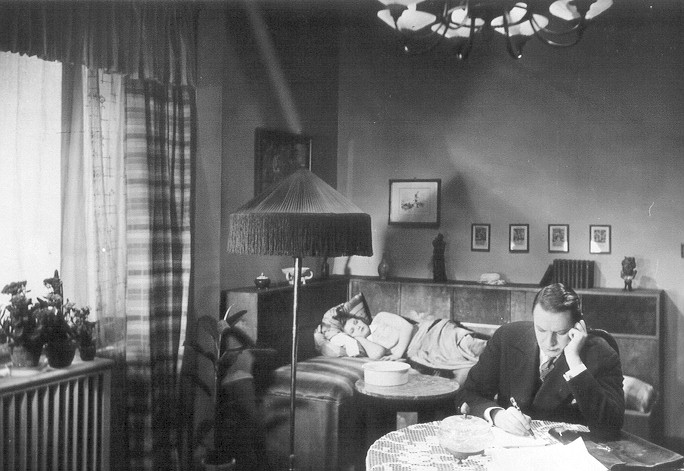
T.l.: Sesso in catene R.: Wilhelm Dieterle. S.: Franz Höllering, Karl Plättner. Sc.: Herbert Juttke, Georg C. Klaren. F.: Walter Robert Lach. Scgf.: Max Knaake, Fritz Maurischat. Truc.: Paul Dannenberg. Mus.: Fritz Brunn, Pasquale Perris. In.: Mary Johnson (Hélène Sommer), Wilhelm Dieterle (Franz Sommer), Gunnar Tolnaes (Rodolphe Steinau), Paul Henckels (Geheimrat), Hans Heinrich von Twardowsky (Alfred), Gerd Briese, Hugo Werner Kahle, Karl Goeth, Friedrich Kurth, Arthur Duarte, Anton Pointner. P.: Leo Meyer, Essem-Film GmbH, Berlino. D.: 112’ a 20 f/s.
“This is a middle-class perfectly ordinary ménage, when each partner is at ease with his/her role. The man is the provider, the womam takes care of the house, while waiting for their child to be born. In this film, the catastrophe of unemployment – although in those days unemployment was reaching staggering figures – is first of all a symbolic event perturbing conventional order: from that time onward the woman has to find work, a job where she displays herself to other men, selling sigarettes to night revellers. As for her husband, he looses the anonymous institutional certainty of his office work and is forced into the constraining role of a mere spectator of modernity – the great social challenge in the days of Taylorism and economic streamlining – but also of the domestic ‘normality’ and bourgeois prosperity: he sells vacuum cleaners door to door. The status of his crime needs a thorough study, considering that he is after all innocent. By defending his property – his woman – from the glance and hands of another man (who will fall to his death after being hit), he just tries to fight against the decline of the old order, the dangerous freedom of the new woman with her new ‘page-boy’ hair cut, whose image is taking hold in newspapers and magazines and is haunting society as much as the fear of homosexuality. It should also be remarked that a paranoid plot is fully developed to push our heroes towards homosexual liasons, all implicitly explicit. And the gesture of a man placing his hand on the one of his cell mate is stressed as the depth of ignominy, the consequence of a twice proclaimed decadence: the loss of a social (unemployment, the plummeting into proletariat) and patriachal status (the house, the wife).
On the one hand the optimism ‘despite everything’ expressed by the suicide of proletarian Mother Krause by Piel Jutzi, as the prelude for a better future; and on the other the desperate realism of the unemployed worker in Kuhle Wampe, freeing his family of the burden of a useless mouth to feed, the double suicide with gas of Franz and his woman, who are unable to survive their sexual ‘difference’, are maybe a gesture encompassing this modest film and its low middle-class paranoia in order to evoke the tragedy soon awaiting the whole nation with disquieting brutality”.
Noël Bürch