[MOVIE]
Edition History
The film-historical fate of Georg Wilhelm Pabst is uniquely depressing. Is there another director who at one point was venerated with such fervour as one of the greatest and politically most important ever – the Red Pabst – who fell so far that his name would be mentioned almost only with disdain and regret. Contemporary critics, and until recently most film historians, couldn’t forgive him his two films made during the Nazi period. Therefore everything he did after WWII was tainted, and only films on Big Subjects such as The Trial (1948), Jackboot Mutiny and The Last Ten Days (both 1955) were looked at more seriously.
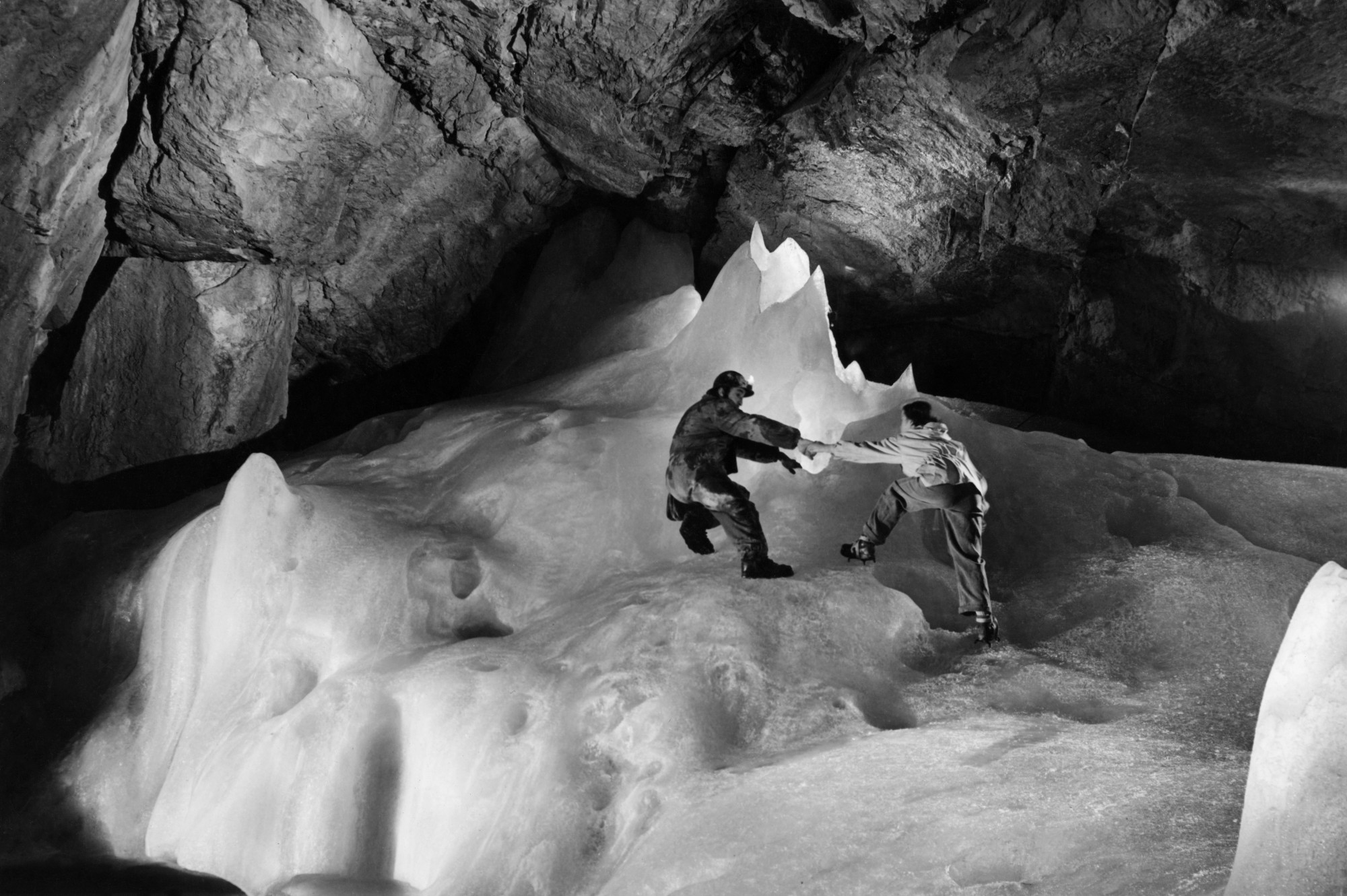
Geheimnisvolle Tiefe had no Big Subjects on offer, and was thus critically destroyed, while audiences also stayed at home. Seen today, Geheimnisvolle Tiefe reveals itself as a crystallisation of Pabst’s core interests – he was fascinated by the pleasures, pitfalls and perversions of sensuality and sex. The story of marital strife and despair, of a woman torn between possible lives as a scientist and a society lady, resembles the questions and tensions of Abwege (1928), while the subterranean settings connect it with the underground empire of L’Atlantide (1932). Pabst, here, looks into a scenery others use only as a landscape/setting or a mere story backdrop. With its glacial sense of irony, Geheimnisvolle Tiefe offers a view of the postwar world’s frosty inside that’s unlike anything else from the period.
Olaf Möller

Bavaria Film’s production schedule for 1941-1942 announced Geheimnisvolle Tiefe (Mysterious Depths) for the first time: the director would be G.W. Pabst, based on a screenplay by his wife Trude and Walther von Hollander, starring Brigitte Horney and Ferdinand Marian. The story focused on a woman in between two men, an idealist who believes in his own powers and delves deep into the dark, prehistoric past, and a materialist who relies on the power of money and lives in the light of the present. But Geheimnisvolle Tiefe was only one of many unrealized projects that Pabst worked on in the early 1940s to avoid being commissioned by Joseph Goebbels to do propaganda films.
In 1947, after the success of his first post-war film Der Prozess (The Trial, which won several awards at the Venice Film Festival), Pabst founded Pabst Kiba Filmproduction with public funding from the city of Vienna. Geheimnisvolle Tiefe was the most expensive project of the four films produced by this company before its liquidation in 1949. It was the most expensive Austrian production to date, with a popular cast (Ilse Werner and Paul Hubschmid), spectacular locations (the Hermann and Dachstein caves) and lavish settings at the Studio Schönbrunn. But representing Austria at the 1949 Venice Film Festival, the film was a terrible flop: critics called it an “embarrassment”.
The German premiere took place on September 30, 1950 – more than a year after the Austrian release. The film was cut from 109 minutes to 94 minutes, but the reviews were no less malicious than the Austrian ones. For decades the film was considered lost until in 1992 the Cinémathèque française was able to compile a shortened version from two decomposing nitrate positive prints. Now the critics rate the film as an interesting minor work of Pabst’s “with disturbing metaphorical imagery” (Thomas Brandlmeier) showing traces of many of his early masterpieces. The new digital restoration by Filmmuseum München is based on a recently discovered complete nitrate negative from the collection of the Svenska Filminstitutet.
Stefan Drössler

Restored in 2018 by Filmmuseum München in collaboration with the Svenska Filminstitutet and Cinémathèque francaise at Alpha Omega Digital laboratory