[MOVIE]
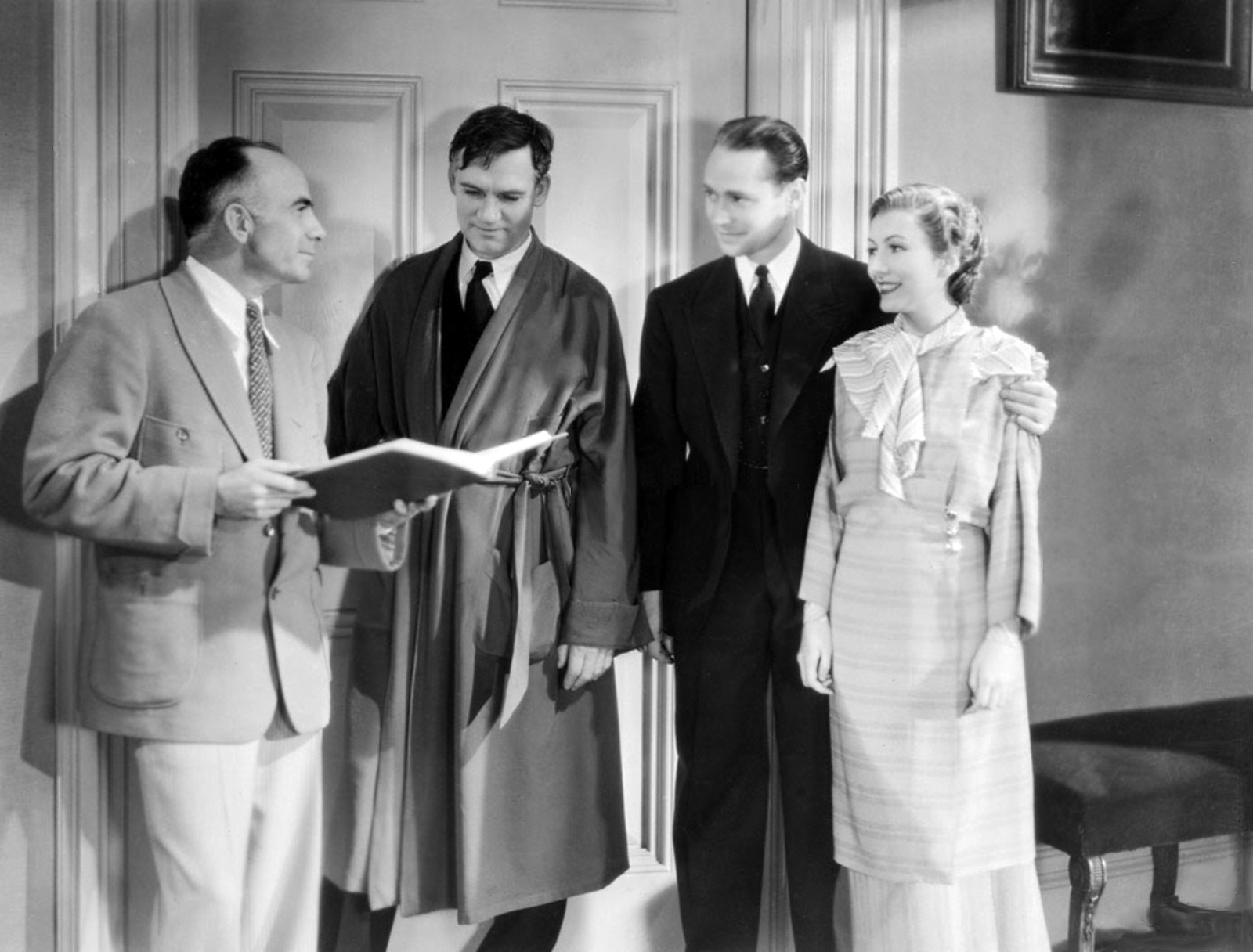
Sog.: basato sulla novella Rinehard di T.F. Tweed; Scen.: Carey Wilson, Bertram Bloch; F.: Bert Glennon; Mo.: Basil Wrangell; Co.: Adrian Adolph Greenberg; Mu.: William Axt; Su.: Douglas Shearer, Charles E. Wallace; Int.: Walter Huston (Judson Hammond), Karen Morley (Pendola Molloy), Franchot Tone (Hartley Beekman ), Athur Byron (Jasper Brooks), Dickie Moore (Jimmy Vetter), C. Henry Gordon (Nick Diamond), David Landau (John Bronson), Samuel S. Hinds (Dr. H.L. Eastman), William Paxley (Borell), Jean Parker (Alice Bronson), Claire Du Brey (infermiera di Jimmy); Prod.: Cosmopolitan Productions, Metro-Goldwyn-Mayer; Pri. pro.: 31 marzo 1933. 35mm. D.: 86′. Bn.
Edition History
A particularly dumb US President is elected – so dumb that he does not know where Siam is (any name coming to your mind?). But America is facing the Great Depression and God sends the Archangel Gabriel to inspire in the President the ‘right’ policies to face the crisis, and these include turning the US into a sort of dictatorship and vehemently humiliating its European and Asian allies, obviously weak, useless and ridiculous. But one second before signing the Treaty that would effectively turn the US into an imperialistic and unilateral dominant nation (how that could be?), the Arcangel leaves the President who suddenly realizes he went perhaps too far. Except that between him and the restoration of democracy and multilateralism stands his secretary (who is also his lover – any bell ringing?).
This could be the plot of Gabriel Over the White House. Or is it? Yes, but of which one? As there are two very different Gabriels, one for the domestic and one for the European market, and the many differences between the two are revealing of both the political debate of the time (or at least of W.R. Hearst’s take on it) and of the limitations imposed by the Hays Code.
The screening of the complete film in one version will be accompanied by a montage highlighting some of the key differences introduced all along the storyline, whose details were unclear until a closer comparison of the two ‘original’ versions held by the Ci- némathèque Royale de Belgique took place. “The film, intended by William Randolph Hearst as a tribute to newly elected Franklin Delano Roosevelt, called for the establishment of a benevolent dictatorship to solve the economic crisis facing America. When Hays saw the film be was dumbfounded. […] The next day Hays ordered (the film) back to the studio for political reorientation. Despite the fact that more than 30,000 dollars was spent on retakes, Gabriel Over the White House played to American audiences with most of its original message intact” (Gregory D. Black, in Film History, vol. 3, 1989).
Nicola Mazzanti

Gabriel over the White House is a wonderful film – a strange definition of 1930s Hollywood as a mass of contradictions. It is almost socialist in imagery, yet it was actively backed by Hearst, whose sympathies for fascism are well known. The film was shot fast and cheaply, which does not show because of the work of two brilliant personalities: director Gregory La Cava (My Man Godfrey, The 5th Avenue Girl) and producer Walter Wanger, who was obsessed with creating a “sensational” political melodrama.
Matthew Bernstein, author of Walter Wanger. Hollywood Independent, sums the film up: “President Hammond is an ordinary, amiable party politician, who after a fatal car accident is revived by God to become a dictator. He dismisses his cabinet and the Congress, repeals Prohibition and punishes gangsters, creates a working corps for the unemployed, enforces disarmament, and creates a new American currency. When felled by a heart attack, Hammond reverts to his former self and tries to rescind his ‘inspired’ actions before he dies.”
The President’s return to the original principles of the country, and more generally his decision to be honest and as simple, cause him to appear to be a madman. The unemployed are ready to march on Washington, and for once a big Hollywood production gives us a dignified view, without comic relief, of the activities of the militant and have-nots. (Here the decision by the filmmakers was poignant: instead of illustrating the ironic fantasy of writer Thomas W. Tweed, they produced a realist film, with newsreel accuracy.) While Gabriel Over the White House is certainly a “fairy-tale treatment of serious economic and social problems” (Bernstein), yet we see much, even if there were retakes and re-cutting of references to armed, revolutionary-minded workers, the contemptuous treatment of Congress, the treatment of foreign leaders.
Everything is open. Is the program presented by the President virulently and creatively radical, or near dictatorial? Is it a vital Rooseveltian tract or Swiftian irony? Or is it perhaps in praise of anti-democratic forms of governing? Is it a lure or a warning? The profoundly ambivalent film shares the characteristics of many later films where behind populist simplicity looms the danger of extreme right-wing temptations.
Last, please do remember the memorable one-liner of W.C. Fields about La Cava (whose talent he appreciated deeply): “Don’t ever sit on a toilet seat after Gregory La Cava has used it.”
Peter von Bagh