[MOVIE]
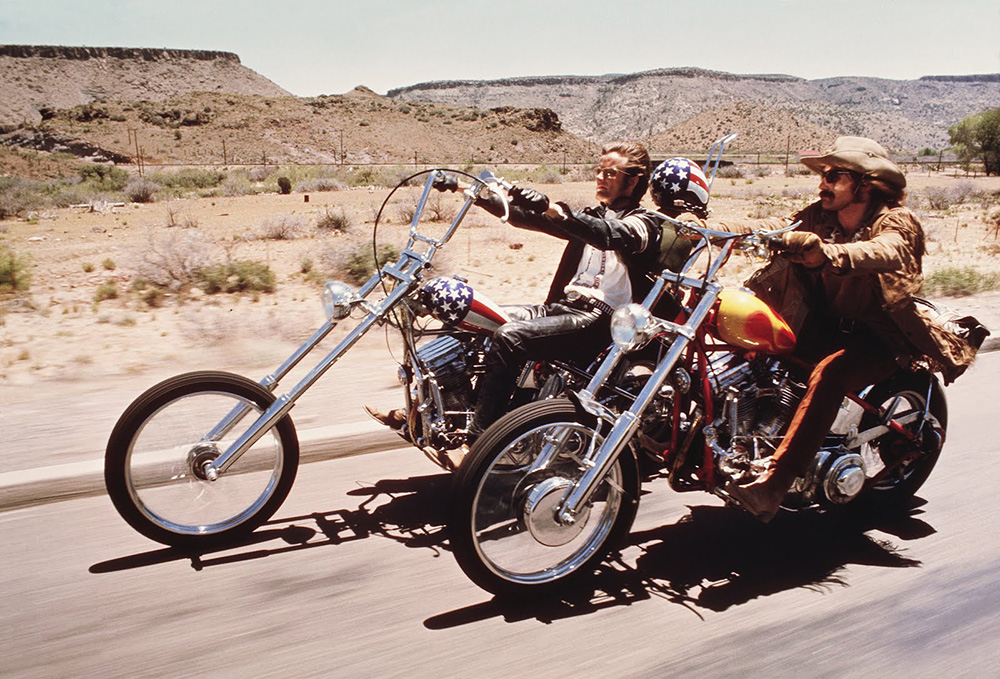
Sog., Scen.: Peter Fonda, Dennis Hopper, Terry Southern. F.: Laszlo Kovacs. M.: Donn Cambern. Scgf.: Jerry Kay. Int.: Peter Fonda (Wyatt ‘Capitan America’), Dennis Hopper (Billy), Jack Nicholson (George Hanson), Antonio Mendoza (Jesus), Phil Spector (Connection), Mac Mashourian (guardia del corpo), Luana Anders (Lisa), Sabrina Scharf (Sarah), Luke Askew (hippy sull’autostrada), Warren Finnerty (il proprietario del ranch). Prod.: Peter Fonda per Raybert Productions, Inc., The Pando Company, Inc. DCP. D.: 95’. Col.
Edition History
Along with the equally influential 2001: A Space Odyssey, Easy Rider was one of the key ‘trip’ movies of the late 60s, making its music more expressive than its dialogue and defining a generational divide by polarising audiences. As critic J. Hoberman has noted, the film “was above all fashionable” when it first appeared “and hence it dated almost immediately”. Yet arguably it is this datedness (unlike that of 2001) that defines much of its value today, as a time capsule in which the conflict between hippies versus rednecks offers a parallel with current struggles between progressives and minorities versus reactionary Trump supporters.
Even though Easy Rider, according to auteurist protocols, is mainly associated with its director, costar, and co-writer, Dennis Hopper, it was Peter Fonda who actually originated the project by pitching its basic premise – a contemporary western with motorcycles replacing horses as its two heroes, named Wyatt (Fonda) and Billy (Hopper) to suggest Wyatt Earp and Billy the Kid, emerge from a drug score and drive east across the country to attend the New Orleans Mardi Gras. And it could be argued that Terry Southern, the film’s principal writer, provided most of the meat lodged between the sandwich slices of Wyatt (relatively Christian) and Billy (relatively pagan). Namely, a figure standing halfway between the heroes and villains: Jack Nicholson’s career-producing role as George, an alcoholic small-town lawyer who briefly joins them before he is murdered by hate-filled compatriots.
The Mardi Gras material, shot in 16mm and edited more discontinuously than the rest to suggest the characters’ LSD trips, was improvised, as was an encounter between Wyatt, Billy, George and several locals at a roadside café who were invited to speak for and as themselves. Along with the cast taking real drugs, this conveys a documentary authenticity that helps one to overlook the metaphysical pretensions and rich-boy entitlements of the cowboy heroes.
Jonathan Rosenbaum

Restored in 4K by Sony Pictures Entertainment in collaboration with Cineteca di Bologna from the 35mm original picture negative and 35mm black and white separation masters. 4K scanning and digital image restoration by L’Immagine Ritrovata laboratory. Audio restoration from the 35mm original 3-track magnetic master by Chace Audio and Deluxe Audio. Color grading, picture conform and DCP by Roundabout Entertainment
The restoration of Easy Rider began approximately 18 months ago when, during an overall evaluation of the picture and audio elements, it was discovered that two of the ten reels of Original Camera Negative were actually duplicate replacement negatives. The Original Negative for these two reels were evidently damaged during the latter half of 1969, probably through overprinting at the time of initial release, the result being multiple vertical scratches to the emulsion of the film. The restoration of Easy Rider is still very much a work in progress, with 20 of the expected 25 minutes of negative digitally reproduced. The new reels need further refinement to a degree, primarily to correct for some minor mix-registration Also, in addition to the previously mentioned two reels, there are 18 other sections throughout the rest of the film that have damage that will be replaced shortly. Most of this damage is in the form of vertical scratches or 3 to 7 frame tears in various reels, seven damaged sections in reel one alone. In the current print, five of the 18 damaged sections have been replaced using digital processing, at both 2K and 4K resolution. Other replacements will be integrated in the coming weeks. Also, because the original camera negative had been treated with a lacquer coating during the 1970’s, there is still embedded dirt in the emulsion of the film. This dirt is manifested by small white dots that cross the image at times, most notably in night scenes. Tests at Kodak in Rochester and at Cinetech lab proved that to remove this lacquer would risk damaging the negative.