[MOVIE]
Edition History
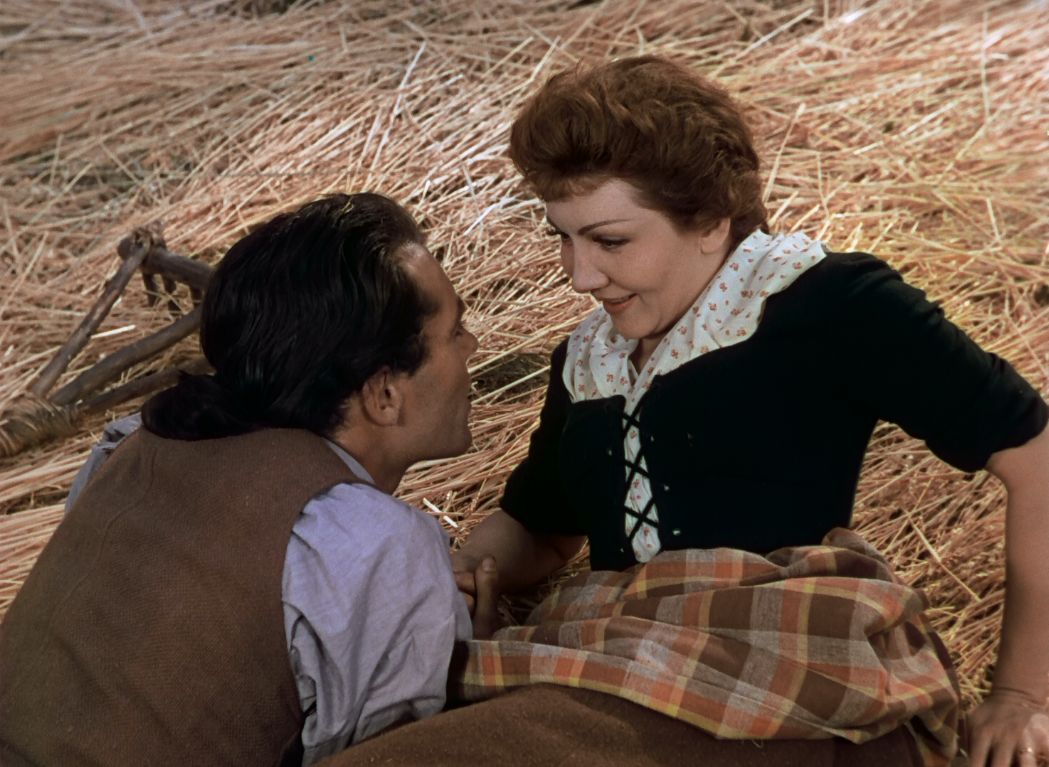
The lesser known and less valued of Ford’s astounding 1939 output (the other two were Stagecoach and Young Mr. Lincoln) and his first colour film ever, Drums along the Mohawk is, probably, a much underrated film owing to several presumptions and some disappointed expectations. In the first place, it turns out (as with so many other Ford movies) not to be a western, but geographically quite an eastern, certainly with Indians and pioneers, and even with war, although not the Civil War but the War of Independence, not in the 19th but in the 18th century. And, though it stars the already ‘Fordian’ Henry Fonda, his co-star is the not very Fordian (although she’s very good here) Claudette Colbert.
One might wonder if this might be the film which Ford was filming when, according to that more or less legendary tale (but likely and much in character), some sort of assistant to the producer complained that the shooting was lagging well behind schedule, to which Ford replied by tearing out several pages of the script and telling him not to worry, “Now we are on schedule”, because there is a magnificent scene in which, instead of a battle, the injured, exhausted Fonda tells his wife what happened in it, in a way much more effective and affecting than the actual showing of the battle would have achieved. And it was, no doubt, shorter and easier to shoot and much less expensive. Although, if I recall it well, it was Joseph LaShelle who told that story to Peter Bogdanovich, and LaShelle only photographed a Ford movie, and that was much later, 7 Women (1966). However, since Drums along the Mohawk was a Fox production and most of LaShelle’s career was at that production company, perhaps Bert Glennon or Ray Rennahan, the two cameramen on this first Ford colour film, had told this revealing anecdote about Ford, who usually combined digression and ellipses in most of his narratives, no doubt because he liked to tell things in a rather roundabout way, so he usually alternated the addition of some scenes with the elision of others.
Miguel Marías

Per concessione di 20th Century Fox e Park Circus. Technicolor print made for a reissue without original tinting on safety stock
A lot could be said about this incredibly rich film in which Ford uses color for the first time and about its allusions to national unity at a time when war was about to break out in Europe (like in King Vidor’s Northwest Passage, made at the same time). I will just mention three things. (…) A panning shot of a vast landscape with a pine forest in the background. The image is crossed diagonally by American soldiers moving away to the tune of “Yankee Doodle Dandy”. In the foreground to the left, Lana (Claudette Colbert), the wife of Gil (Henry Fonda), is standing and then disappears. The composition repeats Griffith’s The Birth of a Nation (Sherman’s march to the sea) “verbatim”. But whereas Griffith’s sympathy with the Confederates created an irreconcilable conflict between epic and pathos, Ford, who worked without Griffith’s sweeping vision, showed the inseparable link between these two mutually functional emotions. (…) Upon his return, Fonda described the battle in which he participated, the Indians painted blue, yellow and red, the British in their red uniforms. They say that Ford, tired of Zanuck’s reminders – he had reprimanded Ford for being late and having gone over his budget – resorted to this “story à la Theramenes” instead of shooting a long and expensive battle. The anecdote does not change a thing; Fonda’s itinerary is what justifies the comparison with classical tragedy (and with the eternal progression of the epic), setting off in search of reinforcement and followed, like Horace, by three Indians. Set to the beat of “Yankee Doodle Dandy” and reminiscent of Paul Revere’s midnight ride and the run from Marathon, the film is a lengthy display of Ford’s skill, which reaches perfection with the silhouettes emerging on the horizon bathed in the orange light of dawn.
Jean-Loup Bourget, John Ford, Éditions Rivages, Paris 1990
Restored by the Academy Film Archive and 20th Century Fox with funding from the Film Foundation and American Express, as part of the Preservation Screening Program, “In Glorious Technicolor”. The original Technicolor negatives were destroyed after they were printed onto a color reversal internegative (CRI) an unstable film stock. Over the years, the yellow layer of the CRI began to collapse and result in visible color-dye fading of the image. The CRI elements were scanned at 2K resolution; the 3 color records were digitally re-registered; image processing improved steadiness and reduced flicker, color breathing and film grain build up; 2 35mm film negatives as preservation elements from the approved digital master were produced – one for the Academy, one for Fox; and additionally, two sets of uncompressed 2K film master data files were created for archival purposes.