[MOVIE]
P.: Electrical Fono Films Company A/S. D.: 20’.
In 1918 the two Danish engineers AzeI Petersen (1887-1971) and Arnold Poulsen (1889-1952) together with some financiers founded the Electrical Fono Film Company Ltd. Their goal was to develop a sound system, with an acceptable fidelity in syncronization with motion pictures.
Five years later, on 12th October 1923, Petersen and Poulsen were ready to demonstrate the result of their combined efforts before an audience of invited persons at the Palads Theatre in Copenhagen.
The programme consisted of two paris with an intermision. The film started with an opening speech by a well known compire followed by seven well known Lanish actors and singers performing one by one (One of the features included two actors, though) on the screen with picture and sound fully syncronized.
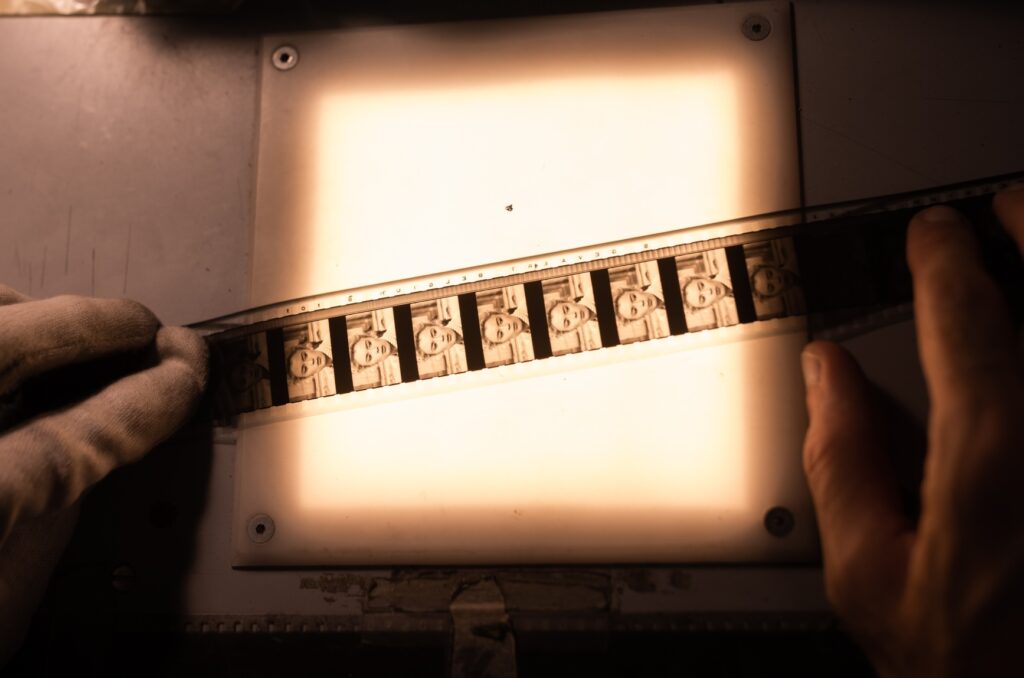
The film ran for 20 minutes. The picture film was a 35 mm full-frame 133:1 shot at 16 frames per second (fps). The photographic sowndtrack, a unilateral variable area about 9 mm wide, was on a separate 35 mm film runnining at 32 fps. Parts of the film were shown as a shot before a silent film, later in 1923. But after 1923 the film was never shown. The original picture and sound negatives have been lost long ago. However, the print used on that very 12th October has by 4 miracle survived and was acquired by the Lanish Film Museum in shreds and patches together with some other films in 1988. Before that time the reels had been stored in airtight cans. We soon came to recognize that some of the pieces of the film originated in the demonstration film of 1923. But in the spring of 1991 we realized that we were faced with the complete film.
Since 1988 we have been concentrating on restoration of soundtracks made by Petersen and Poulsen from 1929. These tracks are also on separate 35 mm film but 24 mm wide with both picture and sound running at 24 fps.
A playback machine for the 24 mm tracks was made. This unit also has a noise reduction shutter with adjustable sensitivity and bias. The machine is able to playback all optical soundtracks on the 35 mm film. The slit can be masked according to the width of the soundtrack concerned. The requency response is flat from 40 to 8,000 Hz.
Very few modifications of the playback machine were necessary to have fitted for the 9 mm tracks. Some gear wheels were changed in order io obtain the necessary 32 fps, a new shutter blade for the noise reduction was made and the slit was masked. The sound tracks were redimensioned for the reduction of wow, and then transferred to full track ¼ inch audio tape at the speed of 15 inches per second (ipe). As the playback machine is driven by a synchronous motor the mains frequency (50Hz) is recorded as the pilot signal on the tape.
One of the features included a singing actor playing the lute. A lute expert was called in. He first watched the film on video to identify the chorde played, and then simply tuned the tape speed by means of a 440 Hz concert pitch reference and a vari-speed connected to the tape recorder. It was now possible to determine the speed of the demonstration film more precisely: 15.2 fps for the picture film and 30.4 fps for the soundtrack. We know that the sound camera (which also drove the camera) was manually adjusted with reference to a tachometer. The presumption is that Petersen and Pouisen had chosen 16 and 32 fps respectively, but owing to a typical error in the tackometer indication, the film was recorded at 5% lower speed. Having every second frame printed twice meant that the final print which combined picture and sound had to be shown at 22.8 fps. We therefore decided to accept a compromise. At the time where sound on the ¼ inch tape was transferred to 17.5 mm magnetic film it was also digitally pitch-changed to match 24 fps.
Because of the Museum’s 50th anniversary in 1991, where the film was to be shown at the reception, we didn’t have time to make any further improvement to the soundtrack. But this almost raw version boasts a signal-to-noise rato of 35 dB with an impressive intelligibiliy of speech.
The demonstration film is called “Den talende Film” (The Speaking Film). Not only is it a historical titbit, but it contains a few artists from the past, some of whom went in front of a motion picture camera on this occasion only. (Uffe Lomholt Madsen, Det Danske Filmmuseum)