[MOVIE]
Edition History

Daniele Casagrande collection, National Film Archive of Japan
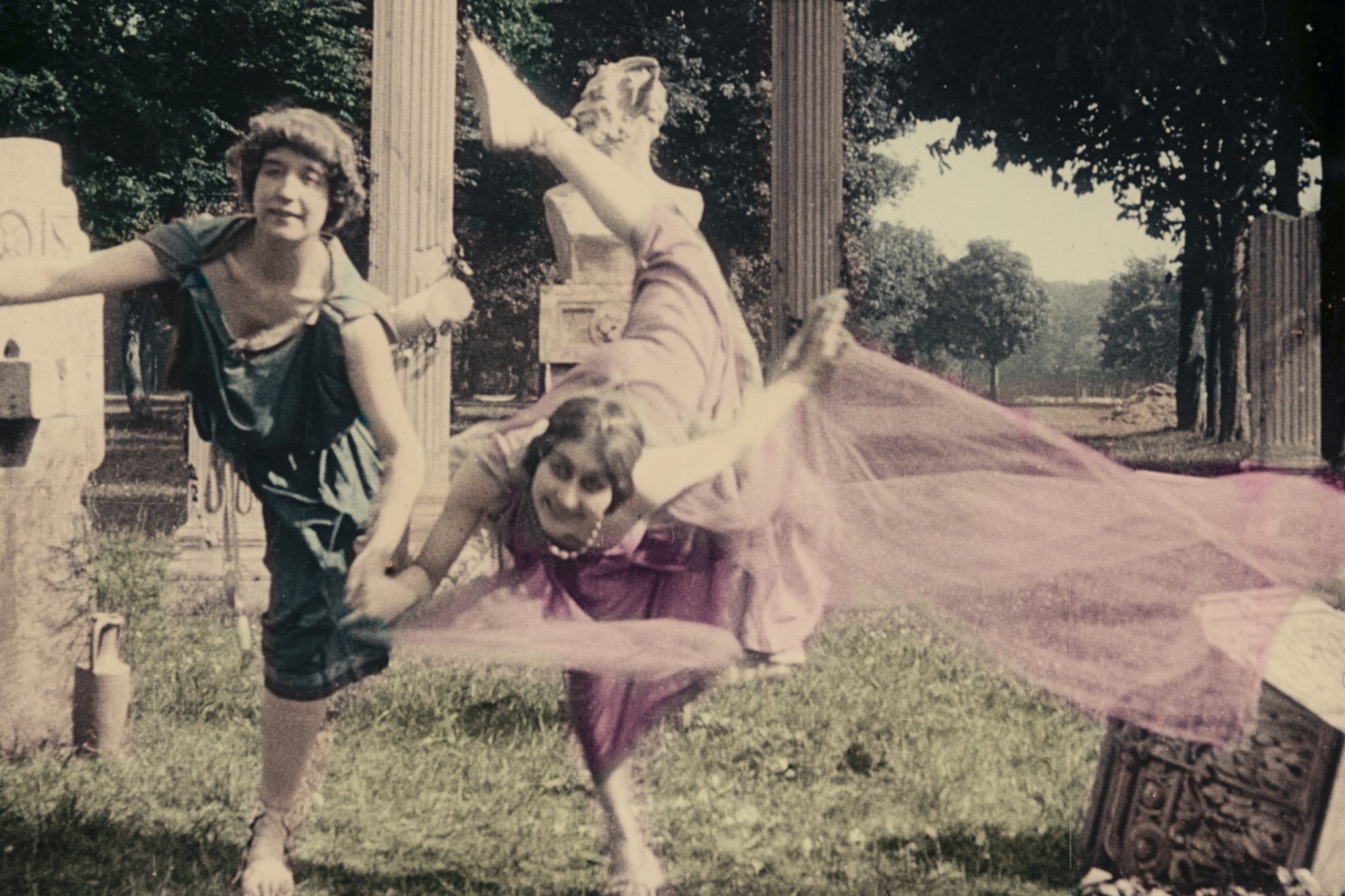
N. 9535 [Fragments. Tomijiro Komiya Collection]
Antiquity was a source of unending inspiration for paintings, novels, dance and not least for fashion. According to Henri Bousquet, Dans l’Hellade was shown in a film programme during the “Festival of Work and Art”, which Charles Pathé organised for his staff (Catalogue Pathé 1909, 1993 p. 204). Until recently this film was only known in a Pathé Kok version (which was shown at Cinema Ritrovato 2008). Since then however both a stencil-coloured nitrate positive and a black and white print struck from the original negative have surfaced.
Digitally restored by L’Immagine Ritrovata laboratory in 2010
In March Pathé launched its “optical report on the latest events” – the first newsreel. The Pathé Journal, and the competing newsreels which came hot on its heels from other companies, ensured a secure place for current affairs and other non-fiction genres of the short film period (such as travelogues and industry films) in cinema programmes for decades to come, even after the switchover to feature length for fiction films. We did not find a film can marked “Pathé Journal No. 1”, but there were enough other films for an optical report on the latest events of 1909.
First Paris season of the Ballets Russes!
The Ballets Russes dance scenes found at the CNC are really sensational: these are probably the only record in moving images of Sergei Diaghilev’s soloists in their dazzling first Paris season of 1909, one of the biggest cultural events of the epoch. We see Tamara Karsavina, who was Vaslav Nijinsky’s partner until 1913, as well as Alexandra Baldina and Theodore Kosloff (possibly understudying for Karsavina and Nijinsky in Les Sylphides). For these documents we have to thank the producer Jules de Froberville. According to Eric Loné’s filmography, de Froberville’s company, “Les Films du Lion”, brought out about 200 titles during its brief two-year (1908-1910) existence.
Aviation and the first aerial film!
In 1909 the Wright brothers were on a European tour, and the film they shot on a flight over Rome on 24 April 1909 is thought to be the first of its kind. The first international aviation meetings took place – with massive press coverage – in August in Reims and in September in Brescia. These were spectacular open-air events for an audience including prominent members of the nobility, the military and the cultural elite. Franz Kafka, accompanied by Otto and Max Brod, was at the Brescia show and observed how “Gabriele D’Annunzio, short and puny, seems shy as he dances in front of Conte Oldofredo” and how “Puccini’s heavy features look over the airfield from the grandstand” (F. Kafka, Die Aeroplane von Brescia, in “Bohemia”, No. 269, 29. September 1909).
Bousquet notes in the Pathé catalogue, referring to the six-minute film of Blériot’s first flight over the English Channel (on 25. July 1909), that it had been screened on the very evening of the flight in the “Pathé Omnia” cinema in Paris. The film’s efficient narrative shows us yet again that formal developments in non-fiction genres had the capacity to outstrip those in their fictional counterparts.
Miscellaneous: Futurism! Montessori! Joyce Opens a Cinema in Dublin!
A hundred years later it is clear to us that the aeroplanes of 1909 had more in common with kites and bicycles than with the planes of today. Yet it was certainly the impact of aviation (and of the cinematograph) which inspired the slogan of futurism, “Velocità, dinamica, tecnica, guerra!” (“Speed, dynamism, technology, war!”). We salute the publication of Filippo Tommaso Martinetti’s Futurist manifesto in February 1909, in Bologna and Paris, with a futuristically speeded up policeman. Also from Italy came a counterforce to this misogynistic, war-loving avant-garde: modern pedagogy. In 1909 Dr. Maria Montessori published the first edition of her groundbreaking work Il metodo della pedagogia scientifica, based on her own social work. To her we dedicate the lovely series of children’s portraits in Concorso di bellezza fra bambini. Une Pouponnière à Paris, one of the films in the programme of 20 December 1909 at the opening of the “Volta” cinema in Dublin, happens to complement it brilliantly. This ultimately unsuccessful initiative – the “Volta” would be sold at a loss in June 1910 – was the brainchild of James Joyce, a film buff who was hoping to supplement his meagre income as an English teacher in Trieste.
Debut of the Movie Star!
Sometimes there actually are clear answers to important questions. Question: Who was the first film star and when? Answer: Cretinetti. 1909.
André Deed had left France and Pathé at the end of 1908. In 1909 he made 28 films for Itala. All 28 titles include the name of the lead, Cretinetti. Other up-and-coming stars were already in the business (including Sarah Duhamel, Prince, Stacia Napierkowska and Max Linder), but it was only later that they would be marketed on the basis of their name and a specific acting persona, as Cretinetti had been. In 1909 Linder was already well paid by Pathé, but he made only 11 films all year and none had the name Max in the title. At this stage he was not always Max the Dandy and could also play a schoolboy if called on to do so (Amoureux de la femme à barbe/ In Love with the Bearded Woman).
At the same time as the comic, this year also saw the birth of the diva, the glamour goddess. From Cleopatra to Antinea, the range of classical and oriental cinema roles played by Stacia Napierkowska could have been taken directly from a Ballets Russes programme.
Mariann Lewinsky

Popular Opposites: High and Low
Film historians watch films to school themselves in belle epoque cinematography; if they choose a ‘panoptic perspective’ (A. Gaudreault), they can place the cinematic images within the synchronic panorama of belle epoque cultural production in their ‘cultural order’, linking them with photography music hall, painting and juvenile literature. Conversely cinematography transports current contents, fashions and imaginations. When looking at the films made in 1907, I was struck by the genuinely looming presence of hunger and poverty in the scènes dramatiques (think of La lutte pour la vie and Le bagne des gosses); this inspired the first part of the programme. An image as unforgettable as a photograph: the old woman in the yard of the dog shelter (where the rich lady visits to choose a dog).
Given our experience nowadays, when media mix, scarcely an opera production dispenses with the projection of moving images on stage and the most interesting theatre directors have their actors dance silently one moment and sing a cappella the next, we would not make a bad audience for the historic gala premiere of L’assassinat du Duc de Guise on 17 November 1908 at the Salle Charras. It consisted of filmed dances in the fashionable ancient Greek style (Le secret de Myrto) to a poème musicale by Bérardi, a “Venetian Series” of projected autochrome images with music by Scarlatti and Monteverdi, the recitation of a poem by Rostand illustrated with a (filmed) pantomime and the two films L’empreinte ou la main rouge (“mimodrame cinématographique”) and L’assassinat du Duc de Guise (“Piece cinématographique”), each accompanied by original compositions. Both films rely on body performance. Alongside the mime Gaston Séverin, who plays the leading role of Pierrot, the highlights of L’empreinte are the valse chaloupée by the music-hall stars Mistinguette and Max Dearly (who had been causing a sensation with this Apache dance at the Moulin Rouge since 27 July 1908) and the performance of the dancer Stacia Napierkowska. The tension and coherence of L’assassinat du Duc de Guise are rooted in the powerful presence of Charles Le Bargy as the black perpetrator and Albert Lambert as his white victim; the quality of the performance is immediately apparent to us. Thankfully film historians have stopped measuring the quality of a film by the number of shots and the movement of the camera.
Mariann Lewinsky