[MOVIE]
Edition History
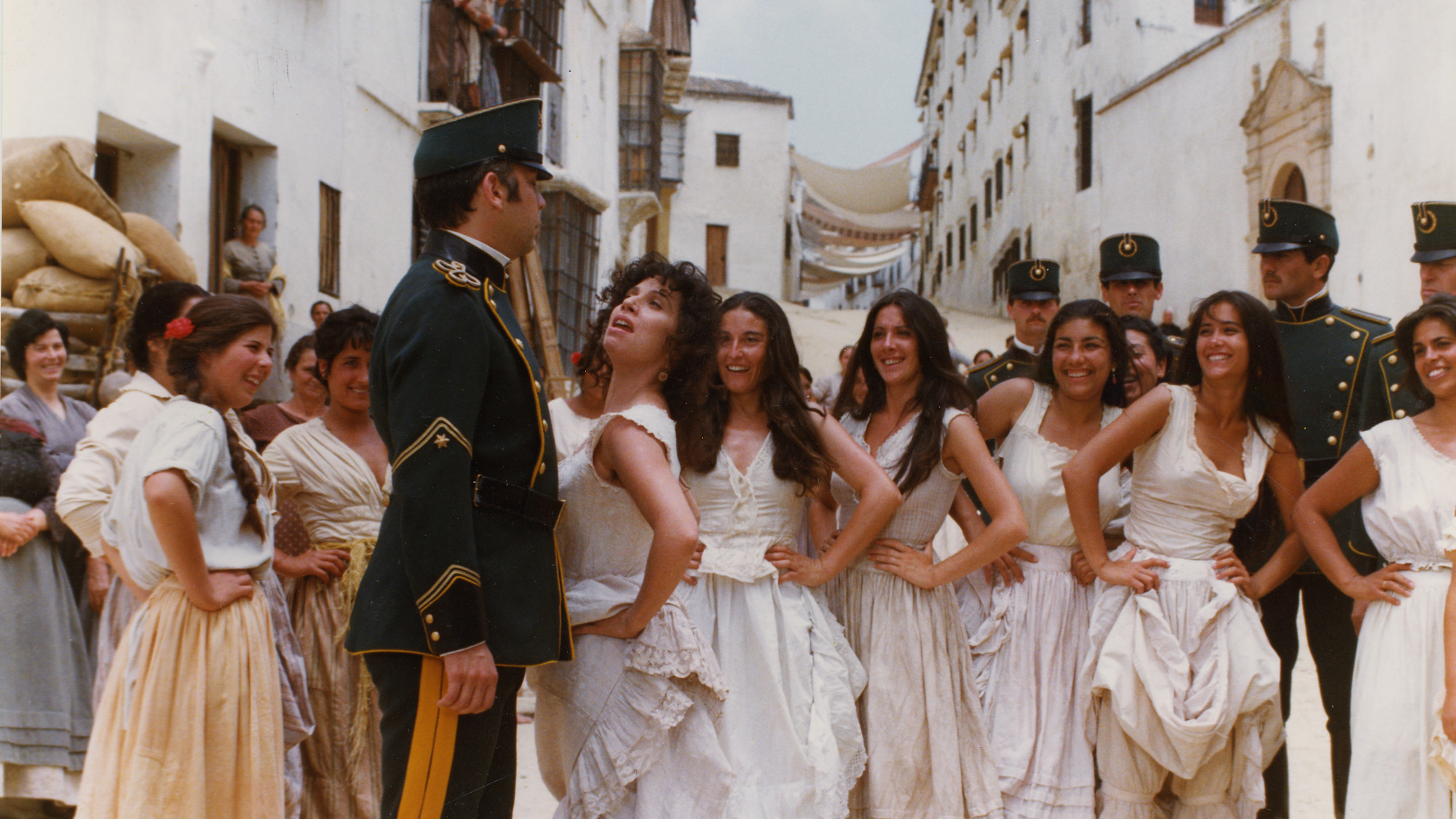
After having produced Losey’s Don Giovanni (1979) and Syberberg’s Parsifal (1982), the managing director of Gaumont, Daniel Toscan du Plantier, proposed a film version of Bizet’s Carmen to Francesco Rosi. According to Toscan du Plantier, “an opera-film can only be the result of a close union between an opera and a filmmaker. And I mean filmmaker, as opposed to a theatre director who steps behind the camera simply to further the opera’s cause. […] Such an idea established the necessary principles: the quality and physical suitability of the actors; forget the stage and think in images.”. Having overcome an initial reticence due to his lack of familiarity with opera, Rosi soon became passionate about the project – “I believe that Carmen is the most cinematic of operas” – and discovered that he was in agreement with Bizet who “viewed the love between a man and a woman exactly as I do: the love between two beings who are, and who inexorably remain, adversaries”. He wanted to produce “a visual interpretation, not only of the libretto, but also of the music”, so that “every note found its equivalent in a precise image which would make an impact on the spectator” thanks to the plasticity and chromaticism of Pasqualino De Santis’ cinematography. Given that Bizet adopted the language of dance because he understood that “for Andalusians and gypsies, gesture and dance are privileged means of expression” (and Carmen, after all, is a gypsy), Rosi, with the help of Antonio Gades, placed emphasis on the film’s choreography, which was inserted into the authentic, arid Spanish landscape (shooting took place in Ronda, Carmona and Seville) and real, natural sounds. He asked the conductor Lorin Maazel to record the singers separately, on different tracks, so that during the mix he could emphasise or vary specific musical passages. One of the most original aspects of Rosi’s Carmen is the variety of registers: “The freedom with which Bizet worked to brilliantly combine operetta and tragedy is the thing that fascinated me the most and led me to agree to make the film.”
Roberto Chiesi

Restored by Gaumont
After having produced Losey’s Don Giovanni (1979) and Syberberg’s Parsifal (1982), the managing director of Gaumont, Daniel Toscan du Plantier, proposed a film version of Bizet’s Carmen to Francesco Rosi. According to Toscan du Plantier, “the opera-film could only come about if there was a strong between the cineaste and the chosen opera. And I use the term cineaste to distinguish the operation from that of a theatrical director who steps behind the camera for the sake of the project. […] This underlying idea established the basic principles of the project: the quality of the actors and their physical suitability for the roles, and the need to forget about the stage and think in images”. Once he overcome an initial reticence due to his lack of familiarity with opera, Rosi quickly became enthused by the project – “I think that Carmen is the most cinematic of operas”. He soon recognised a rapport with Bizet who “conceived of the love between a man and a woman in exactly the same way as I do: a love between two beings who are, and who inevitably remain, adversaries.
He wanted to make “a visual interpretation, not only of the libretto, but also of the music”, so that “each note corresponds to a precise image that imposes itself on the spectator” thanks to the plasticity and chromatic scheme of Pasqualino De Santis’ cinematography.
Bizet also made use of the medium of dance, since he realised that “for the Andalusians and gypsies, gestures and dance are a privileged form of expression” (and Carmen is a gypsy). So, with the help of Antonio Gades, Rosi privileges choreography, but locates it within the authenticity of natural sounds and the airy Spanish locations (in Ronda, Carmona and Seville). Rosi asked the orchestral director Lorin Maazel to record the singers separately, on different tracks, to retain the possibility of underlining or varying particular moments of the music during the mixing. One of the most original aspects of Rosi’s Carmen is the variety of registers: “the liberty with which Bizet operated, mixing ‘operetta’ and tragedy, is the thing that most fascinated me and convinced me to do the film”.
Roberto Chiesi
Restored by Gaumont