[MOVIE]
Sog.: Karel Lamač. Scen.: Karel Lamač, Martin Frič. F.: Otto Heller. Scgf.: Bohuslav Šula. Int.: Karel Lamač (Ivan Holar), Vladimír Majer (Jakub Rezek), Anny Ondráková (Nina Mirel), Josef Rovenský (Tomáš), Saša Dobrovolná (madre di Holar), Jan W. Speerger (poliziotto), Karel Schleichert (poliziotto), Karel Fiala (guardiano della prigione). Prod.: Kalos. 35mm. L.: 2013 m. D.: 73’ a 24 f/s. Tinted and toned.
Edition History
In “the wild mountain country where people were born with loneliness in their hearts” (as the opening intertitle rather poetically puts it), orphan girl Nina fantasises about being a princess in a crystal palace while she toils in the tavern run by her miserly guardian, Jakob Rezek. Escaped convict Ivan Holar returns home to the mountain country on Christmas Eve to visit his dying mother. Nina and Ivan cross paths when both seek refuge in the tavern cellar – Ivan from pursuing patrol guards, Nina from the tyrannical Rezek – leading to love, loss, redemption, and ultimately the start of a new life for both.
Reportedly made on a modest budget of only 90,000 koruna, this Christmas (fairy)tale was the second and last production of the short-lived Kalos company (an abbreviation of Karel-Anny-Lamač-Ondra-spol). Like its previous film, Otrávené světlo (The Poisoned Light, 1921), Bílý ráj brought together the “dream team” of actress Anny Ondráková, actor-director Karel Lamač, and cameraman Otto Heller, who – together with screenwriter Václav Wasserman – would come to be known as “the mighty four” of Czech silent cinema. All three would go on to forge successful careers abroad, and continued to work together well into the 1930s, with Ondráková (now going by the name Anny Ondra) at one point forming her own production company with then-boyfriend Lamač in Berlin. Gustav Machatý, future director of such masterpieces as Erotikon (1929) and Extase (1932), meanwhile makes a brief appearance in a supporting role.
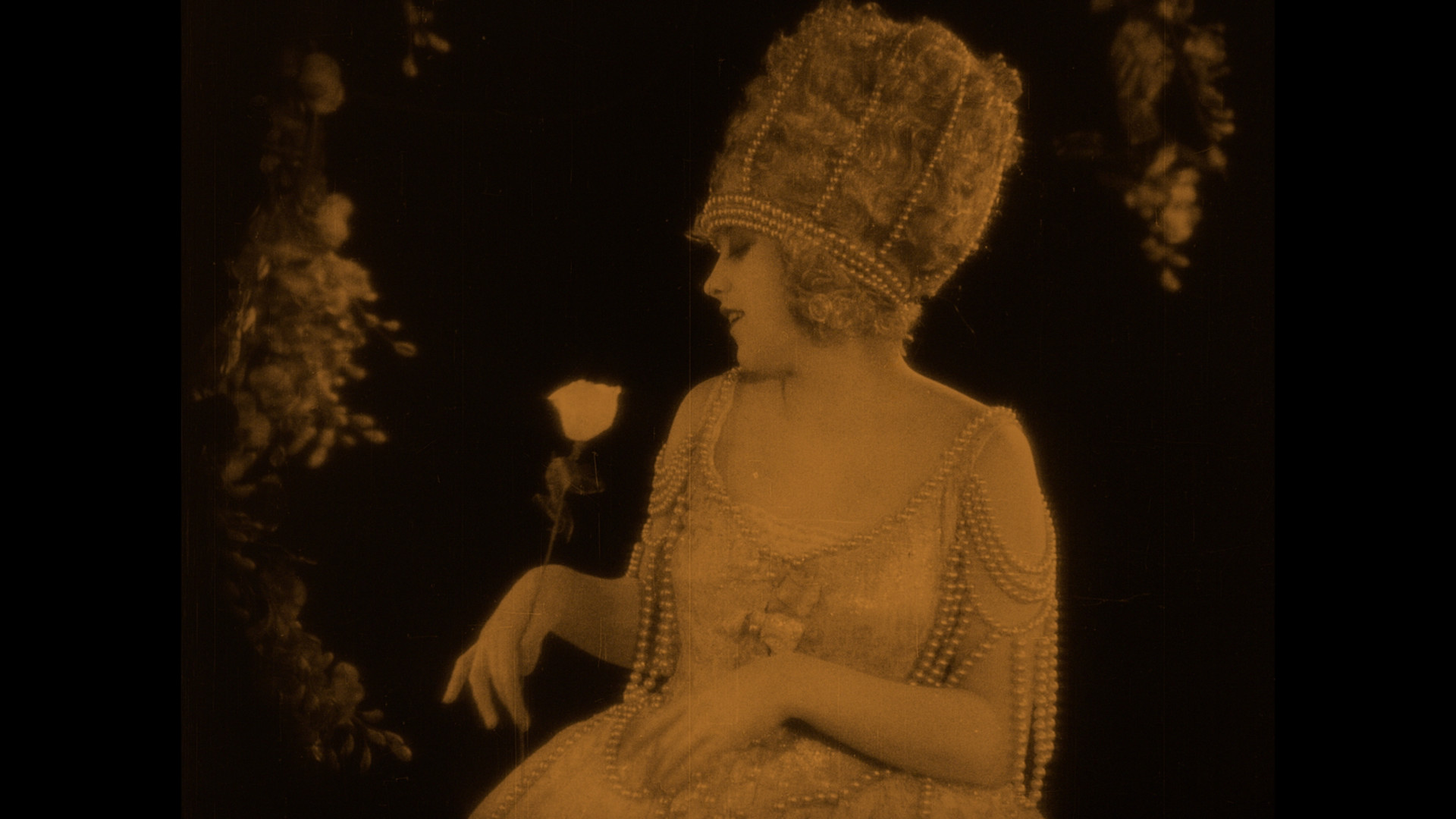
Heller’s breathtaking exterior photography is very much the third star of the film after Ondráková and Lamač, and the natural beauty of the snow-covered mountain landscape is accentuated by the vibrant colours of Národní Filmový Archiv’s restored print. Eight years after it first wowed the audience at Il Cinema Ritrovato, the tinted and toned print will be presented this year in the added splendour of the warm glow of the carbon-arc light projector.
Oliver Hanley

Restored by Národní Filmový Archiv from a 35mm tinted and toned nitrate print. Colour tinting and toning reproduced by Jan Ledecký, under the supervision of Národní Filmový Archiv, in line with the original historical methods
There is no other way to see what a tinted and toned silent film really looks like but to see one. So come and see Bílý ráj; do not miss the unique opportunity to experience a black and white positive print, colored by tinting and by toning, and not a facsimile, a transfer, an approximation, a simulation.
It is a blissful experience, since one can simply sit there and watch the film, undisturbed by nagging doubts about how it could or should actually look and without the usual constant suffering from never ever seeing a black black nor a white white and from basically everything being somehow wrong. And it’s exciting viewing, with many exclamation marks. Oh! Shimmering snow! Ah! Blue and White! There is a plot – handsome hero accused of a crime the bad guy committed, sick mother, Cinderella heroine, pursuits and chance meetings – which doesn’t interfere too much with the pleasure of being in the presence of all this shimmering translucence. An outstanding work would have made it difficult to measure how important colour can be, while this friendly, average film with the Czech dream team Karel Lamač and Anny Ondráková and the inappropriate title White Paradise proves beyond any doubt that colours can make all the difference.
Mariann Lewinsky
According to the laboratory assistent Frantíšek Rubáš special attention was given to the colours: “Lamač brought recipes for tinting and aniline colours from Germany and in my free time I made a lot of tests to establish the precise program of toning and tinting for each sequence of Bílý ráj. The result was really beautiful. The sunny shots in the mountains were yellow, evening and night scenes were blue, the sunset was a combination of blue toning and pink eosin, the interiors illuminated by oil lamps were orange, and there were other colour effects, all of them chosen with care to give a natural impression and to help the action of the film”. Indeed, the film shows an exceptional range of colours: three different tints, blue toning and brown toning and two combinations (blue toning with yellow tinting; blue toning and pink tinting).
The source of the restoration is a unique nitrate print. Under the supervision of the Národní filmový archiv in Prague, a black and white acetate positive print made from the nitrate in 1997 using wet gate printing was carefully tinted and toned to conform to the original colours in 2016 by Jan Ledecký, with a method that did not require cutting and splicing the film.
Jeanne Pommeau
Restored in 2016 by Jan Ledecký under the supervision of Národní Filmový Archiv, from a tinted and toned 35mm nitrate print