[MOVIE]
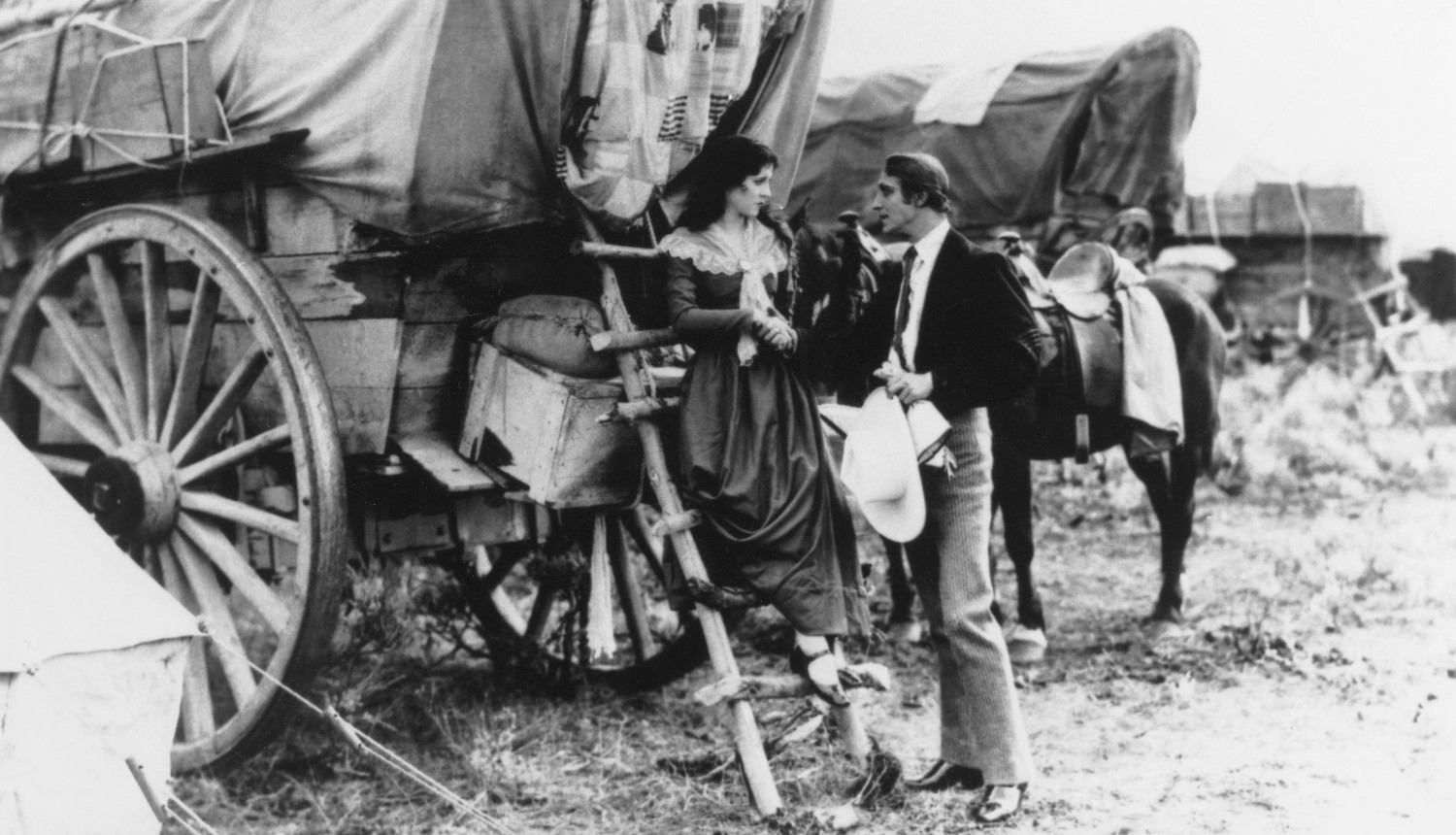
Sog.: dal romanzo Over the Border (1917) di Herman Whitaker. Scen.: John Stone. F.: George Schneiderman. Int.: George O’Brien (Dan O’Malley), Olive Borden (Lee Carlton), Lou Tellegen (Layne Hunter), Tom Santschi, (‘Bull’ Stanley), J. Farrell MacDonald (Mike Costigan), Frank Campeau (‘Spade’ Allen), Priscilla Bonner (Millie Stanley), Otis Harlan (Zach Little), Phyllis Haver (Lily), Alec B. Francis (reverendo Benson). Prod.: William Fox per Fox Film Corporation. DCP 4K. D.: 91’. B&W and tinted.
Edition History
John Ford’s first epic western, the 1925 The Iron Horse, helped to establish Fox as a major studio and Ford as Fox’s most prominent director. Granted an even larger budget and creative independence for his 1926 return to the genre, 3 Bad Men, Ford created perhaps the most fully achieved of his silent features, a historical pageant that never overwhelms its foreground characters.
Establishing the theme that would define his work for decades to come – the outsider who sacrifices himself for the good of the group that has excluded him – Ford creates three lovably eccentric outlaws (played by the early western star Tom Santschi; Allan Dwan regular Frank Campeau; and the first of Ford’s elfin Irishman, J. Farrell MacDonald) who resolve to protect a young homesteader (Olive Borden) and her fiancé (George O’Brien) from the violence surrounding the opening of the Dakota Territory.
Villainy, in the form of the territory’s gambling boss, is provided by the colorful Lou Tellegen, a Dutch-born actor who made his film debut opposite his romantic partner Sarah Bernhardt in the 1912 Film d’Art production La Dame aux camelias. Ford costumes Tellegen against convention in dazzling white with a 20-gallon hat, likely a sly reference to the extravagant costumes of Fox’s reigning cowboy star, Tom Mix.
A cascading series of action climaxes – including a land rush filmed with (or so the studio claimed) 2,400 extras, 1,800 horses and 450 covered wagons – leads to the first of Ford’s haunting diminuendo endings, which finds the young couple settled into an Edenic ranch with their first child, still protected by the spirits of the baby’s three godfathers.
Paradoxically, 3 Bad Men would prove to be Ford’s last western until he returned to the genre, with far greater self-consciousness, with Stagecoach in 1939.
Dave Kehr

By courtesy of Park Circus.
Restored in 2019 in 4K by 20th Century Fox in collaboration with MoMA – The Museum of Modern Art at Cineric and Audio Mechanics laboratory from a nitrate composite print (and, for Quick Millions, from a composite duplicate safety fine grain master) held at MoMA.
When approaching the scoring of 3 Bad Men, it was clear from the beginning that I had to draw from two, equally strong ‘memories’: that of my own family (my Irish grandfather and his stories on the Oklahoma land rush), and that of my symphonic upbringing, shaped by quintessentially American, yet heavily Europeaninfluenced, musicians. Composers like David Diamond, Aaron Copland, Roy Harris, Virgil Thomson who were first and foremost students of Nadia Boulanger. Following their example, I approached this score trying to express a clear American voice through a European ear. When we listen to Roy Harris’ Symphony no. 3 or Virgil Thomson’s The Plough that Broke the Plains, we feel like we could be listening to music scored for Western films. When film studio composers from 1930s were looking for something uniquely ‘American’ to accompany what is probably the most American of themes – immigrants claiming a new homeland – they looked to classic American symphonies, using its inherent quartal harmony and western folk songs. Without attempting to upset the cinematic genre I was composing for, I tried to avoid, and hopefully succeeded, the musical clichés (I must admit, for the most violent moments of the film, this score would have most certainly been rejected by any Hollywood producer of the 1930s…). Because Ford’s last silent Western is a violent, dark film (counterpointed with Irish humor and an undeniable ‘human’ tenderness) which gets richer and more intense as it progresses. The magnificence of the photography and the vitality of the land rush dictated respectively the colour and the expansiveness of the orchestration and the use of percussion, while some of the thematic material was inspired by the lighter yet melancholic Irish folk tunes.
Timothy Brock
When Ford was ready to make another big movie in 1925, he returned to the Western genre. Ford learned a great deal about his craft from the improvisatory, trial-and-error process of making The Iron Horse, and the result was 3 Bad Men, the silent film pointing most clearly to the strengths of his mature masterpieces. Set in 1877 during a Dakota land rush, 3 Bad Men gracefully blends the epic with the intimate. This seriocomic tale, starring George O’Brien as an Irish immigrant saddle tramp, was adapted by John Stone from a novel by Herman Whittaker, Over the Border. Although the director’s favorite among his silent work was Marked Men,3 Bad Men contains many thematic similarities to that lost 1919 Harry Carey Western. Both stories are centered around three outlaws who redeem themselves by protecting pilgrims (a child in the earlier film, a young woman [Olive Borden] in the latter) who need their help to reach what 3 Bad Men explicitly calls “the promised land.” Ford again draw ironic parallels with the Bible story of the Three Wise Men, represented here by J. Farrell MacDonald’s Mike Costigan and his pals “Bull” Stanley (Tom Santschi) and “Spade” Allen (Frank Campeau). Thanks in large part to the magnificent work of cameraman George Schneiderman, 3 Bad Men contains some of the most complex compositions of any Ford movie and some of his most virtuosic use of chiaroscuro in black-and-white photography. Yet despite its pictorial sophistication, this picaresque adventure saga always unfolds with effortless naturalness, and the images never come across as mannered or overly studied. After a previous audience reacted badly to the film, Fox made heavy cuts. Actress Priscilla Bonner was told that Ford “got very angry about what was done to the picture and wanted his name taken off it.” But Peter Bogdanovich’s book on Ford praises “the magnificent landrush sequence in 3 Bad Men (1926), a film unjustly overshadowed by The Iron Horse, which he had made two years earlier and which was more successful critically. The later picture, however, is better in many ways and more personal to Ford.”
(from Searching for John Ford)