Film notes
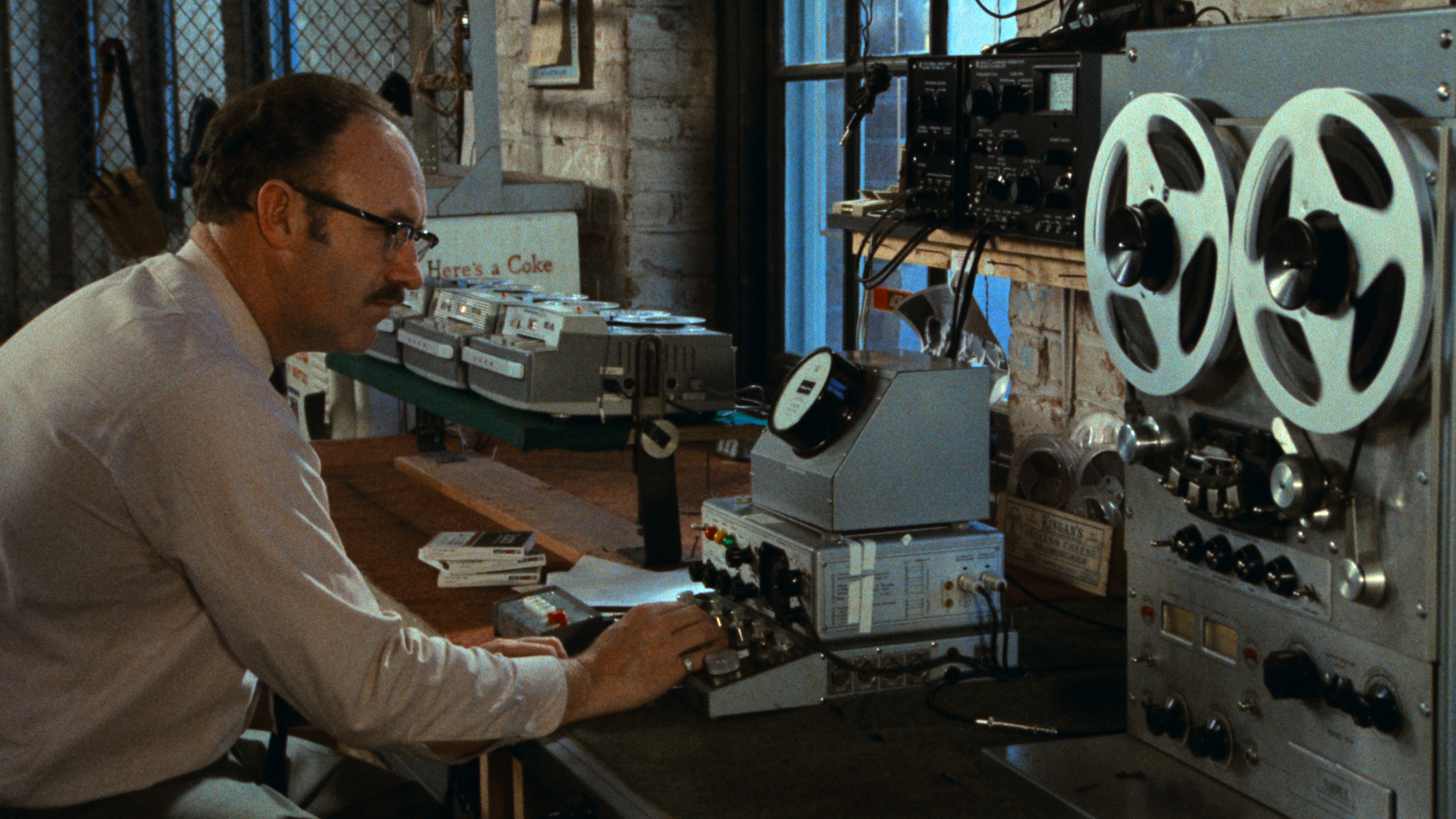
In 1966 [Francis Ford Coppola] had started work on The Conversation, fascinated by technical developments in the field of espionage, in particular the art of carrying out surveillance in a crowd, using long-range microphones. We recognise here the first sequence, in which Harry Caul monitors the conversation of a couple who are carrying on an illicit affair, as they walk through Union Square in San Francisco. The film appears to be the diametric opposite of The Godfather. It is the story of a man who is brilliant at his job but emotionally inadequate, who finds himself embroiled in a case that is beyond his grasp and that drives him deeper into his state of torpor. Gene Hackman, with his closed-down features, moustache and grey raincoat, answers with resignation to the name Caul. This professional has no sort of grandeur about him as he carries out his commissions as if with his eyes shut, too wary to confide in anyone, whether it be his competitors, friends or mistresses. But there’s a crack in his armour: his professional activities once caused the deaths of a woman and a child, and when another case threatens to take a similar turn, he falls prey to his inner demons…
An error, a guilty conscience, neurotic repetition: the scenario seems closer to Brian De Palma than to Coppola’s flights of grandeur. And The Conversation happens to be one of De Palma’s favourite films; he quotes it explicitly in Blow Out (1981), in which a recording engineer witnesses the murder of a politician. The two films have a common source: Michelangelo Antonioni’s Blowup (1966), in which a photographer captures the image of a murder without realizing it. All three films share the same motifs: a lonely man shuts himself up in his workroom in order to retrieve what he had failed to see; his frantic efforts produce evidence but are not enough to save the people under threat; the wouldbe detective, buried in the detail, withdraws from the world into a parallel reality. He knows everything, but is unable to bring this knowledge into the real world. These men, like the photographer in the final shot of Blow-up, disappear.
Stéphane Delorme, Francis Ford Coppola, “Cahiers du cinéma”, Paris 2010