Film notes
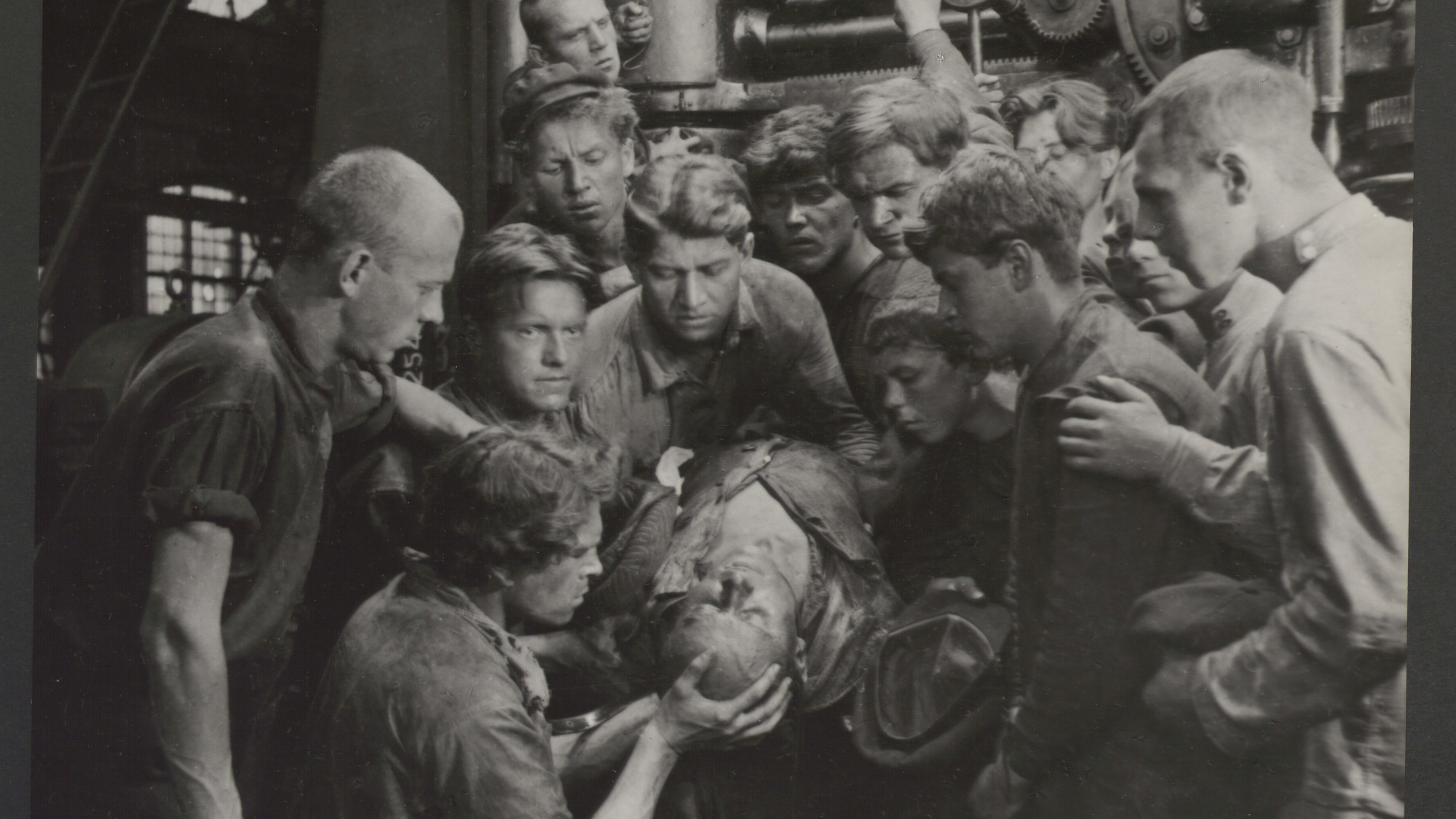
Whatever may seem like a flaw in Eisenstein’s first, anarchic feature is, in fact, an attribute. Mismatches; discontinuities; disorienting camera setups; even the shot of a puddle that has been spliced in upside-down – any inanity we encounter in Stachka is there not by mistake but by design. Eisenstein’s is a ruleless film, and it cost him many a struggle to keep it that way.
The seasoned fiction-film cameraman initially assigned to film Stachka fled the moment he learned of Eisenstein’s plan to shoot at a real factory in lieu of a studio stage, and his intention, moreover, to disregard conventional camera angles and lighting schemata. The documentary cinematographer Eduard Tissé came in as a replacement, and, to Eisenstein’s delight, did everything the wrong way. The Proletkult (an abbreviation of Proletarian Culture, a Marxist uplift institution in charge of involving workers into artmaking), which coproduced Stachka, was appalled by what they saw as a lack of a coherent storyline, having expected Eisenstein to stick to a strictly narrative scenario (the saga of a working family whose members grow stronger as they live through the hardships of class struggle – or something similarly nourishing and boring).
As Eisenstein explained in 1925: “The real conflict was about methods: the Proletkult leaders were uninterested in any experiments, and opposed to anything they found out of the ordinary about Stachka. Stachka is my victory in the field of form. In revolutionary art, revolutions in form are more important than revolutionary content.” In other words, there was a method to his madness: if the strikers were at odds with their bosses, why should Eisenstein have been at peace with his?
Daria Khitrova and Yuri Tsivian