Film notes
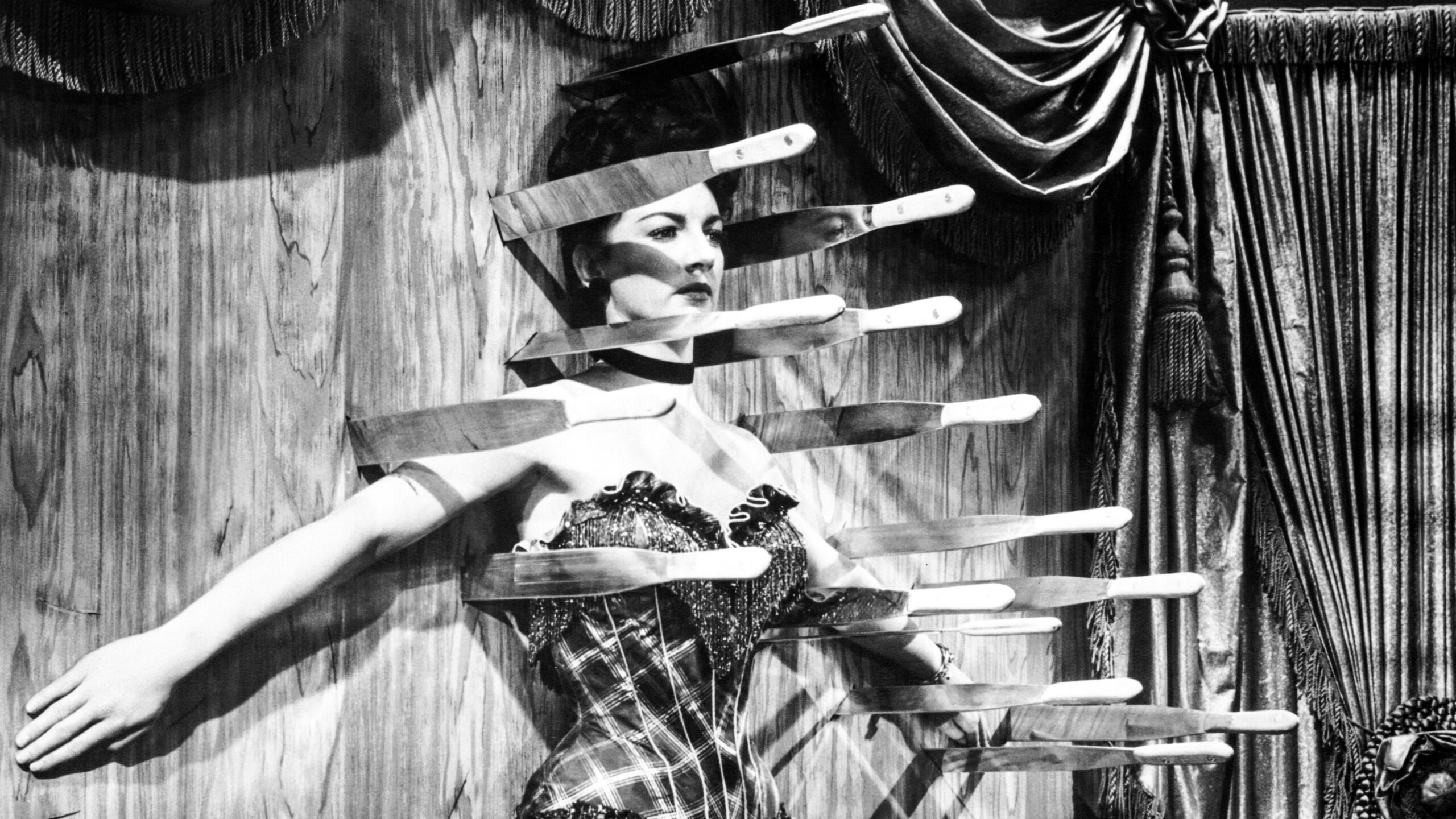
Warner was keen to repeat the success of its biggest 3-D hit, House of Wax, with another colour horror film. Of the two attractions, however, colour somehow managed to override 3-D. With its flared-up, garish, erotic tones, Phantom of the Rue Morgue turns scenes of grisly crime into a kind of abstract expressionist painting made from body parts, splattered oil paint, and shattered glass. This belongs to the more familiar vein of 3-D filmmaking, in which objects are hurled at the lens at regular intervals: gendarmes fire directly at the audience, reliving the thrills of early cinema in The Great Train Robbery; a knife-thrower does the same; a trapeze artist plunges onto the safety net beneath him where the camera awaits his downfall. The eyes – we – are under constant threat once the third dimension is unleashed. The weight is always on the eye, rarely on the brain. Based on Edgar Allan Poe’s 1841 short story about a series of gruesome murders whose motive and method defy logic, the film retains the Paris setting but transposes the material into a post-Freudian world. “These days everything is Freud or is nothing,” complains a zoologist played by Karl Malden. Thus, Phantom of the Rue Morgue populates itself with an array of rejected side characters, all living with suppressed libidos and the tightly locked secret rooms of their desires. The serial killer attacks women of a certain beauty and bearing. The scantily dressed models and performers have what little they wear violently torn away by the killer, and every murder scene carries a disturbingly sexually perverse undertone. After all, the “beast” is simply the human form reduced to instinct, and of all instincts it is lust that rules. Roy Del Ruth shows very little interest in directing actors and instead relies on the wood-and-papier-mâché sets – featuring some of the dreamiest Paris rooftops since Lazare Meerson – fully responsive to the film’s acrobatic demands. It is a fantastically brazen and lewd film, all the more surprising coming from a director whose heyday belonged to the 1930s.
Ehsan Khoshbakht