
Film notes
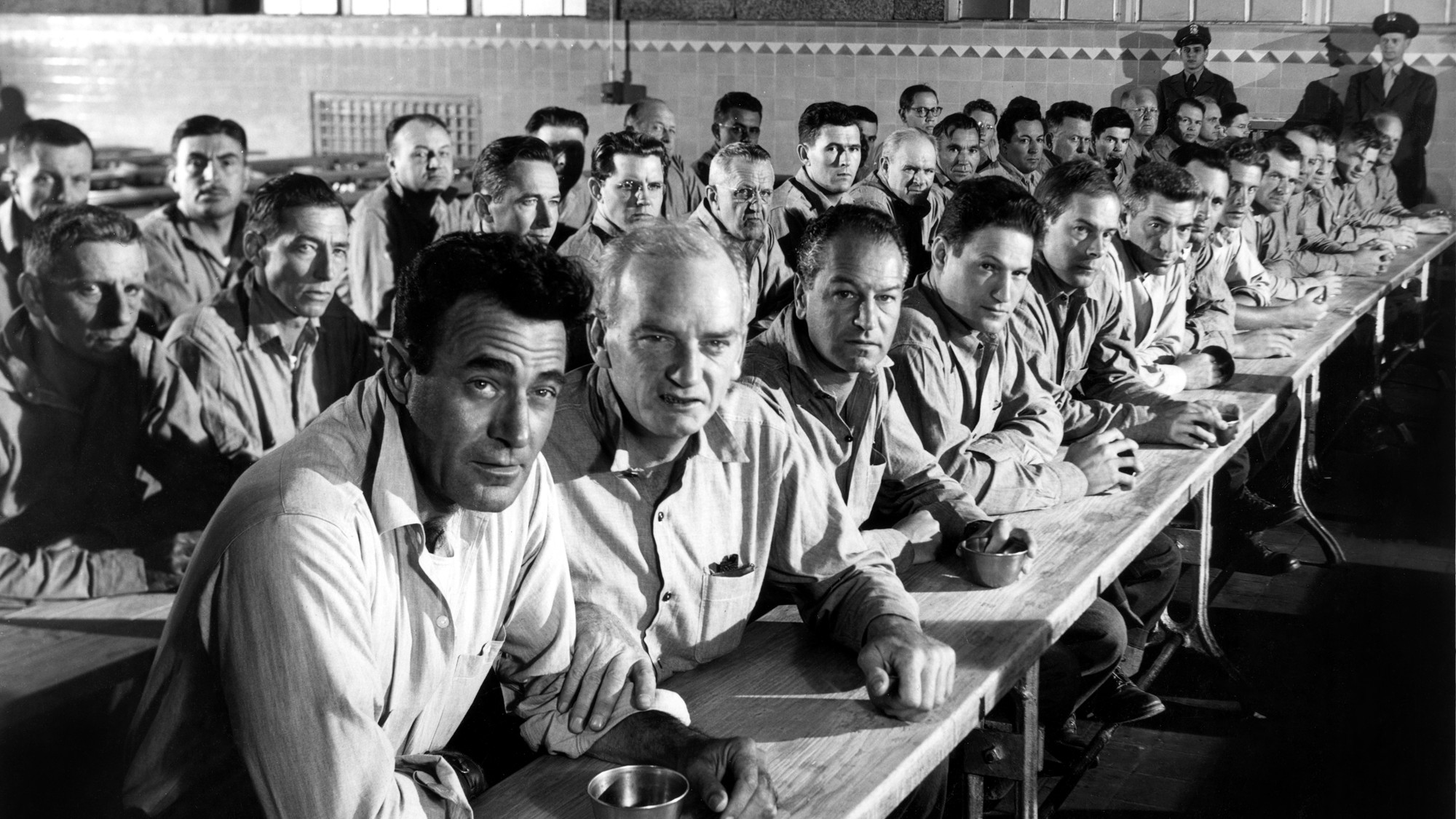
This terrific prison-set Blackboard Jungle, in which an idealist doctor uses modern psychology to help the inmates, was based on an autobiographical book by Donald Powell Wilson. The rights were acquired by producer Stanley Kramer, known for sensationalism, big ‘messages’ and verbose stories, but Fregonese stripped the material of pretence and pomp, letting his melancholic side take over. He shifted the focus of empathy from the doctor and his mission to the prisoners, revealing one of his overlooked talents in the process – the ability to mould actors into their roles. Who else could transform a B-actor such as John Beal and make him shine with a nervous fragility worthy of Dirk Bogarde?
The visual approach is rooted in Fregonese’s earlier prison drama Apenas un delincuente, the director once again shooting on location (in this case, at San Quentin where real guards were used as extras) and using a voice-over. Fregonese proves to be more playful this time: in addition to an entirely wordless scene, accompanied only by music (which Dimitri Tiomkin nevertheless completely misinterprets), he shows a flashback from the perspective of Millard Mitchell’s character in which he voices the dialogue of all the other characters, the effect being reminiscent of Sacha Guitry’s Le Roman d’un tricheur (1936).
The controlled space of the prison becomes a metaphor for the filmmaking itself, in which every element is determined by Fregonese, especially in his mosaic-like arrangement of the violence inherent in spaces of confinement – with canted angles, vast empty spaces and elements repeated in many shots, such as indu trial-sized pipes and valves, eroding any sense of comfort and belonging. On the other hand, the group framing of the ‘six convicts’ often has the veracity of a renaissance painting, with gestures indicating awakening, and gazes directed at a larger truth somewhere outside the frame. There is also a systematic use of one-point perspective, to signify the futility of what is shown in the foreground. At the end, when the doctor is shown in this manner, as he walks away from the prison, the film rejects the possibility of reform in such a space – but it has already endorsed a more essential humanism.
Ehsan Khoshbakht