
Film notes
PORTRAIT-PROFILE LITTLE CHRYSIA
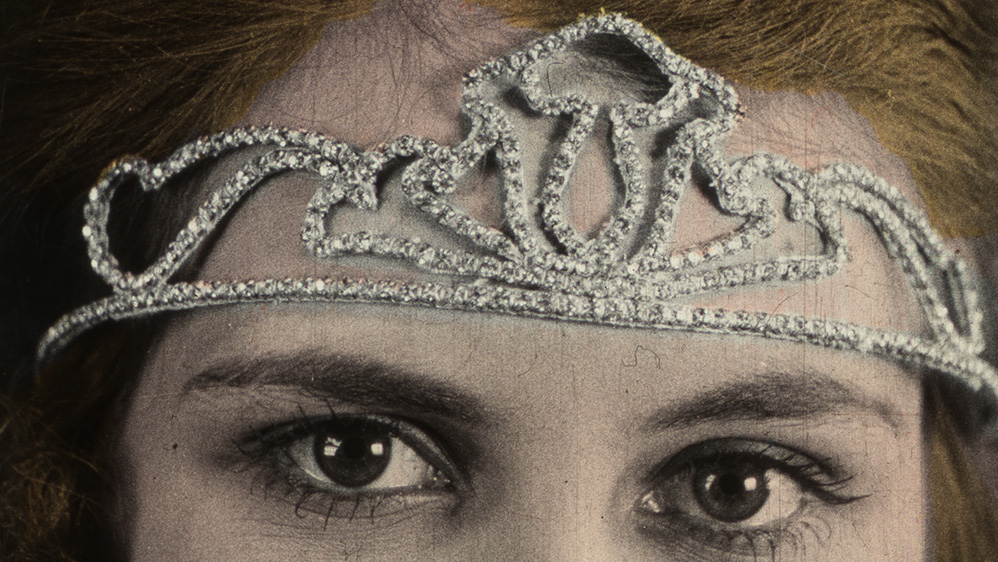
Until recently Little Chrysia was completely unknown and we only knew her as the actress playing Cunégonde in the Lux comedies. As there are no credits, neither on the films nor in the numerous paper documents, it is only through recognising her on the screen that we can attempt to reconstruct her biography and filmography. Luckily, her physical appearance and expressions are unmistakable.
By 2022 we know of 15 films with her that exist, five of which are unrelated to Cunégonde. It is also confirmed that she appeared at least in 52 films between 1911-1915, all proven by the paper trail. Her name is written as Little Chrysia, Little Chrysias, Miss Chyrisia(s), M.lle Little Chrysia, in different language sources. We first see it appear in the French newspapers from 1906 onwards, related to her work at Théâtre de Cluny. Then follows her transition to cinema; by 1911 she has her own comedy series produced by Société Lux, as Cunégonde. Around 1912, her appearance in other films by Lux proves that she was simultaneously appearing in unnamed supporting roles. In early 1913, Little Chrysia moves to Pathé Comica, to appear in the shortlived Zoé series. A brief but accredited appearance follows in the Italian Ambrosio films in 1914, next to Marcel Perez (Robinet), where she is advertised as “on retrouve Cunégonde, l’artiste bien connue du sourire”. Next, we find her in a 1915 issue of “Pictures and the Picturegoer”, where she is reported as having signed a contract with the British Phoenix-Comedio: “Another new Phoenix artiste is Little Chrysia, familiar but a short time ago with most picture-goers as Arabella of Lux Films. After a sojourn on the Continent she has returned to England”. So far, only one episode of an Arabella film is found to have survived, at the BFI. But what did Little Chrysia do before her “sojourn on the Continent”? According to “The Bioscope” (17 June 1915) “many circus people have attached themselves to the newer business (‘the pictures’), amongst them ‘Little Chrysia’ (widely known as Arabella). At one time, Miss Calcott as she is in private life, owned a thriving circus, now she appears exclusively in films.” After 1916 all leads go cold and she disappears. However, the research continues – and we hope for more discoveries in the future.
Elif Rongen-Kaynakçi
To follow:
Presentation of Cinema’s First Nasty Women dvd/blu-ray box, curated by Maggie Hennefeld, Laura Horak and Elif Rongen-Kaynakçı