

Film notes
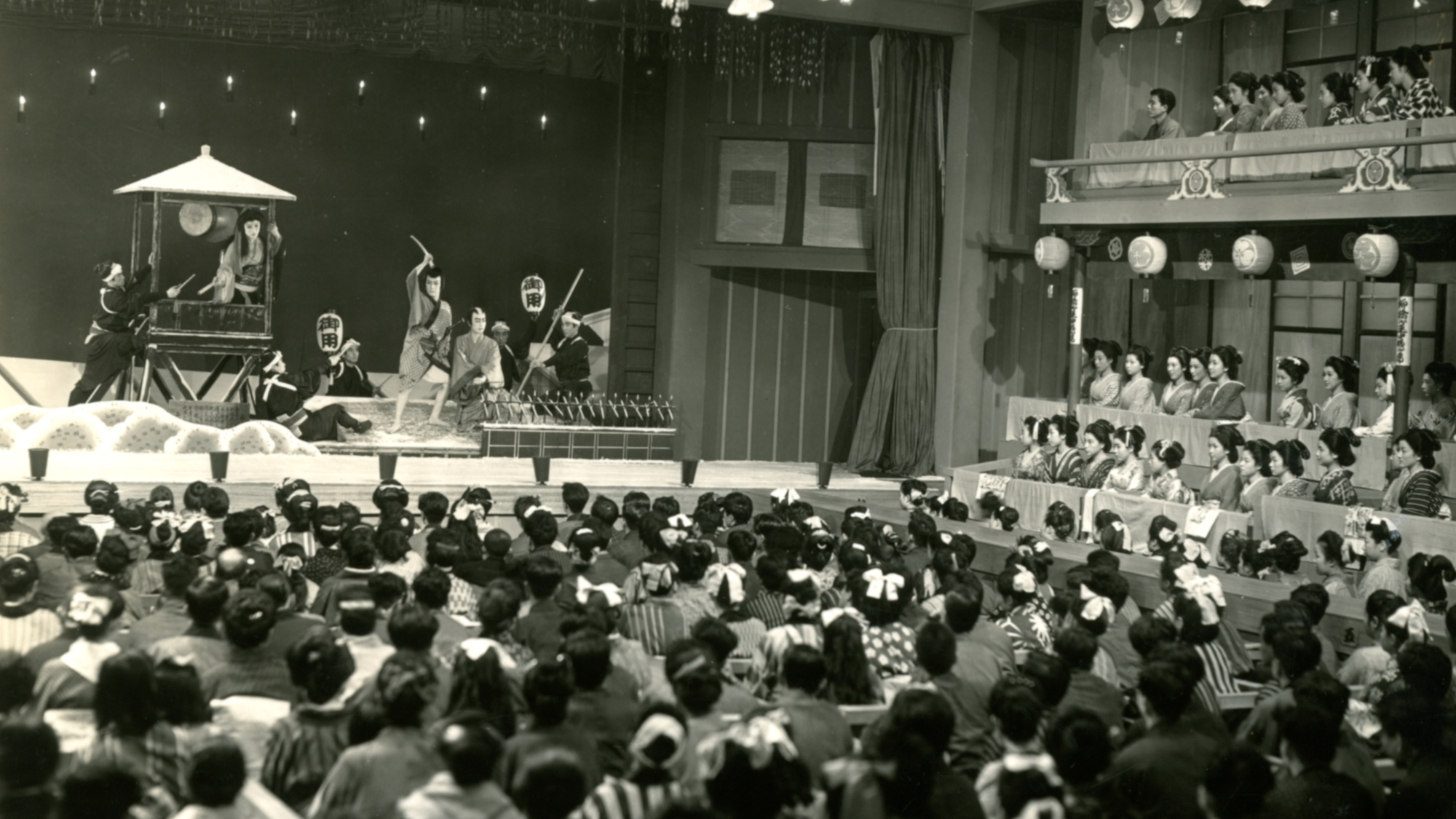
Set in the Meiji Era (1868-1912), a period of rapid modernisation and Westernisation in Japan, this compelling melodrama tells the story of a geisha in love with a young kabuki actor, who goes to dangerous lengths to fund his debut under a new name. As in Shishi no za, Ito sought to tell the story with maximum authenticity, casting a genuine kabuki actor, Yataro Kitagami (1932- 1987) in the relevant role. He stars opposite the distinguished actress Michiyo Kogure (1918-1990), who appeared in films by almost all of Japan’s leading directors, and whose strong yet sensitive persona lent itself to a great variety of roles. In the role of palanquin bearer Minokichi, Ito cast Jun Tazaki (1913- 1985), and was impressed enough by his performance to offer him the lead role in his next film, Gero no kubi. The film was drawn from a novel by Matsutaro Kawaguchi (1899-1986), already filmed by Tomotaka Tasaka in 1935. Kawaguchi’s prose fiction furnished the basis for films by Kenji Mizoguchi, Mikio Naruse, Kozaburo Yoshimura and Yasuzo Masumura, among others. He was also co-screenwriter on several of Mizoguchi’s most celebrated films, including Story of the Late Chrysanthemums (Zangiku monogatari, 1939) and Ugetsu monogatari (1953).
The plot, typical of the early 20th-century shinpa (“new school”) theatre, echoes Mizoguchi’s silent films Cascading White Threads (Taki no shiraito, 1933) and The Downfall of Osen (Orizuru Osen, 1935). Indeed, Kawaguchi’s novel had also been adapted as a shinpa play starring the distinguished stage actor Shotaro Hanayagi. “Kinema Junpo” critic Tadashi Iijima found the story somewhat derivative, and claimed that the shots “felt uncharacteristically static for an Ito film, lacking his usual flow”. Nevertheless, he praised the “lavish sets” and “meticulous craftsmanship”, and admired Tazaki’s performance, “one of his recent best”. Critic Masatoshi Oba praises the film as “a period piece steeped in Meiji atmosphere, which adapts its story of human relationships bound by duty and sentiment in a weightier and more visceral fashion than the original stage version”.
Alexander Jacoby e Johan Nordström